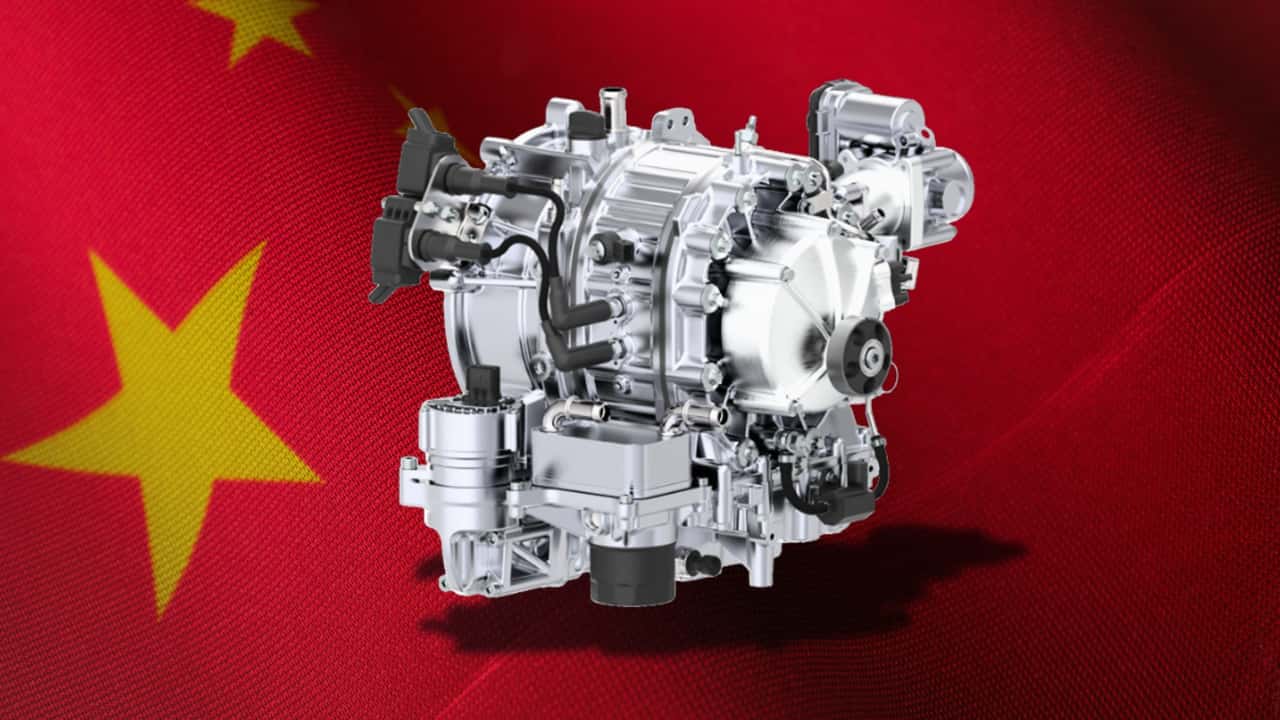
Changan has developed a new Wankel engine for use in the ‘low-altitude economy.’
The Wankel rotary engine is the stuff of legends: a compact, high-strung, ultra-smooth motor with a single triangular rotor at its heart. Mazda, of course, is a pioneer of the Wankel engine, using it in cars like the Cosmo, the RX-7, and the 787B race car. But this new rotary engine doesn’t come from Mazda—as with most technological breakthroughs as of late, this one is from China.
A company called Changan has developed a new rotary engine, according to reports from CarNewsChina. It’s called the R05E, and it’s the very first high-powered rotary engine developed in the region. The project was originally announced on April 9 in collaboration with mobility company AVL, but the first working prototype debuted on December 19. Production is scheduled to start sometime in 2027.
We’re sad to report that this new rotary engine isn’t for road cars. Instead, Changan plans to use this new motor in the “low-altitude economy”—things like drones, eVTOLs (electric vertical takeoff and landing aircraft), and maybe one day, flying cars, all of which operate below 1,000 meters (roughly 3,300 feet). China predicts that the low-altitude economy will be worth as much as ¥3.5 trillion ($490 billion) by 2035.
So why a rotary and not an electric powertrain like the ones proposed by Hyundai and Toyota for their eVTOL projects? According to Changan, the rotary engine is smoother, smaller, quieter, and offers a better power-to-weight ratio than other gas powertrains—and even some electric setups. The R05E engine reportedly makes 71 horsepower and can rev up to 6,500 rpm, but a more powerful version is still in the works.
The R05E uses a cast aluminum casing with a nanodiamond composite (NDC) anti-friction coating to help combat energy loss. A single curved-edge triangular rotor is paired with a low-mass eccentric shaft and a balancing system designed for stability during flight.
What’s interesting is that Changan—one of China’s “big four” automakers alongside Dongfeng, FAW, and SAIC—does have a strategic partnership with Mazda in China. Changan helps the Japanese automaker bring vehicles like the EZ-6 sedan and EZ-60 SUV to market. But according to Changan, Mazda was not involved in the development of this particular rotary engine.
So, could this rotary potentially make it to a production car? It’s unclear. The engine’s diminutive size and output mean it could theoretically make sense as a range extender, but Changan hasn’t said whether it plans to use the engine in a production car.
Here’s hoping even some of that technology trickles down to Mazda’s lineup.
Mazda’s Rotary Future
Source:
CarNewsChina
We want your opinion!
What would you like to see on Motor1.com?
– The Motor1.com Team