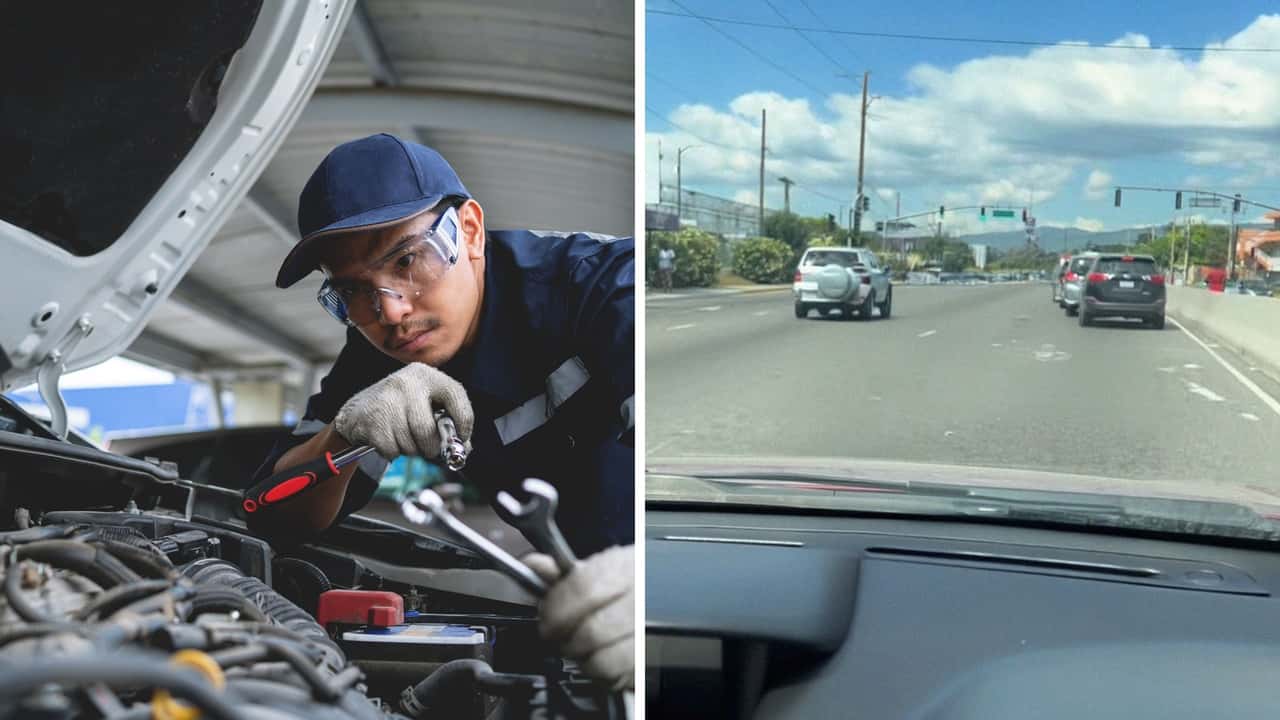
“This is probably the most useful content in decades.”
Nothing quite rings in the new year like a new sound coming from under your vehicle’s hood. It can be tempting to ignore whatever distressing noise has become the soundtrack to your daily commute. But you do so at the risk to your safety and your pocketbook.
“Any grinding, knocking, whining, or rattling noise isn’t ‘normal.’ Those noises mean something is wearing out or about to fail. Catch it early or pay more later,” warns RCJ Mobile Mechanics (@RCJMobileMechanics) in a recent Facebook Reel.
A new serpentine belt might be considered a slightly less-than-glamorous way of celebrating than a rooftop toast. The upside? It could have a more positive long-term impact than that bottle of bubbly.
Because of the specificity of RCJ Mobile Mechanics’ video, the comments section looks like a revival of the NPR show Car Talk. On that legendary radio show, callers described the sound their cars were making to the two hosts, who attempted an on-air diagnosis. They were surprisingly accurate.
“What if my car sounds crunchy whenever I turn the steering wheel?” asked Sandy Lynn Oliveres in response to RCJ’s video.
The responses rolled in–everything from “it’s probably a CV joint/axle” mentioned by several users, to Caroline Jailine Serrano’s note that her problem turned out to be a “blown differential.”
Incidentally, the mechanics posted a video with the sound of CV joints going bad.
Those aren’t the only questions posed. “What if it sounds like a helicopter going down the road,” asked John Matthew Porter Barrington.
RCJ Mobile Mechanics offered a solution: “Probably need to change that car.”
Perhaps the comment we can all relate to is the one exclaiming, “Why has no one done this before,” Angelica Rosado wrote, ” I can play this instead of beat boxing at the mechanic.”
The video itself is one of several on the mechanics’ Facebook page. And with over 1 million views, the internet clearly wants help understanding their vehicles. Or to at least get an idea of what “that” persistent sound could be.
In the Reel itself—as in the others—several sounds are highlighted with an image of the corresponding car part in the video section. It’s a good technique for visualization, but there’s also something oddly soothing about hearing the sound of an individual problem.
In the video, the mechanics take viewers through five distinct noises and their corresponding causes: serpentine belt, piston knock, rocker arm, power steering pump, and starter. Each problem has a distinct and specific noise.
Commenter London Brian gushed, “This is probably the most useful content in decades.”
Diagnosing a vehicle’s problems can be frustrating and stressful because you’re not just trying to describe the specifics of the “clunk” you heard; you’re also hoping to replicate the sound. Because what you hear and what the mechanic’s experienced ears hear might be two totally different things.
Nonetheless, according to Greely, Colorado-based car pros Bullet Automotive, “Your car communicates its health through sound.” So, driver, you need to pay attention to when something (literally) sounds off.
How quickly this needs to happen, according to the mechanics, is often a case of “the sooner the better.” If for nothing else, peace of mind. Some noises can be ignored, but grinding, screeching, or whining is more often your first indication of a significant issue.
So how do you know what your vehicle sounds like? “Every once in a while, roll down the windows and start listening for any sound that is odd,” suggests Geico. “You know your car, so you can often pick up something that may become a problem.”
Motor1 reached out to RCJ Mobile Mechanics via Facebook Messenger. This story will be updated if they reply.
We want your opinion!
What would you like to see on Motor1.com?
– The Motor1.com Team