“Keeps the resale value.”
When an insurance company cuts you a check for collision damage, the expectation is simple: You’ll spend it fixing the car. But one driver is going viral for taking the payout, heading to the junkyard, and arguing that body shops are an expensive middleman most people don’t actually need.
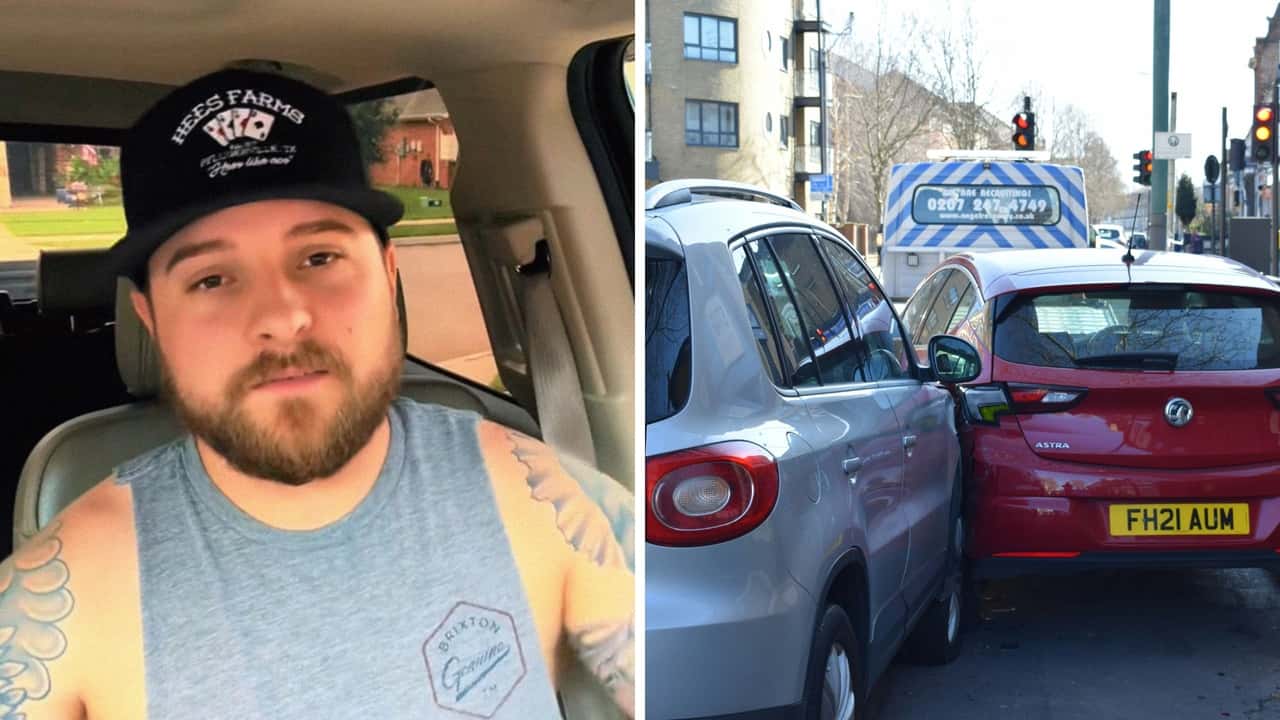
The viral clip from Fort Worth, Texas, creator Corey Williams (@officialcorey199) shows a damaged driver’s-side door on what appears to be a silver Hyundai Santa Fe Sport. Rather than signing the insurance check over to a local body shop, Williams decided to get scrappy and industrious, pocketing more than $2,000.
“I got paid $2,800 just for this little damage, and went to my local junkyard and found a door, same paint match code, no damage, nothing at all. Did all the work myself for $150 bucks, so that was $2,650 in my pocket after everything,” he said in the clip that’s been viewed more than 6,600 times.
What Williams presents as a straightforward money-saving move quickly becomes more complicated once viewers scrutinize the result. While many commenters praised him for avoiding body shop labor rates and keeping the factory paint on the vehicle, a much louder, more technical debate erupted over whether the replacement door actually matches the rest of the car.
Several viewers who identified themselves as professional painters and estimators pointed out that modern automotive paint codes often include numerous factory variants, especially for metallic and silver finishes. Even when two panels share the same paint code, differences in production batches, aging, and environmental exposure can result in visible mismatches when installed side by side. Paint manufacturers such as PPG and BASF acknowledge this reality, noting that variant decks are often required to achieve an acceptable color match during refinishing.
Williams pushed back repeatedly in the comments, insisting the mismatch viewers claimed to see was simply a matter of lighting and cleanliness. He argued that the replacement door was clean while the rest of the vehicle was dirty, and that both panels carried the same factory paint code from the same model year.
The dispute highlights one of the most misunderstood aspects of collision repair: panel blending. When body shops write estimates that include repainting and blending adjacent panels, it isn’t simply to inflate costs. Blending is the industry-standard method for ensuring color uniformity across a vehicle, particularly with metallic and pearl finishes that reflect light differently at varying angles.
The Insurance Information Institute explains that blending is often required to restore a vehicle to “pre-loss condition,” which is the standard insurers use when approving repairs. Without blending, even factory-matched paint can look different after installation, especially on vehicles several years old.
That blending work adds labor hours, materials, and refinishing costs, which helps explain why Williams’ insurance estimate was significantly higher than the salvage-yard fix he ultimately chose.
Beyond appearance, several commenters raised concerns about what doesn’t show up in a short video. Modern doors often house side-impact airbags, wiring harnesses, window regulators, blind-spot sensors, and mirrors that may require programming or calibration after removal. Even when no warning lights appear on the dashboard, manufacturers and repair organizations typically recommend post-repair diagnostic scans anytime electrical components are disconnected.
On newer vehicles equipped with advanced driver assistance systems, door and mirror replacement can also affect blind-spot monitoring and lane-assist functions, which may require recalibration using specialized equipment. The National Highway Traffic Safety Administration has warned that improperly repaired or calibrated safety systems may not perform as intended in a crash.
Another debate that surfaced in the comments section involved vehicle history reports. Some viewers argued that avoiding a body shop would keep the accident off the Carfax report and protect the resale value. Others countered that once an insurance claim is filed, the incident is often reported regardless of where repairs are completed.
Carfax states that accident entries can originate from police reports, insurance claims, and repair facilities, but reporting is not guaranteed in every case and varies by state and insurer. In short, collecting a check does not automatically mean the vehicle will later show an accident history.
For older, high-volume vehicles, salvage-yard parts are plentiful, relatively inexpensive, and often available in factory colors. For mechanically inclined owners who understand the tradeoffs, taking a payout and performing a cosmetic repair can make financial sense.
But professionals caution that this approach becomes riskier as vehicles get newer, more complex, and more dependent on electronic safety systems. What works for a simple door swap may not translate to quarter panels, structural components, or vehicles equipped with extensive driver-assistance technology.
Williams’ video doesn’t break any rules, and his math adds up. But the intense reaction it sparked shows how wide the gap can be between a repair that looks “good enough” to an owner and one that meets industry standards for appearance, safety, and resale.
Motor1 reached out to Williams via direct message and commented on the clip. We’ll update this if they respond.
We want your opinion!
What would you like to see on Motor1.com?
– The Motor1.com Team