“What?”
A Chick-fil-A employee’s parking garage nightmare has captivated millions, exposing the confusing reality of automated parking systems and what happens when they malfunction.
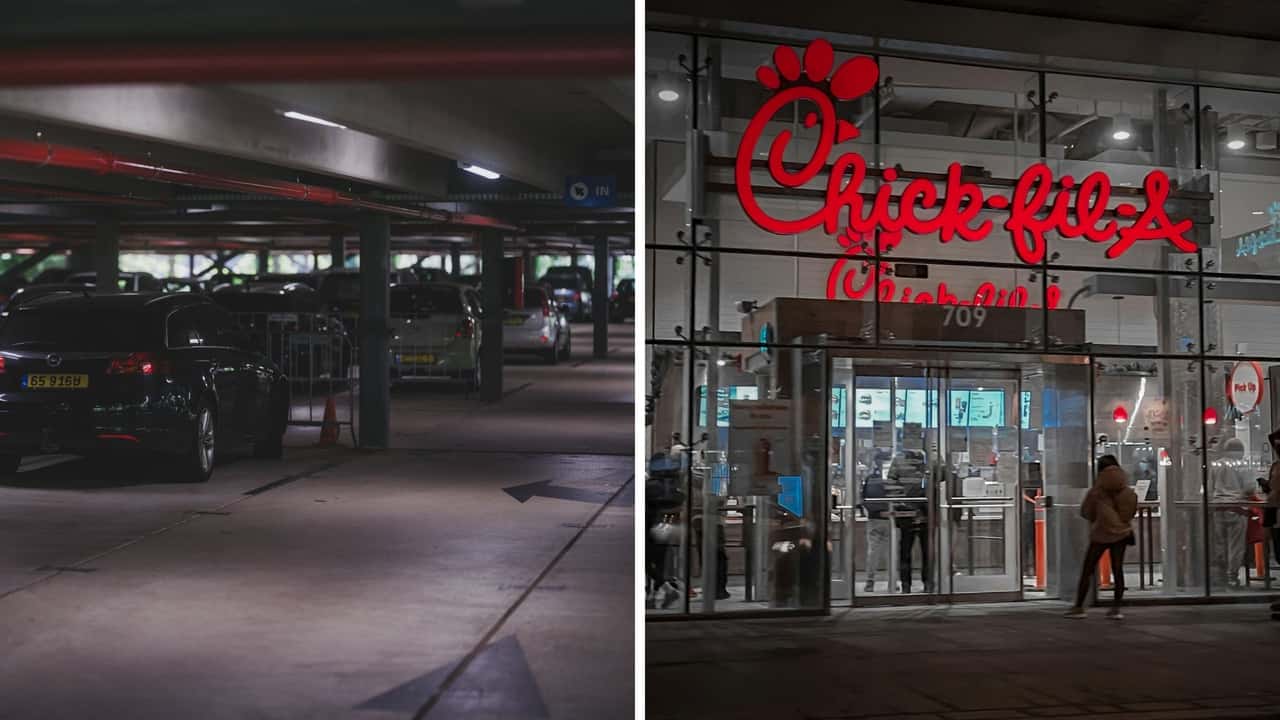
Lilly (@lillyrog24), still wearing her Chick-fil-A uniform, filmed her encounter with a parking pay station that demanded an eye-watering $3,728 for what she claims was just 10 minutes of parking. The 38-second video has garnered 4.6 million views since it was posted.
“Someone help me. This has $3,000 to pay. Why? Help,” Lilly says at the start of the video, filmed from the passenger seat by her friend as they sit at the automated pay station barrier.
The brief but memorable clip captures Lilly’s genuine confusion as she tries to exit what should have been a quick parking stop, only to be confronted with a bill that’s more than many people’s monthly rent.
In the video, Lilly can be seen pulled up to an automatic parking pay station with the barrier down, preventing her exit. Her friend, who is filming and giggling throughout the ordeal, captures Lilly’s escalating confusion as she interacts with the payment machine.
“I’m not paying $3,000. Oh, there’s a whole line,” Lilly says as her friend pans the camera to show multiple cars now waiting behind them.
The situation reaches its climax when Lilly presses the help button and speaks to a customer service operator via the intercom. “It’s telling me to… I’m so confused. It says to pay $3,728. I don’t really understand,” she explains to the operator.
The operator’s response—a simple, bewildered “What?”—perfectly captures the absurdity of the situation and became a big focus of the comment section.
While Lilly’s caption states they were only in the garage for 10 minutes, the astronomical bill suggests the parking system believed the vehicle had been there far longer. One commenter, David Hernandez, offered the most likely explanation: “Says u stayed 143 days 1 hour and 58 min u must have picked up the wrong ticket.”
This theory makes mathematical sense. At typical daily parking rates of $20-30, a 143-day stay would easily generate a bill in the $3,000-4,000 range.
Another user disputed this theory, noting, “You take your ticket with you. There’s no way for her to pick up someone else’s ticket. This is a weird computer glitch.”
However, as another commenter explained from experience, “If you lose your ticket, you select ‘lost ticket.’ Then, if you find that lost ticket and pick it up instead of the correct one, then it calculates it like this.”
The scenario becomes plausible if Lilly had an old parking ticket from a previous visit tucked in her car or wallet and accidentally grabbed it instead of the current one. Most parking garages charge a “lost ticket” fee that equals the daily maximum rate—essentially billing customers as if they’d been parked since the garage opened that day. For example, Charleston International Airport charges a lost ticket fee of $21 per day for hourly parking, while their daily garage lost ticket fee is $17 per day. If a system incorrectly reads an old ticket as a “lost ticket” from months ago, charges can quickly escalate into the thousands.
Modern parking garages use various systems to track vehicles and calculate fees, each with its own potential for user error or technical glitches. Traditional ticket-based systems print a time-stamped ticket when you enter, which you must present when you exit. The system calculates your fee based on entry and exit times. Philadelphia International Airport’s system, like many facilities, requires drivers to collect and retain their parking ticket, and if the ticket is misplaced, drivers must pay the lost ticket fee.
Newer license plate recognition (LPR) systems scan your plate upon entry and exit, eliminating the need for physical tickets. However, these systems can malfunction if plates are dirty, damaged, or misread by the cameras. Research on advanced IoT-integrated parking systems shows that LPR technology’s accuracy declines in low light and can be affected by plate angle and camera distance.
The daily maximum parking rates vary widely by location and facility. Downtown San Diego parking now costs $2.50 per hour at street meters with daily garage rates typically running $15 to $35, while Miami Beach entertainment districts charge up to $6 per hour. Premium downtown locations can exceed these rates significantly. If a system incorrectly calculates a multi-month stay at these rates, bills can quickly escalate into the thousands.
The comment section erupted with reactions ranging from mathematical pedantry to genuine anxiety about parking garage mishaps. The top comment, from user Jacob with over 19,000 likes, joked: “Girl $3,728 is 4 thousand dollars!”
This sparked an extensive sub-thread debate about rounding, with users arguing whether $3,728 should be rounded to $3,000 or $4,000—a discussion that generated dozens of replies and perfectly illustrated the internet’s ability to focus on tangential details.
More substantively, user Lilyana captured what many found most entertaining: “The ‘What?’ from customer service is taking me out,” referring to the operator’s confused response. The comment received 87,500 likes, with Lilly herself clarifying in a reply: “lol it was literally the speaker box. Why would I call my mom at work?”
Many commenters shared their own parking anxiety. User viva expressed what thousands were thinking: “idc how much anxiety I have im not paying 3k lmao.” This sentiment resonated strongly, generating 65,000 likes and spawning a popular reply: “If I owe you $300 that’s a me problem but if I owe you $3000 that’s a you problem.”
Several users related similar experiences. One commenter shared: “One time me and my friend had a ticket and we tried to put it and then it fell along with the 10 other tickets on the floor that we had to go through,” highlighting how easily ticket mix-ups can occur.
If you encounter an obviously erroneous parking charge, parking enforcement best practices recommend staying calm and following these steps. First, press the help or call button at the pay station to speak with an attendant. Explain the situation clearly and mention when you actually entered the garage. Most parking facilities keep digital logs and can verify your actual entry time.
Second, take photos or screenshots of the charge, your correct parking ticket, and any other evidence showing your actual parking duration. Accurate documentation is essential for resolving parking disputes, as parking enforcement companies prioritize evidence when evaluating contested charges.
Third, never pay an obviously incorrect charge out of panic or social pressure. Parking operators would rather resolve a technical glitch than deal with the customer service nightmare of refunding thousands of dollars. Parking payment providers sometimes experience delays in processing data, and when systems evaluate vehicles for compliance, payment information may not have been received yet—most facilities will automatically dismiss notices once the data is confirmed.
Finally, if the on-site operator cannot resolve the issue immediately, get their name and a reference number, then ask for the management office contact information to follow up. Most reputable parking facilities will quickly void charges that are clearly system errors.
Despite the video’s viral success and thousands of comments, Lilly never posted a follow-up explaining how the situation was ultimately resolved. Viewers are left wondering: Did the operator void the charge? Did they determine she had the wrong ticket? Was it simply a computer glitch that reset once identified?
The lack of resolution hasn’t dampened interest in the video, which continues to circulate as both a cautionary tale and a source of entertainment for anyone who’s ever felt the cold panic of an unexpected bill.
Motor1 reached out to Lilly via email. We’ll be sure to update this if she responds.
We want your opinion!
What would you like to see on Motor1.com?
– The Motor1.com Team