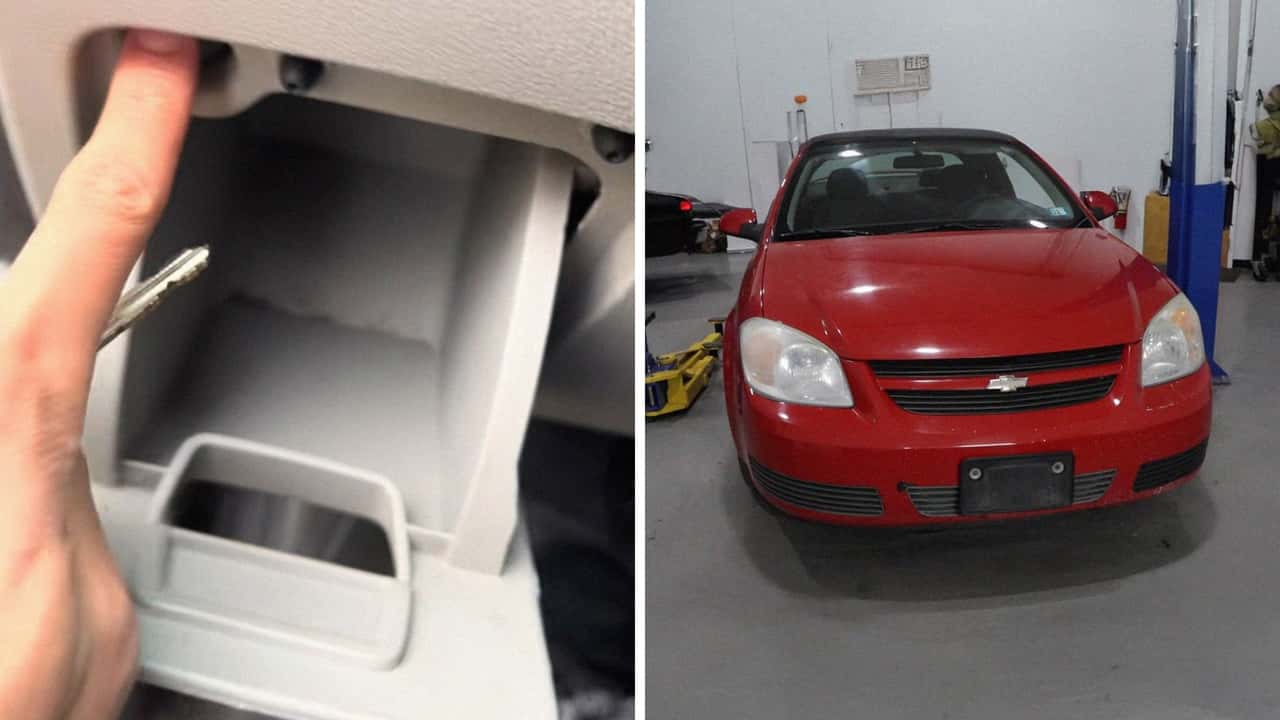
“All I wanna know is what General Motors thought they were doing when they made this car.”
For decades, charging a car battery was one of the most basic and important lessons given to new drivers. It was a reliable, straightforward thing to teach because the battery was always accessible under the hood, and a quick lesson on the proper use of the positive and negative terminals was all it took.
That reliability and predictability are gone, however, as we see in a recent TikTok from Chevy Cobalt owner @gophergasser, who is at his wits’ end with GM’s placement of the battery in his car’s trunk and its lack of access when the car is completely dead.
“All I wanna know is what General Motors thought they were doing when they made this car,” he said in the clip that had been viewed more than 9,600 times before being deleted on Wednesday. “Now you gotta… go all the way to the back, and then you can have your car started.”
What we see from a quick view under the hood is just remote battery terminals or jump-start posts, which are not an energy source but are directly wired to the trunk-mounted battery. The design that the owner and several commenters on the clip found nonsensical is a safety measure intended to prevent sparks near vented batteries and to reduce the risk of damage to electronics.
Part of the owner’s aggravation comes from his inability to access the trunk battery when it’s dead, although commenters on the clip repeatedly insisted that he was making the situation more difficult than it needed to be.
“First off, open your truck with the key. Secondly, those posts go directly back to the battery and distribute power to the rest of the car; they explicitly serve a ‘Battery Purpose’. Third Its in the truck as a space saving measure to not bury half the electronics behind the dash,” one viewer wrote.
A retired mechanic also weighed in with the view that the vehicle itself had larger problems than its design: “GM put those battery lugs under the hood specifically for jump starting. Car manufacturers do this whenever the battery isn’t easily accessible – whether in the trunk, under the back seat, or in the fender. If you were unsuccessful at jump starting from those lugs, then there’s an issue with your car, not the design.”
In follow-up replies, the owner explained that he had been repeatedly unsuccessful in trying to jump the car from the terminal under the hood. His exact claim was that the terminal provided only enough power to light the gauges and pop the trunk, but not enough to crank the engine; each attempt ended with the car dying again and the key locking in the ignition.
The cause of all the confusion is a design known as a remote battery setup, or sometimes called remote jump-start terminals. It’s a layout where the battery is mounted elsewhere than in the engine bay, while clearly marked positive and negative jump points are provided under the hood.
The Cobalt is hardly novel or distinctive in its use of this setup. Automakers began moving batteries out of the engine bay decades ago for a few practical reasons, one of which was to improve battery longevity. Research shows batteries last longer when they’re kept away from engine heat, vibration, moisture, and other disruptive factors. Since engine bays have become increasingly crowded with emissions equipment, electronics, and safety systems, moving the battery elsewhere in the vehicle frees up space and provides a slight advantage in weight distribution for front-heavy cars.
The underhood terminals shown in the video are designed to route power directly to the trunk-mounted battery and the rest of the electrical system, so the battery can be jump-started without accessing it.
Although it may seem counterintuitive, the battery configuration used by the Cobalt is part of a larger industry trend also used by BMW, Chrysler, Dodge, Cadillac, Buick, and Saturn vehicles over the years. Other alternate locations for batteries include under the rear seats, inside the fenders, or behind the wheel wells.
As for their persistence and staying power, relocated battery systems remain in use because manufacturers see them as a successful design innovation that meets an underappreciated need. The principal goal of the setup is to keep the battery away from engine heat to extend its service life, with remote jump terminals allowing technicians and roadside assistance providers to safely access power without disassembling interior panels or making other modifications.
To avoid the angst and blood pressure spike experienced by the owner of the Cobalt, motorists with this kind of battery setup should allow several minutes for the system to stabilize, and use a solid engine or chassis ground with a sufficiently powerful jump source. If the car still won’t start, you need to have a new battery installed.
Motor1 reached out to the creator via direct message and commented on the clip. We’ll update this if they respond.
We want your opinion!
What would you like to see on Motor1.com?
– The Motor1.com Team