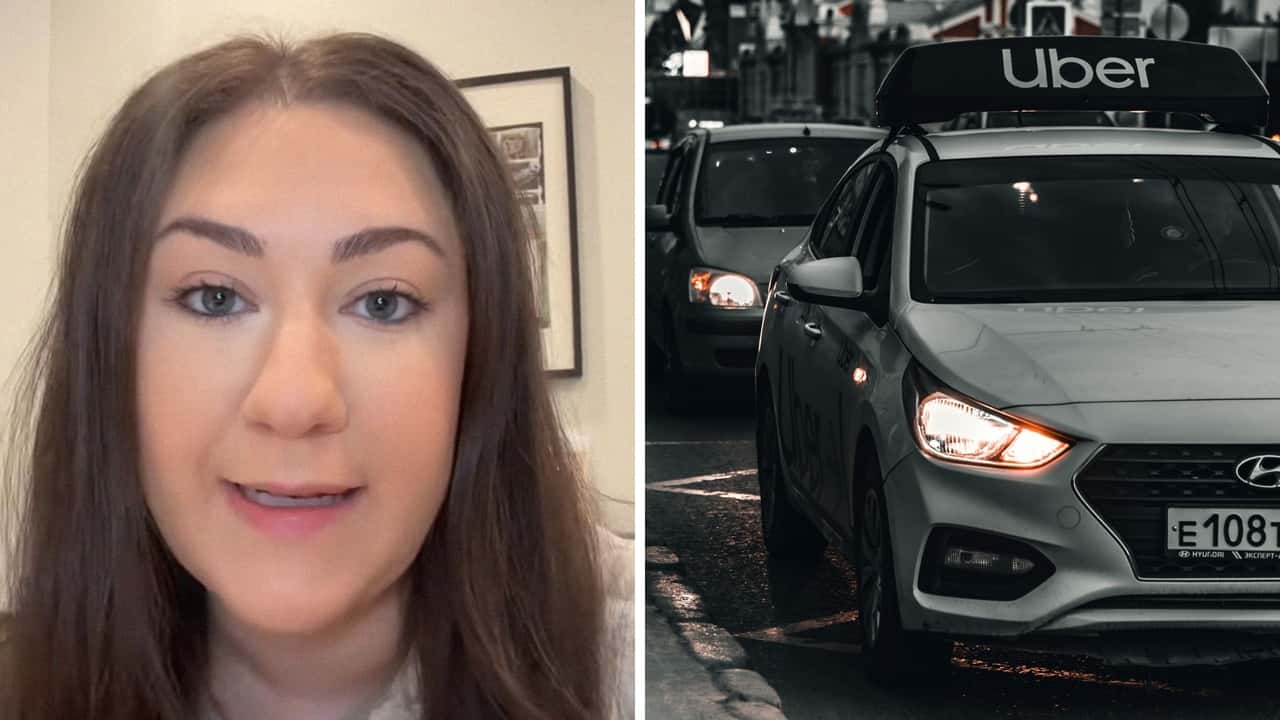
“Uber/Lyft literally need to ban air fresheners I’m sickkkkkk of it.”
People with sensitive noses or prone to headaches were commiserating in the comments section of a video featuring an Uber driver who took the task of making his vehicle smell nice a bit too far.
Some are saying it’s so common that Uber needs to do something about it.
In a viral video with more than 1.6 million views, content creator Chloe Carter (@chloe___carter) recorded herself in what for some people would be the Uber from hell.
In the video, Carter looks visibly distraught and disgusted, as if she’s ready to jump out of the moving vehicle at any point.
“Imagine being carsick and ur Uber driver is a fragrance mixologist,” Carter said in the text overlay.
When Carter flips the camera, there’s something no viewer could have seen coming. Now, plenty of drivers use air fresheners to give their vehicles a nice scent. But hanging from this driver’s mirror were—by our count—at least 16 of the tiny scented trees.
That’s enough to make anyone nauseated. (To give the driver the benefit of the doubt, maybe he adds one when the scent from the previous one dissipates.)
In the caption, Carter said: “At least it’s not a Tesla???????”
Those iconic tree-shaped car air fresheners hanging from rearview mirrors have a surprisingly specific origin story.
According to Little Trees, the company behind the design, it all started in 1952 when a milk truck driver in northern New York complained to chemist Julius Sämann about the smell of spilled milk that wouldn’t go away.
Sämann had spent years extracting aromatic oils from pine trees in Canada’s forests, so he came up with a solution: combine fragrances with specialized blotter material to create the first car air freshener.
Mental Floss reports that he gave it the shape of an abstract evergreen tree as a tribute to those years working in the pine forests.
His original 1954 patent application actually featured a pin-up girl design that was popular in the 1950s, but by 1959, he’d switched to the tree shape that made more sense for a pine-scented product.
The design proved so successful that Car-Freshner Corporation has aggressively protected its trademark over the decades, filing lawsuits against everyone from Old Navy to Glade for producing similar tree-shaped products.
Strong scents in enclosed spaces like cars can be problematic for some people. According to Migraine Again, perfume tops the list of odor triggers for migraine sufferers, followed by cleaning products, cigarette smoke, and motor vehicle exhaust.
The connection goes deeper than just disliking certain smells. Research shows that people with migraines have smaller olfactory bulbs—the part of the brain that processes smell—than those without migraines. This heightened sensitivity means that strong scents can both trigger new migraine attacks and worsen existing ones.
The migraine community reports that air fresheners get mixed reviews because they add more scent to mask odors rather than neutralizing them, potentially making symptoms worse in enclosed spaces like vehicles.
“And it’s 85 degrees in the car,” a top comment theorized.
“As a migraine person this is like final boss level,” another said.
“Uber/Lyft literally need to ban air fresheners I’m sickkkkkk of it,” another commenter added.
One viewer offered the driver’s perspective: “If you guys drove Uber you’d know that the fragrance is for the drivers to endure the many stinky passengers.”
Motor1 reached out to Carter via email and Instagram direct message and to Uber via email. This story will be updated if either party responds.
We want your opinion!
What would you like to see on Motor1.com?
– The Motor1.com Team