“Best part is when the order is restricted, star orders and it gets cancelled.”
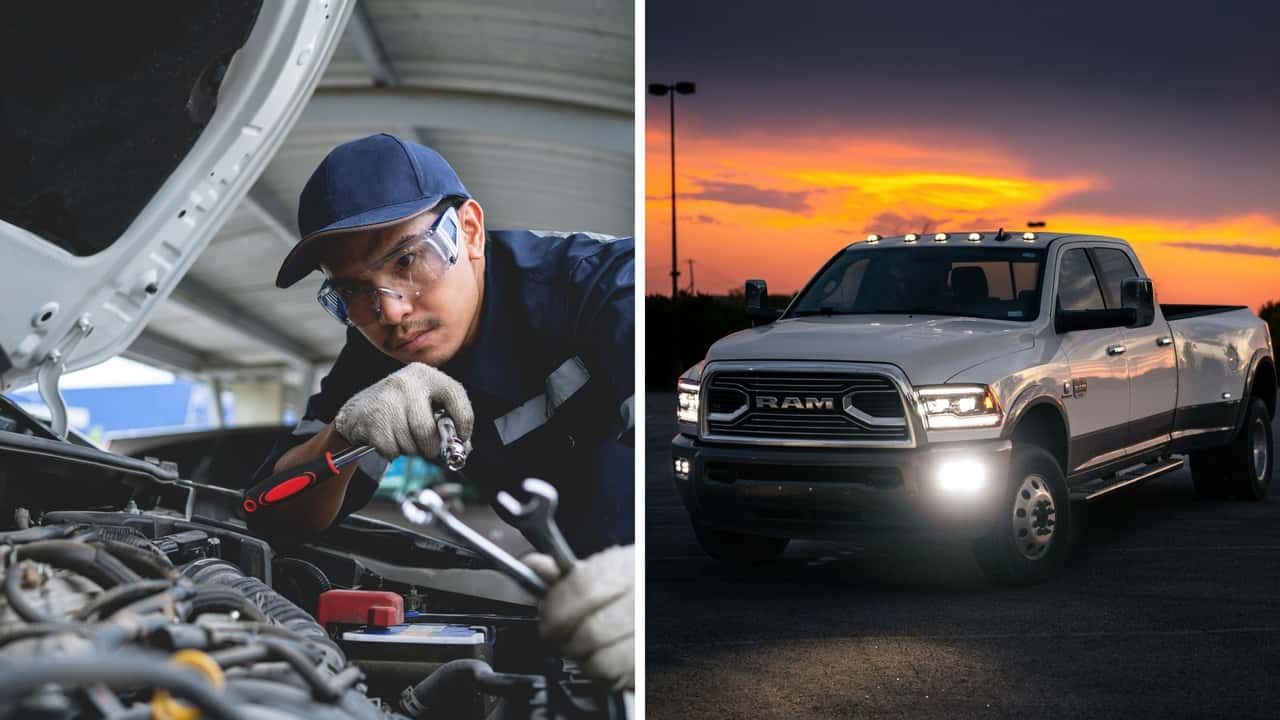
You get the feeling from the weary tone of the mechanic that he’d love nothing more than to just do his job and complete the obvious, simple fix for the vehicle in front of him. But we learn pretty quickly that the Dodge Ram truck he’s looking at will require a lot of unnecessary problem-solving and diagnostic hoops to jump through, thanks to strict repair guidelines.
TikTok creator John Zacek (@johnzacek), a master technician at Russ Darrow Chrysler Dodge Jeep Ram in Madison, Wisconsin, seems fairly certain that the cylinder misfire on the Ram would be a simple fix with the replacement of an injector on the third cylinder. But it appears that Stellantis’ warranty restrictions require several additional, time-consuming steps.
“We could have just taken [cylinder] three and replaced it, but we’re gonna swap it with [cylinder] one, drive it 20 miles, and see if the code comes back on the same cylinder or if it moves to [cylinder] one,” he said in the clip that’s been viewed more than 29,000 times. “I would have much rather just put an injector in it, but here we are.”
The complicating issue isn’t the diagnosis itself, but the process dictated by the Cummins 6.7L engine’s manufacturing guidelines. Certain components on late-model Ram trucks are classified as “restricted,” meaning dealership technicians can’t simply order and replace them, even when experience strongly suggests the specified part is at fault. Instead, mechanics have to open a case with Stellantis’ internal technical assistance system and document specific diagnostic steps to prove the failure outright before getting approval.
Zacek told Motor1 that the manufacturer’s Service Technical Assistance Resources (STAR) guidelines required him to reset fuel system adaptations, complete a 20-mile drive cycle, and then physically swap injectors between cylinders before the restricted part could be released.
In this case, extra layers of oversight mean swapping an injector from a fully functioning cylinder to the problem cylinder to see whether the switch corrects the issue, thereby identifying the original cylinder as the problem component.
Zacek said the warranty operation was limited to 1.3 hours of pay, but the full process, including documentation, coordination with parts, and waiting on STAR, kept him clocked on the repair for more than four hours. “That’s about two and a half hours of unpaid time,” he said.
Technicians who watched the clip certainly had some feelings about the extra time and labor required. Many commenters who identified themselves as dealer technicians described similar experiences with restricted parts, case delays caused by STAR, and warranty labor that doesn’t fully account for diagnostic time. One Ram owner said their 2025 model was at the dealership for 44 days because extra diagnostics were required under the warranty.
Zacek doesn’t seem all that concerned about the cylinder misfire itself, which is a manageable problem if addressed quickly. A misfiring cylinder can be caused by a faulty injector, an ignition issue, a wiring problem, or, in more serious cases, internal engine damage. On a modern truck with low mileage, injectors are often among the first suspects, especially if the engine is running smoothly otherwise and there’s no other mechanical noise that’s been documented.
The high likelihood that the injector is the problem point has upset Zacek, who sees the extra troubleshooting step of switching the injector to a different cylinder for a test as an unnecessary waste of time. Plus, the extra verification means additional drive cycles, more shop time, and longer delays before a repair is approved.
Zacek said his initial hunch proved correct. The truck ultimately required a new injector, which arrived roughly a week after the restriction was lifted. The owner was given a loaner car while the repair took place, but the process can still cause significant inconvenience, with their vehicle remaining at a dealership longer without a clear timeline for resolution.
All that uncertainty and inconvenience from other repair work could make an owner reluctant to address a clear repair need on their vehicle. That’s never a good practice, and for a cylinder misfire, waiting to fix the problem can lead to reduced fuel economy, rough operation, and, in some cases, damage to engine components like the catalytic converter.
Modern engines rely on precise fueling and combustion, and when one cylinder consistently misfires, unburned fuel can make its way into the exhaust system, where repairs can quickly become more expensive than the original problem.
That cost escalation is why warranty systems like STAR exist; to ensure that repairs are accurate and consistent across dealerships. But as Zacek notes, the trade-off for that certainty is speed and efficiency, even when the problem is clear, because technicians must follow a prescribed diagnostic path for parts to be released for installation.
While not addressed directly in the video, an issue likely at the root of Zacek’s frustration is how warranty labor is structured for dealerships, since technicians are typically paid a flat rate for specific operations. While those systems do standardize costs, mechanics and technicians frequently point out that they often fail to account for the real-world diagnostic time required to perform a repair properly.
That dynamic is part of the reason warranty work is increasingly unattractive to technicians, especially as service on newer vehicles becomes more complex. With mechanic jobs becoming increasingly difficult to fill, tensions between manufacturers’ warranty requirements and the economic realities of service departments are a major reason for turnover and recruiting problems in the industry.
We want your opinion!
What would you like to see on Motor1.com?
– The Motor1.com Team