“I have questions.”
A Mercedes-Benz salesman’s discovery of an RFID stamp on a Michelin tire has people hypothesizing about why manufacturers are now tracking their products. It has also raised broader questions about why tires need electronic identification tags.
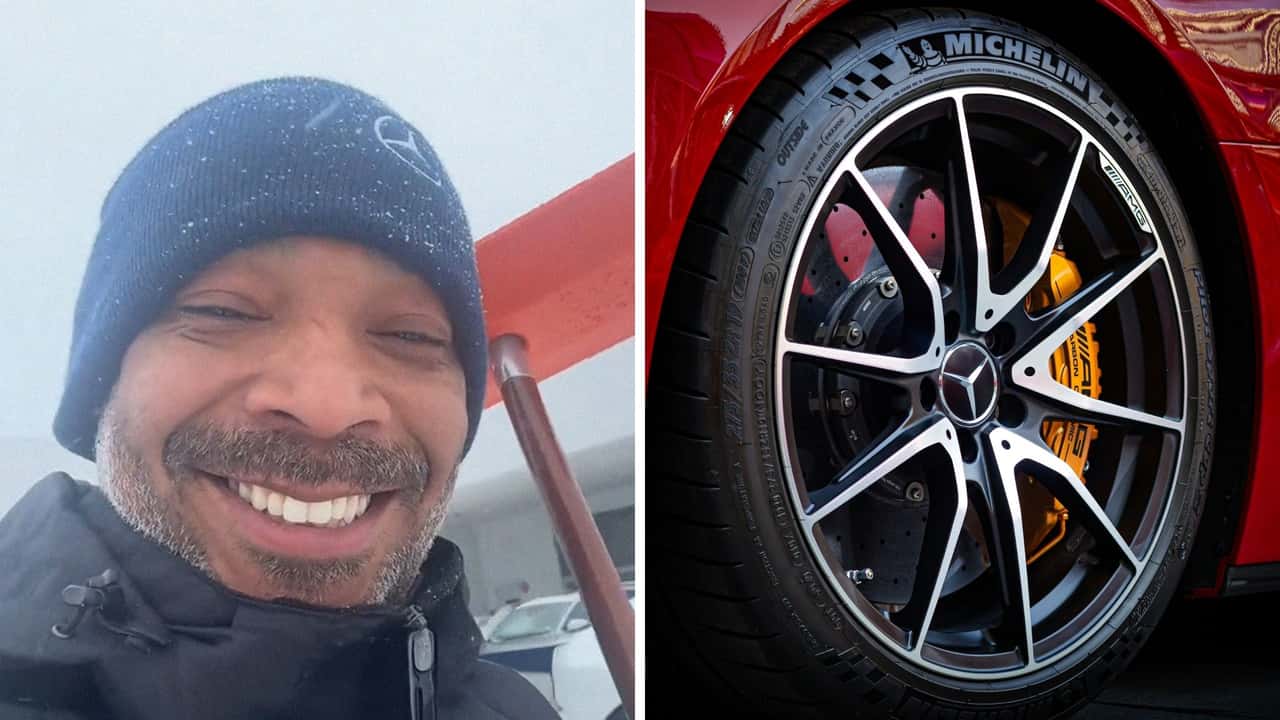
Jay Pichardo (@jay_sellsbenz), a car salesman at Mercedes-Benz of Manchester in New Hampshire, posted a TikTok about the RFID tags that has racked up over 17,600 views.
The video shows a close-up view of a Michelin Pilot Sport 4S tire, with Pichardo’s camera focusing on a small stamp on the tire’s sidewall. A red circle graphic, edited by Pichardo, highlights the marking indicating the presence of an RFID tag.
“Michelin, I have questions,” Pichardo says. “Why is there an RFID tag on a tire? Explain that to me.”
RFID, or Radio-Frequency Identification, uses electromagnetic fields to automatically identify and track tags attached to objects. It’s the same technology used in a variety of familiar devices, such as car key fobs, anti-theft tags in department stores, and contactless credit cards.
The technology has become increasingly common in automotive applications, and international industry standards have emerged that specify requirements for tire traceability using RFID tags.
Michelin has been a pioneer in tire RFID. According to RFID Journal reporting, the company had already embedded RFID tags in around 50 million tires—mostly light and heavy trucks and buses—and promised to target passenger-car tires worldwide, which would mean tagging an additional 100 million tires. The chips store information about the tire’s manufacturing date, specifications, and unique identification number.
In December 2024, Michelin announced a partnership with RFID manufacturer Beontag to incorporate RFID technology into millions of new commercial and passenger tires over the following two years. The tags allow the tire to be tracked throughout its life cycle, from manufacturing to disposal and recycling.
Mercedes-Benz partners with Michelin to develop custom tires for its vehicles, enabling RFID-equipped tires to integrate with other vehicle systems to provide more accurate, holistic data.
Viewers offered their own explanations in the comments section, and many were well-informed.
User Jeff Hensley provided a comprehensive answer, posting, “Tire pressure monitoring maintenance temperature etc. They also use for logistics.” Pichardo responded with gratitude: “Thank you!”
User Sinclair highlighted the safety and recall applications, writing, “Tracking during production, if there’s a faulty batch or recall they can easily find all the tires and get them off the road. [Save] them millions in insurance.”
Another commenter, Wasteoftime, shared his own use case, posting, “My BMW knows exactly the tires on it and it will calculate tire air pressure based on that information and the average speed I drive.”
User tommyboy740 was quick to point out that this technology isn’t exclusive to luxury vehicles, claiming, “So will my Honda Civic.”
Another offered a different perspective on the tags’ purpose, writing, “So u know it’s real. It’s a verification method to differentiate knock offs vs real.”
AJ DURANTZLLC suggested a more legal angle: “Integrated inventory systems tied to service records in case of litigation.”
Increasingly, regulators are requiring the use of RFID technology in tires. The European Union’s Ecodesign for Sustainable Products Regulation (ESPR) will require Digital Product Passports (DPPs) for tires sold in Europe starting in 2027. The rules mandate unique identification for each tire throughout its life cycle.
EU regulations are designed to promote circular-economy business models through product tracking and data collection, but RFID has other benefits.
For consumers, as Pichardo’s commenters pointed out, this technology can offer benefits such as more accurate tire-pressure monitoring, easier verification at purchase, and faster recall notifications if a safety issue is discovered.
For tire manufacturers and dealers, RFID improves inventory management, reduces counterfeiting, and provides performance data over time.
Pichardo’s video reflects the questions drivers might have when they first notice tire RFIDs, but the technology is well on its way to becoming an industry standard. Hana Technologies, which has been RFID-tagging tires since 2005, claims to have tagged over 250 million tires to date for major manufacturers worldwide, including partners such as Michelin.
So, the next time you buy a new car or new tires, don’t be surprised to see an RFID marking on the sidewall. It just means they are evolving toward self-awareness.
Motor1 reached out to Jay Pichardo via email. This story will be updated if he responds.
We want your opinion!
What would you like to see on Motor1.com?
– The Motor1.com Team