“What if the gasket starts leaking?”
DIY fluid changes are among the most enduring points of pride for many car owners. And it seemed like one of those nuances of ownership that would always be there, giving mechanically minded motorists an opportunity to gain some satisfaction from being actively involved in their car’s care and maintenance.
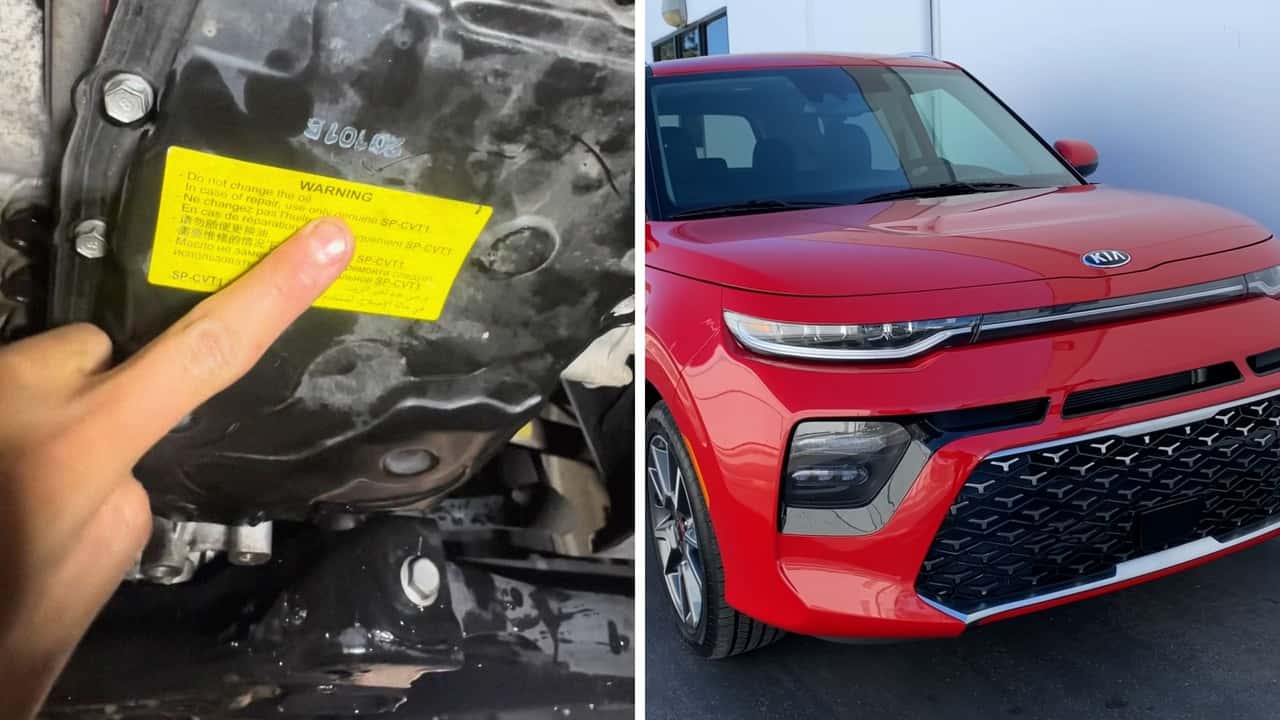
But the times have changed for a cohort of cars labeled “non-serviceable,” including the Kia Soul shown in a viral TikTok by creator @adrn.fr. Intending to change the transmission fluid in his wife’s compact car, he runs into a bright yellow label telling owners not to try to perform this basic maintenance step.
“I just serviced the transmission, like I do on any other one of my cars, and it says, ‘Do not change the oil.’ And when I went to the dealer to buy all the parts that I needed to—the filter, the gasket, the fluid—um, they said it’s a non-serviceable transmission,” he said in the clip that’s been viewed more than 10,000 times. “So, you’re never supposed to change the oil, but what if this gasket starts leaking? What if you hit something and dent this pan?”
While the first line of the label clearly says not to change the oil, the clip’s commenters clarified that the transmission fluid was the real issue. That’s because the Soul’s continuously variable transmission (CVT), which is sealed and non-serviceable under normal maintenance schedules, isn’t intended to require any fluid replacement. Instead, it means the manufacturer doesn’t recommend routine drain-and-fill service unless the transmission is being replaced for a specific issue.
It’s a distinction that’s tough to parse and not exactly intuitive for owners who aren’t involved in maintenance and repair on a daily basis. The key detail is that the transmission still has a drain plug, replaceable filter, and fluid that’s available over the counter.
Commenters who were not fans of the CVT-style transmission jumped in with theories that “lifetime fluid” is really intended to last only the life of the warranty, not the life of the vehicle.
“It’s simple thay want the transmission to fail just outside of warranty, then car manufacturers are counting on the repair costing so much you go buy a new car,” one of them opined. Another added, “it’s planned obsolescence.. they say it has lifetime fluid which means the lifetime of the warranty and then they’re hoping it blows so you buy a transmission or a new car should be done every 30 to 50,000 [miles].”
Understandably, the phrase “lifetime fluid” will raise eyebrows and spark skepticism among anyone who’s at least halfway engaged in their vehicle’s maintenance. This is especially because “lifetime” can be twisted and interpreted in a whole variety of ways, and should in no way be taken to mean infinite or forever.
In automotive cases involving CVTs, “lifetime” refers to the expected service life of the transmission under normal use, as defined by the manufacturer. Automakers increasingly design transmissions, especially CVTs and intelligent variable transmissions, to operate with tightly controlled fluid properties over long intervals, reducing the need for routine service during the years most owners keep the car.
For manufacturers, fewer service points also reduce opportunities for improper maintenance, which can cause premature failures and costly warranty claims. For determined owners, this all just creates a challenging puzzle about how to access the transmission and perform what they consider routine maintenance.
In modern CVTs, fluid service has shifted from a fairly DIY-friendly task to a procedure that requires factory-spec fluid, precise fill levels, and electronic recalibration afterward. Avoiding or overlooking any of those steps introduces the risk of unintended side effects and malfunctions.
With a much lower margin of error for a DIY mechanic, that means the safest path doesn’t rule out routine maintenance entirely. It just means making sure any service is done with the right tools, information, and expectations.
If you’re going to take the “non-serviceable” label as advice rather than a warning, the clip’s commenters offered some critical steps to avoid overlooking. First and foremost, CVTs rely heavily on electronic control modules that adapt over time to fluid conditions and driving behavior.
Changing the fluid without resetting those adaptive values can result in harsh or simulated shifting, belt slip, or driveability complaints that didn’t exist beforehand. Doing that reset typically requires a shop-level scan tool that most DIY mechanics don’t have access to.
It’s also important to note that similar sealed- or lifetime-fluid language appears on transmissions from many major brands, including Toyota, Subaru, and Honda, among others, particularly on CVT-equipped vehicles.
Take all of this to mean that we’ve entered an era where the cost and consequences of getting at-home maintenance are higher than they used to be. Anyone planning to keep a vehicle well past its warranty should weigh the benefits of preventive service against the need for proper tools, correct fluid, and the ability to follow complex manufacturer-specific procedures.
Motor1 reached out to the creator via direct message and commented on the clip. We’ll update this if they respond.
We want your opinion!
What would you like to see on Motor1.com?
– The Motor1.com Team