‘I am so sick of extended warranty companies.’
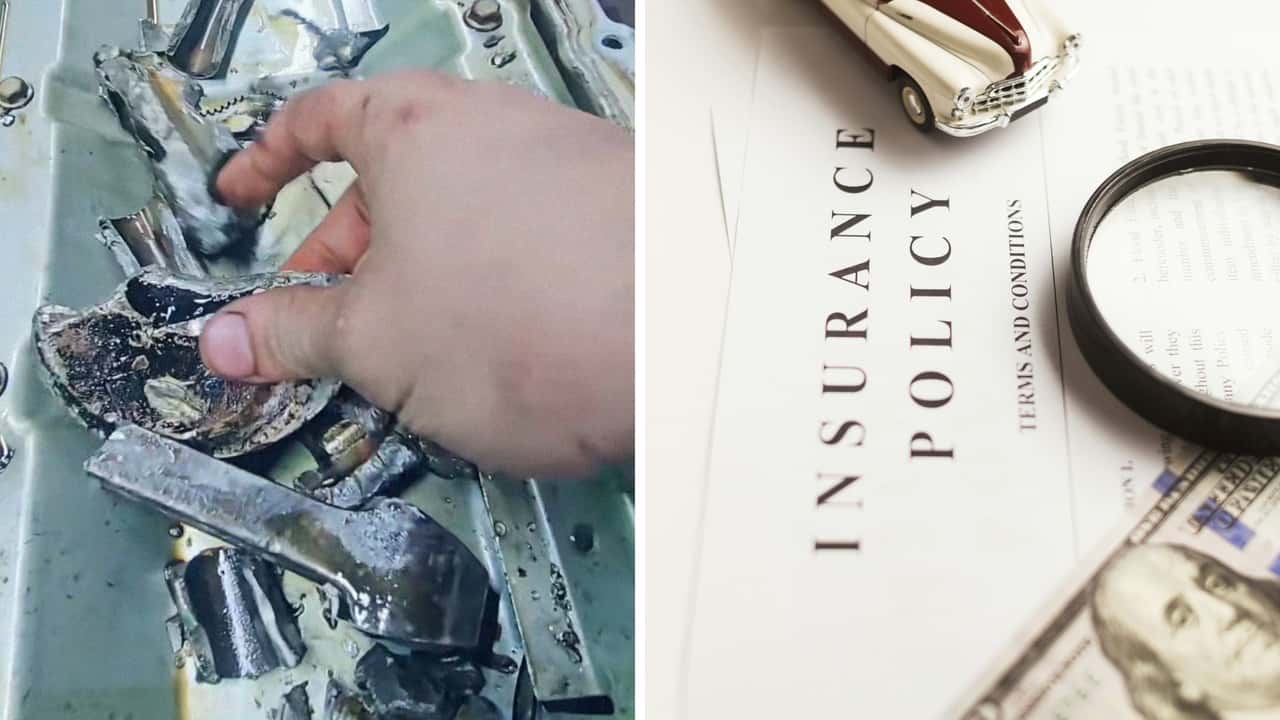
A viral TikTok clip opens on the gaping hole in a vehicle that used to hold an engine, which is now more of a loose collection of warped component parts than anything of actual mechanical use. Even to automotive newcomers, common sense says the engine is toast. But the clip drives home the point that warranty companies will look for every possible excuse to deny approval for an expensive repair.
The clip from Norfolk, Virginia, mechanic Michael Griffin (@mechaniclink), which has been viewed more than 196,000 times, lets viewers look and listen as he sarcastically recreates the conversation with the warranty company, asking for further diagnostic testing on the engine whose only value is as scrap metal.
“Well, we found metal chunks in the oil pan,” Griffin responds to his own impersonation of the warranty company representative asking for clear proof of carbon buildup.
In the clip’s caption, he explains, “I mean… I get where they are coming from… but at some point you just gotta give in and say, ‘Yeah, that’s a blown engine.’”
The video plays out like a short, two-person farce, with one “actor” playing both roles. On one side of the imaginary call is Griffin, staring at an engine that no longer resembles a machine so much as a collection of warped paperweights. On the other end is a warranty company voice that remains politely unconvinced despite Griffin’s insistence that the engine is “locked up,” to put it lightly.
The well-timed close-up views of the oil pan filled with shards of metal and other clearly warped machinery provide the perfect comedic counterpoint.
It’s obvious this isn’t an engine on the edge of failure that could be saved with some ambitious, excessive elbow grease. Its on-the-road days are done.
Commenters on the clip appeared to appreciate Griffin’s sense of humor, but also let loose with their feelings on warranty companies and the hoops they require customers and repair shops to jump through.
“Nope. I need you to pull the valve covers to check for sludge and lack of maintenance, I don’t care that the owner has proof of oil change history,” one of them wrote.
Others recognize the clip as a near-perfect impression of their own workdays: “Car shield, endurance, silver rock, fidelity, aul, jm&a, maxcare, ally, I don’t know how much of my life has been wasted listening to hold music.”
A few shared stories that sounded less like jokes and more like quiet, familiar indignities. “I actually had to call them for the first time. They didn’t wanna cover anything,” one defeated observer recalled.
Taken together, the replies read less like a comments section and more like a group therapy session for people who spend their days navigating the space between broken machinery and business world bureaucracy. The specific companies, cars, and mechanical failures may change, but the rhythm stays the same: Send more photos, perform more tests, spend more time on hold, and give us more proof that what’s sitting in front of you is as dead as it looks.
You have to give Griffin credit for condensing all of that nonsense into less than a minute of sarcasm and absurdity. If this auto mechanic gig doesn’t pan out for him, there’s evidence he could have a future in improv comedy.
Away from the comedy fodder, the back and forth with warranty companies is pretty far from being a punchline. The reality is it’s an afternoon or sometimes a full day, and even longer. While an engine or transmission sits in pieces, someone is taking and uploading photos, sitting on hold, and answering the same questions repeatedly in slightly different formats.
Meanwhile, a service bay is tied up while a customer waits for a call that it seems may never come. The car sits unfixed, not because of any uncertainty over the cause but because the warranty process demands exhaustive levels of proof.
That process exists because warranty companies are built to manage risk, reduce abuse, and avoid paying for damage caused by neglect or improper maintenance. From their side of the phone, every claim looks like a potential argument waiting to happen, and every extra photo or test is supposed to shrink that uncertainty. It’s a system that runs on paperwork and documentation, where even obvious failures have to be captured with forms, images, and checklists.
This all leads to obvious friction and frustration for all involved, even if an engine has already given up the ghost and is now nothing but twisted metal and regret. On the administrative side, a case isn’t real until it’s been submitted, reviewed, and approved repeatedly.
Griffin’s video took off because he distilled that monotony and ridiculousness into a quick, bite-sized clip. By the time he holds up the remains and asks, “Is this proof enough?” the answer isn’t just in the parts scattered on the shop floor, but in the collective appreciation of enduring no-win conversations that never seem to end.
Motor1 reached out to Griffin via email and direct message. We’ll update this if they respond.
We want your opinion!
What would you like to see on Motor1.com?
– The Motor1.com Team