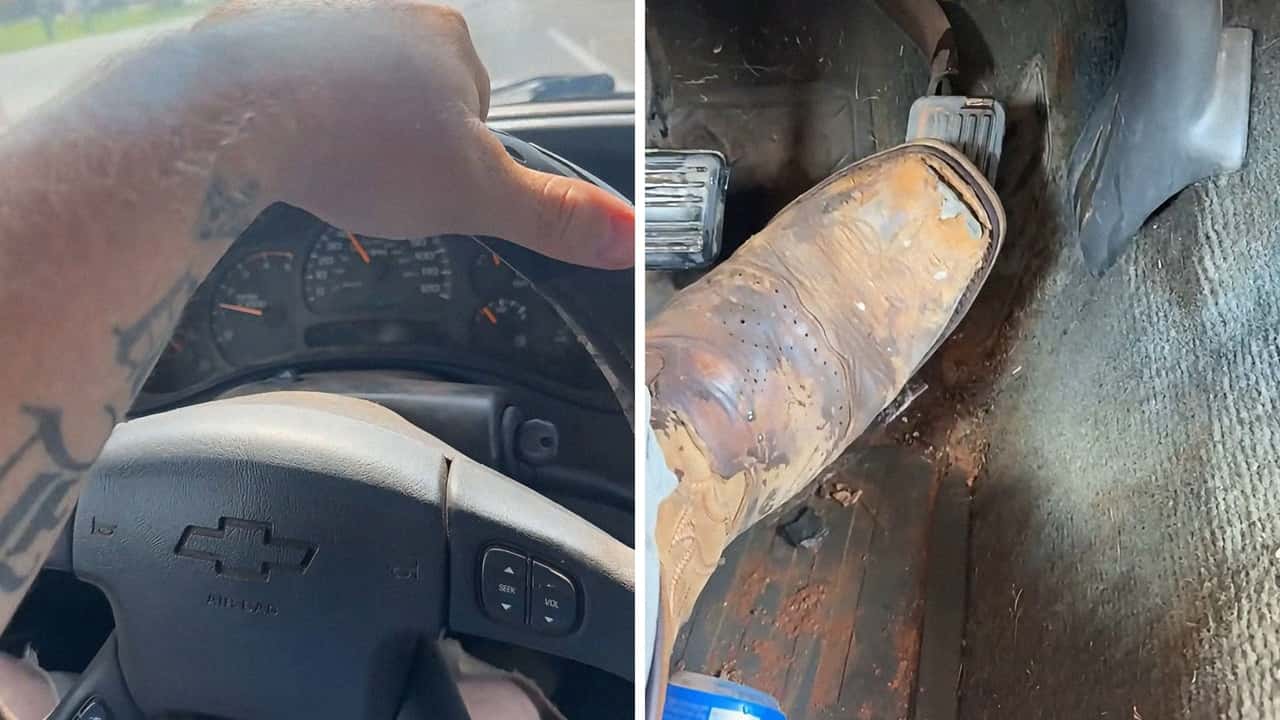
A viral Chevy clip looks like a catastrophic leak, but the likely culprit is a much more familiar A/C drainage problem.
Mechanical quirks and misbehavior somehow manage to embellish the feel of well-worn trucks, but a recent video appears to go pretty far over the line. Still, the driver of the Chevrolet seems amused and entertained as he shows off his cowboy boots getting soaked when he hits the accelerator.
The clip from creator Terry Pittman shows his hand on the wheel of what appears to be a Silverado idling normally. But when the gas pedal hits the floor, a small flood of what looks like water comes cascading down onto his boots and the floor mats.
“This truck is so [expletive] badass. It just… sweats horsepower,” he said in the clip that’s been viewed more than 3.6 million times. “Yep, she’s a squirter.”
The obvious question is what kind of leak the Chevy is actually suffering from. Clearly water pouring into the driver’s footwell isn’t listed among factory options, even in the most outrageous and far-fetched trim packages.
Viewers immediately started diagnosing the truck from their phones and keyboards. Some suspected a bad heater core, which can send coolant into the cabin. Others landed on a much less alarming explanation: condensation from the air-conditioning system isn’t making it outside the truck the way it should.
“Bro clean out your ac evap line,” one commenter wrote. Another was even more specific: “Ur evaporator drain is plugged lol.”
Pittman appeared to already know what he was dealing with. When one viewer asked whether the heater core was responsible, Pittman instead pointed to the small drain tube that normally creates the familiar puddle of water beneath a vehicle when the air conditioner has been running. If that drain becomes clogged, he explained, the water has to go somewhere else.
“This is where it’ll go instead if that pipe is clogged,” he wrote.
That explanation fits with the clear liquid seen in the video. Pittman confirmed elsewhere in the comments that it was water, not gasoline or some other automotive fluid, which might’ve caused a whole lot more concern.
He was also quick to push back against the heater-core theory while taking some shots at its proponents. With the truck already running at operating temperature, Pittman noted that he probably wouldn’t be casually filming if that was the case.
“Do you think I’m this calm if 200 degree coolant is dumping on me,” he asked.
Several viewers said they’d dealt with similar problems. One commenter said the same thing happens in a Chevy Sonic, while another said his wife’s Cobalt has dumped water into the passenger side. Others described periodically clearing their evaporator drains with compressed air when dirt and debris build up.
The weirdest part of Pittman’s demonstration was the triggering event, since the water rushed out when he pressed the accelerator. The whole scene made it look like the Chevy had a potentially system-level malfunction, though the whole matter tickled Pittman’s funny bone rather than causing him much worry.
Motor1 contacted story subjects. This article will be updated if they respond.
Pittman’s explanation for the downpour came with plenty of fleet-level backup since General Motors has documented similar HVAC drainage problems in its 2000s-era trucks.
A 2012 GM service bulletin covering 2010–2013 Chevrolet Silverados and several related GM trucks and SUVs instructed technicians to inspect the evaporator drain hose when owners complained about wet front passenger flooring, a sloshing sound, or even mist coming from the dashboard vents. In those vehicles, GM said a kinked drain hose could keep condensation from escaping properly and directed technicians to reposition the hose.
The underlying process is less dramatic than Pittman’s video makes it look. As an air conditioner removes heat and humidity from cabin air, moisture collects on the cold evaporator and is supposed to drain underneath the vehicle. GM service information for Silverados specifically tells technicians to verify that the A/C drain hose is clear.
Proving that this is a longstanding GM issue, a bulletin covering 1988–1992 Chevrolet C/K trucks described owners finding A/C water inside the passenger compartment during humid conditions rather than safely draining outside.
Evaporator drains can become clogged as dust, leaves, and other debris work their way into the air conditioning system and collect around the drain opening. The damp environment gradually encourages buildup that restricts the small passage meant to carry condensation outside.
Preventing these clogs mostly involves keeping debris from accumulating in the first place. That means clearing leaves and other material from around the base of the windshield and exterior air intakes to keep drainage paths open.
We want your opinion!
What would you like to see on Motor1.com?
– The Motor1.com Team