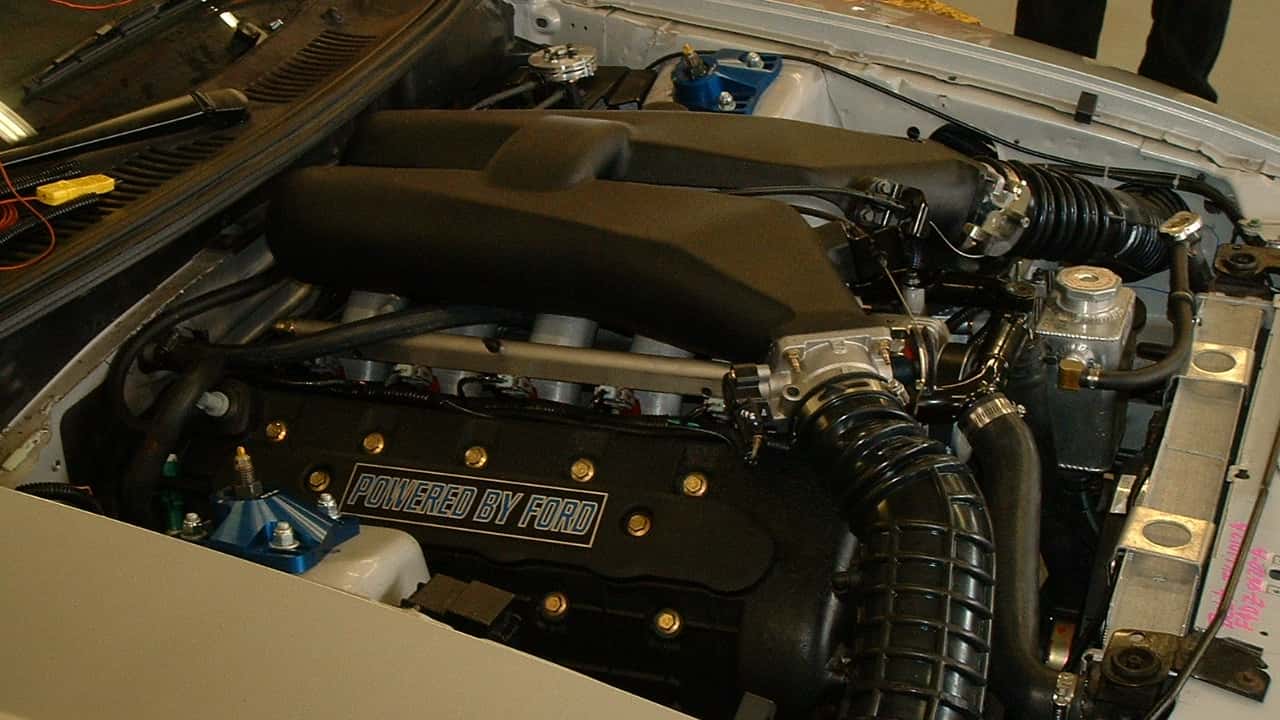
With more than 510 ponies at the wheels, this ‘Stang can definitely run.
Ford has brought one of the wildest Mustangs you’ve (probably) never heard of back to life. The one-off V10-powered prototype spent years sitting around and came dangerously close to disappearing, but the company’s Heritage Fleet team has now revived it, and it sounds every bit as outrageous as you’d expect.
The story starts roughly a quarter of a century ago, when a group of Ford engineers decided to do something that probably looked completely unreasonable on paper: shove a ten-cylinder engine into a Mustang. The result was the V10 Boss 351 Prototype, a secret project that eventually became a fully functional one-off Mustang coupe.
Ford’s Heritage Fleet recently teamed up with several members of the original development team to get the car running properly again. After years of sitting, you can imagine that the prototype needed more than a jump-start. The team went through its electronics and other systems before putting the Mustang on a dyno to see whether its unusual heart still had some fight left in it.
The V10 Mustang produced more than 510 horsepower and 480 lb-ft (651 Nm) of torque at the wheels during the dyno pull. Ford doesn’t quote an equivalent crank-horsepower figure, but assuming roughly 15 percent drivetrain loss provides a reasonable estimate. That puts the engine’s output at close to 600 hp, which isn’t too shabby by early 2000s standards. Nowadays, the most powerful Mustang production car is the ludicrous GTD with 815 hp from a supercharged 5.2-liter V8.
Rather than adapting a Triton V10 from one of Ford’s trucks, the engineers started with the 4.6-liter four-valve DOHC Modular V8 from the Mustang Cobra R. They essentially grafted two additional cylinders onto the architecture, combining parts from two 4.6-liter engines and developing new cylinder heads and camshafts. The result was an all-aluminum, short-stroke, high-revving DOHC V10 displacing 5.8 liters.
For engine management, the engineers involved in the skunkworks project came up with a wonderfully makeshift solution. They essentially rigged two Triton ECUs together, with each one controlling a bank of cylinders. Power was routed to the rear wheels through a six-speed manual transmission.
Motor1’s Take: Maybe the best part of this story isn’t the 510-plus wheel horsepower figure. It’s that Ford decided this bizarre piece of Mustang history was worth saving. Automakers build countless prototypes that disappear once their usefulness expires, so this one surviving, and now being properly preserved, is a win for enthusiasts.
A V10 Mustang was never going to make much sense as a production car, but that’s precisely why we love it. Modern Mustangs have become increasingly sophisticated and powerful. Yet, this prototype represents a different era when engineers could still take a perfectly good muscle car and ask themselves whether it would be better with two extra cylinders. Thankfully, Ford didn’t let this one die.
Mustang In The News:
We want your opinion!
What would you like to see on Motor1.com?
– The Motor1.com Team