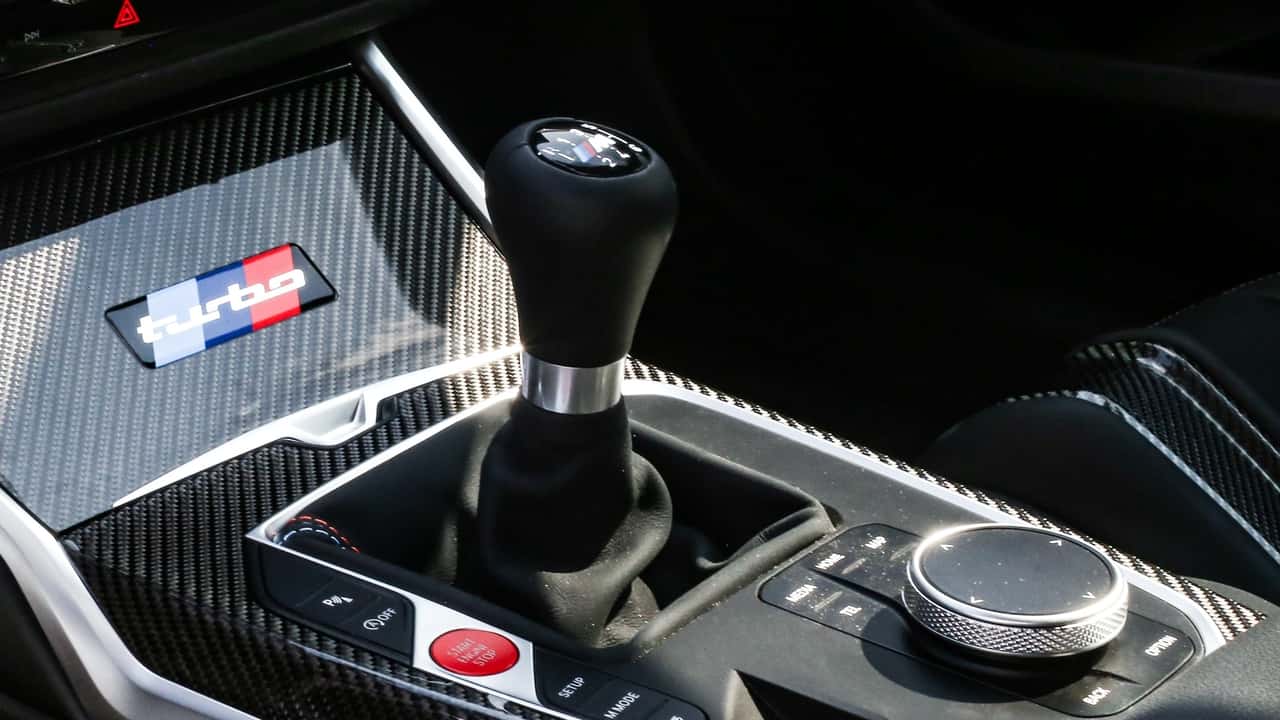
BMW’s smallest M car with a third pedal has a 50 percent take rate in the United States.
The manual gearbox may be disappearing from new cars at an alarming rate, but Americans apparently aren’t ready to give up the clutch pedal just yet. According to BMW M CEO, every second M2 sold in the United States has a manual transmission. Van Meel revealed the surprisingly strong take rate in a recent interview with us, explaining how customer feedback influences product decisions.
That’s an impressive figure in 2026, particularly for a performance car available with an eight-speed automatic that’s quicker and more convenient. Yet half of American M2 buyers are willingly choosing the six-speed manual instead. And BMW M is paying attention. Van Meel specifically connected the M2’s manual take rate to the decision to create the M3 CS Handschalter, a limited-run, manual-only special edition developed for North America. Demand was apparently enormous, with the car selling out almost instantly.
‘Especially in the U.S., the love for the manual transmission is enormous. Every second M2 we sell there has a manual gearbox. Rear-wheel drive and a manual transmission are the dream combination for many purists. That is why we also made a limited model with a manual transmission for the U.S. Demand was enormous; the car was practically sold out immediately.’
2027 BMW M3 CS Handschalter
Similarly, the retro-flavored M2 Turbo Design Edition is also a manual-only affair for America, but manuals have become the exception in BMW’s lineup. The M2, M3, and M4 are the last cars with a clutch pedal, and only if you stick to the lower-tier models. If you want all-wheel drive, it’s only available with the eight-speed automatic transmission.
The company isn’t pretending manuals are objectively better for performance or efficiency, but it recognizes they’re about much more than numbers. Unfortunately for enthusiasts, strong demand doesn’t necessarily guarantee a long-term future. BMW has acknowledged that the manual transmission faces several challenges, including increasingly stringent emissions regulations, driver-assistance systems, hybridization, and a shrinking supplier base. In some cars, using a manual has forced engineers to detune the engine because the transmission couldn’t handle the full torque.
That’s why the M2’s 50-percent take rate is significant. It gives BMW hard evidence that enthusiasts aren’t merely complaining about the disappearance of manuals online; they’re actually paying for them. For BMW, that’s arguably the most important distinction. If every second American M2 buyer is willing to choose the clutch pedal, there’s still a compelling business case for keeping it around.
Motor1’s Take: The 50-percent figure is genuinely impressive, especially when you consider how far the industry has moved toward automatic transmissions. The M2 is proof that when an automaker gives enthusiasts a compelling package with an inline-six, rear-wheel drive, relatively compact dimensions, and a manual gearbox, there are still plenty of people willing to embrace it.
The problem is that demand isn’t the only factor determining the manual’s future. Regulations, engineering costs, suppliers, and electrification are all working against it. So, enjoy that third pedal while you can. If half of M2 buyers in America are giving a shift, BMW M has every reason to keep listening. Whether the manual will live to see 2030 is anyone’s guess, so you might want to buy one while you still can.
Stay Up To Date With BMW:
We want your opinion!
What would you like to see on Motor1.com?
– The Motor1.com Team