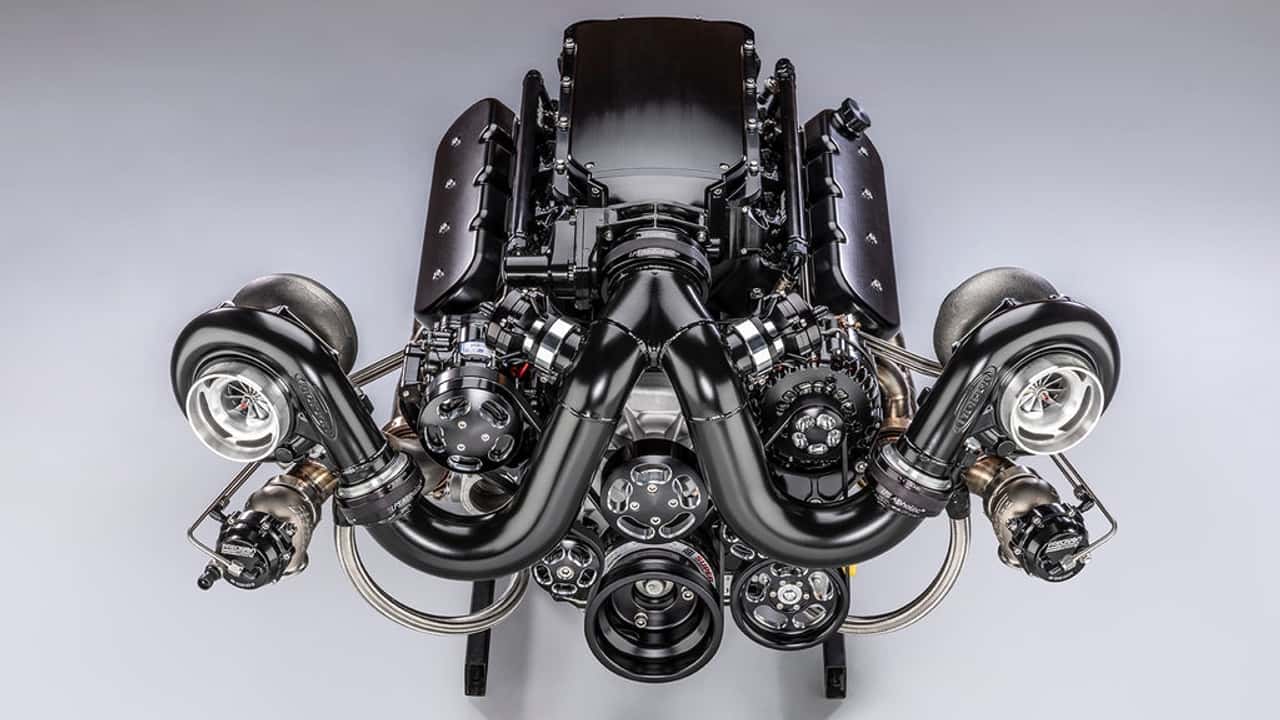
Nelson Racing’s new 427-cubic-inch twin-turbo V8 makes 1,200 horsepower on 91-octane pump gas, or up to 1,500 hp on race fuel.
Most high-horsepower crate engines come with a few strings attached: mandatory race fuel, tons of maintenance, and a whole lot of time spent keeping everything happy. Nelson Racing Engines, however, has a new option that delivers serious power without being too complicated.
The company’s Intercooled Outlaw 427 makes 1,200 horsepower on regular 91-octane pump gas. No race fuel required. Nelson Racing builds this complete LS-based V8 to order and dyno-tests it before sending it to its new home.
That 1,200-hp figure comes at 7,200 rpm on 91-octane fuel. If you’re willing to step up to higher-octane race gas, Nelson Racing says the engine can make as much as 1,500 hp.
Nelson Racing Intercooled Outlaw 427
Despite the old-school-sounding name, the Outlaw 427 isn’t a giant Ford big-block. It’s based on GM’s LS architecture and displaces 427.7 cubic inches, or about 7.0 liters.
Nelson Racing builds the engine around a beefed-up aluminum block with iron cylinder sleeves and a stronger six-bolt head design. Inside, there’s a billet crankshaft, forged connecting rods, and custom pistons. The 9.0:1 compression ratio also helps make all that power possible on pump gas.
The rest of the recipe is pretty serious, too. Nelson Racing uses upgraded cylinder heads, a custom camshaft, and a host of strengthened internal components designed to handle the abuse that comes with four-digit horsepower.
The Outlaw 427 then bolts on a pair of Nelson Racing’s 72.0-millimeter Mirror Image Generation 2 turbochargers. They use billet compressor wheels and custom exhaust manifolds, while the rest of the setup includes upgraded wastegates and blow-off valves to keep all that boost under control.
Naturally, 1,200 hp on pump gas doesn’t come cheap. Nelson Racing lists the Twin-Turbo Intercooled Outlaw 427 at $41,999 to start—or about the price of a modern mid-size sedan. Each engine is built to order and dyno-tested before it leaves the factory.
That’s a serious chunk of change for an engine, but for a serious project car, it seems like it’s worth the investment.
Motor1’s Take: We’re not saying you need 1,200 hp for your next project car. But if you’re going to build something completely ridiculous, you might as well do it right.
The Latest Engine News
Source:
Nelson Racing Engines
We want your opinion!
What would you like to see on Motor1.com?
– The Motor1.com Team