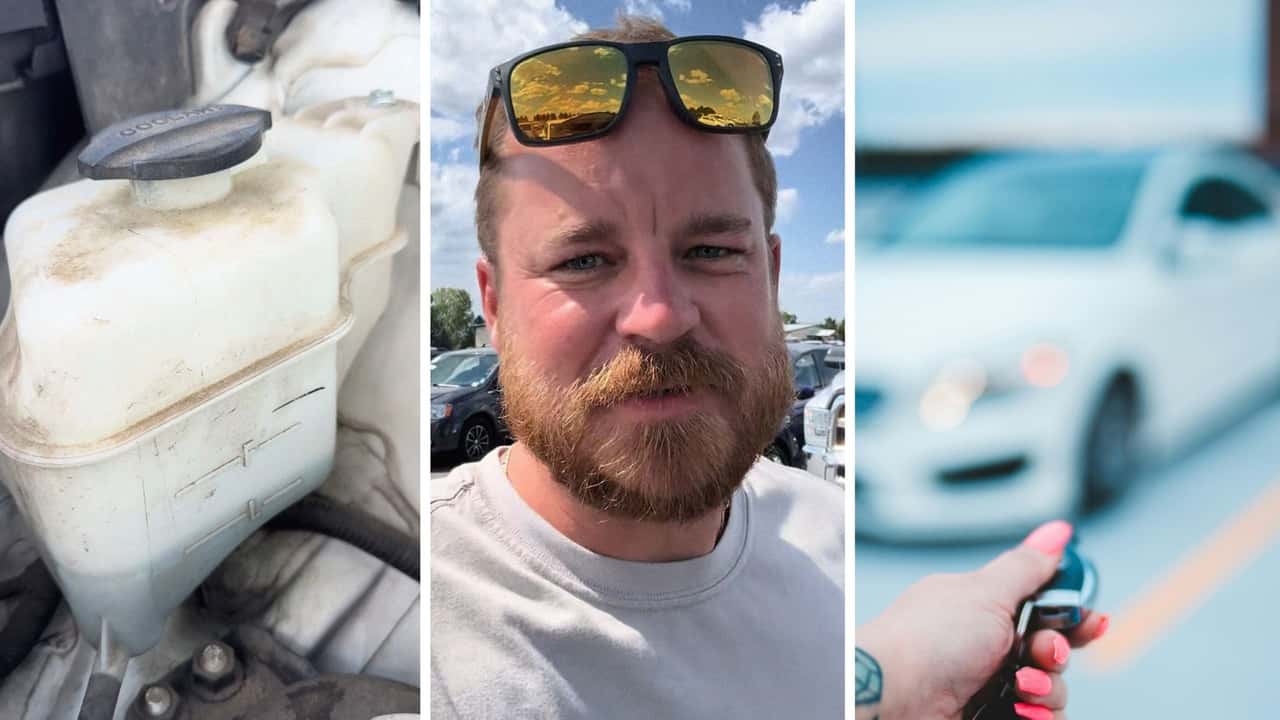
“A little pro tip…”
Paying close attention to small, but consequential details can save you from getting stuck with a lemon. A man recently shared one little indicator he clocked on a used Mazda that prompted him to immediately walk away from the vehicle: a marking on its coolant tank.
But is this really a bad sign. And if so, why?
Car enthusiast Ty Backes (@tybackes) begins his video with a recording of the Mazda’s engine bay. He focuses on its coolant tank, pointing out a small marker line made on the plastic receptacle. “A little pro tip for you when you’re buying used cars. When you pop the hood, and you check the coolant. And there’s a mark and the coolant is below the mark, just shut the hood and walk away.”
Several people who watched his video were left scratching their heads. “But failed to say why?” one person wrote. Another asked. “What does that mark mean?”
Other commenters seemed to be picking up what Backes was laying down. “It means there is a leak somewhere that they know about. They marked it after filling it and it leaked out,” one explained.
Another person said that what they took from the video is that buyers should look for small details such as this one. According to them, seeing a line on the coolant tank could point to potentially deeper issues with the ride as a whole.
“The advice here is to pay attention and look for clues. If there is no external leak and they are monitoring the coolant levels that means it’s probably a head gasket,” they wrote.
Moreover, they added that there’s no way to tell for certain what the issue with the car could be based off a single marker line. Then again, the fact that the previous owner was watching their coolant levels so closely indicates they were concerned about it for one reason or another.
Another person argued that a mark on the coolant tank wasn’t a major issue. They pointed out that it doesn’t necessarily indicate there’s a leak, but rather the fluid level fluctuates depending on the engine bay’s temperature. “It’s gonna blow your mind when you find out that’s where the level is supposed to be when the engine is cold,” they wrote.
Thanks to thermal expansion, drivers can expect their car’s coolant levels to appear higher when the engine is hot. Per Automotive Yeah, “Coolant level rises when the engine heats up due to thermal expansion … temperature increases, pressure builds, pushing excess coolant into the overflow tank. This rise is normal in sealed systems.”
Conversely, when an engine is cold, the coolant level decreases.
In the Mazda’s case, the previous car owner could’ve accidentally overfilled the coolant tank, causing it to spill when driving. Thus, getting their engine bay covered in the liquid and causing an unpleasant smoke to emit from the car.
Additionally, Wiibook writes that altitude plays a part in coolant levels. If the previous driver was constantly cruising around in higher altitudes, this atmospheric pressure change mitigates the coolant’s boiling point. Subsequently spiking evaporation of the liquid causing incremental drops in coolant over time. This primarily occurs in older and less efficient vehicle cooling systems.
Wiibook lists several reasons why a vehicle’s coolant levels would drop. Leaks are the primary cause. Namely in radiators, hoses, water pumps, and thermostat housing units. Blown head gaskets can cause coolant to spill into an engine’s cylinders or seep into engine oil. This can ruin an engine.
If you’re worried about your coolant levels and a sweet aroma begins to permeate your car’s cabin, this could point to a heater core leak.
If your car is constantly overheating, there are some usual suspects you should consider. These include improperly functioning thermostats, clogged radiators, and malfunctioning water pumps.
Keeping tabs on your car’s fluid levels is a relatively easy and inexpensive maintenance protocol that can greatly extend the life of your vehicle. Car Fluid Guide recommends making a spot check every 5,000 miles for your everyday driver.
However, if you’re rolling around in a high performance vehicle, you’re going to want to peep it every 1,000 miles or so. This is where your car’s in-dash temperature sensors come in handy as well. If you’re noticing massive spikes and drops while driving, then you should see what’s going on with your car’s coolant system immediately to save yourself from headaches and potentially costly repair bills down the line.
Motor1 has reached out to Backes via TikTok direct message for further comment.
We want your opinion!
What would you like to see on Motor1.com?
– The Motor1.com Team