“While I was at a stop.”
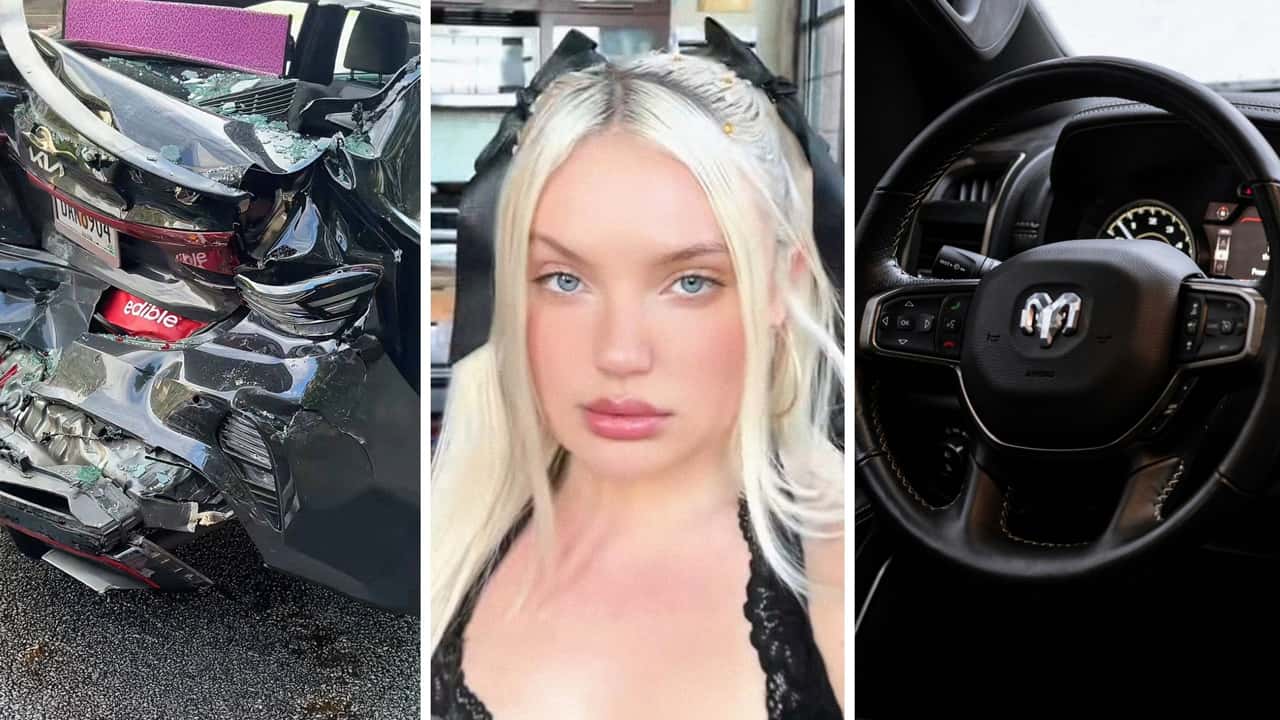
There are never winners in an auto accident. A viral video shows why whoever’s driving the larger vehicle is probably going to come out on the better end. The short video presents the back of a Kia crushed nearly beyond recognition, while the Ram pickup that hit it has at most some minimal damage to its front bumper and no other sign it was involved in a serious collision.
TikTokker Grace Roberts (@not.yoursavinggrace) is understandably upset at her situation. Her post shows her holding an ice pack to her head on the side of an Atlanta road in the aftermath of the accident.
“I hope the sun explodes this big truck just rammed into me while I was at a stop,” she wrote in a text overlay on the clip, which has been viewed more than 2.7 million times.
The damage to Roberts’ Kia was so severe that it’s difficult to see where the trunk once ended and where the passenger compartment began. The rear glass is shattered, body panels are folded inward, and debris is scattered around the car.
The Ram, on the other hand, appears to have taken comparatively little visible damage low on the front end, around the bumper area.
Those still images don’t tell us everything about the force of the collision or what may have been damaged beneath the surface. But they also don’t leave much for accident investigators or insurance adjusters to solve, especially given Roberts’ claim that she was stationary when the truck hit her.
The comments quickly moved past sympathy for Roberts, into a broader argument about whether heavy-duty pickups should be treated differently from ordinary passenger vehicles.
“Big [expletive] trucks need a separate licensing. Normal driver’s test doesn’t cut it,” one commenter wrote. Another viewer said the discussion brought back memories of a much more serious crash involving their own family.
“My parents’ car was demolished by a guy that just casually drove an F-250 super duty… they are permanently disabled because of him,” the commenter wrote.
The stark mismatch between the two vehicles points to a problem crash researchers have studied for years: What happens when a much heavier vehicle collides with a smaller one?
The underlying physics of these kinds of automotive weight class mismatches is well established. When two vehicles of significantly different sizes collide, the heavier one tends to continue moving forward while pushing the lighter vehicle backward.
That means the people inside the lighter vehicle are generally subjected to greater forces. The Insurance Institute for Highway Safety has found that this size mismatch still matters even as newer vehicles have become safer.
In crashes studied from 2017 through 2022, pickups were about 1.9 times as likely as cars to kill the driver of a car they struck. That was an improvement from 2011 through 2016, when the rate was 2.5 times as high. But it still left car occupants at a measurable disadvantage.
Part of the improvement in the fatality rate came from changes in truck design. Older pickups and SUVs often had bumpers and energy-absorbing structures that sat higher than those on cars, allowing them to ride up over a smaller vehicle’s crash structures. Automakers have since done more to align those areas, reducing some of the incompatibility.
Weight, however, remains a factor that engineering can’t entirely erase.
That helps explain why so much of the discussion under Roberts’ video turned toward licensing.
One commenter suggested there should be a another category between an ordinary license and a commercial driver’s license.
Georgia law doesn’t draw that kind of middle distinction based simply on a pickup being large or heavy-duty. A Class B commercial license generally applies to a single vehicle with a gross vehicle weight rating of at least 26,001 pounds, while Class A covers qualifying vehicle-and-trailer combinations at or above that same threshold.
Some viewers argued that large trucks are built to haul loads that smaller vehicles can’t handle. One commenter drew a distinction between owners actually using heavy-duty pickups for work and those simply choosing them as everyday transportation.
When another person suggested stricter licensing, someone else replied that drivers of large trucks could at least be required to carry higher insurance coverage than drivers of ordinary cars.
Whether heavy duty pickups warrant their own licensing rules is a debate one wreck can’t settle, but the stark contrast between Roberts’ demolished Kia and the comparatively intact Ram shows us why it can be such a hot topic.
Motor1 reached out to Roberts via direct message and comment on the clip. We’ll update this if she responds.
We want your opinion!
What would you like to see on Motor1.com?
– The Motor1.com Team