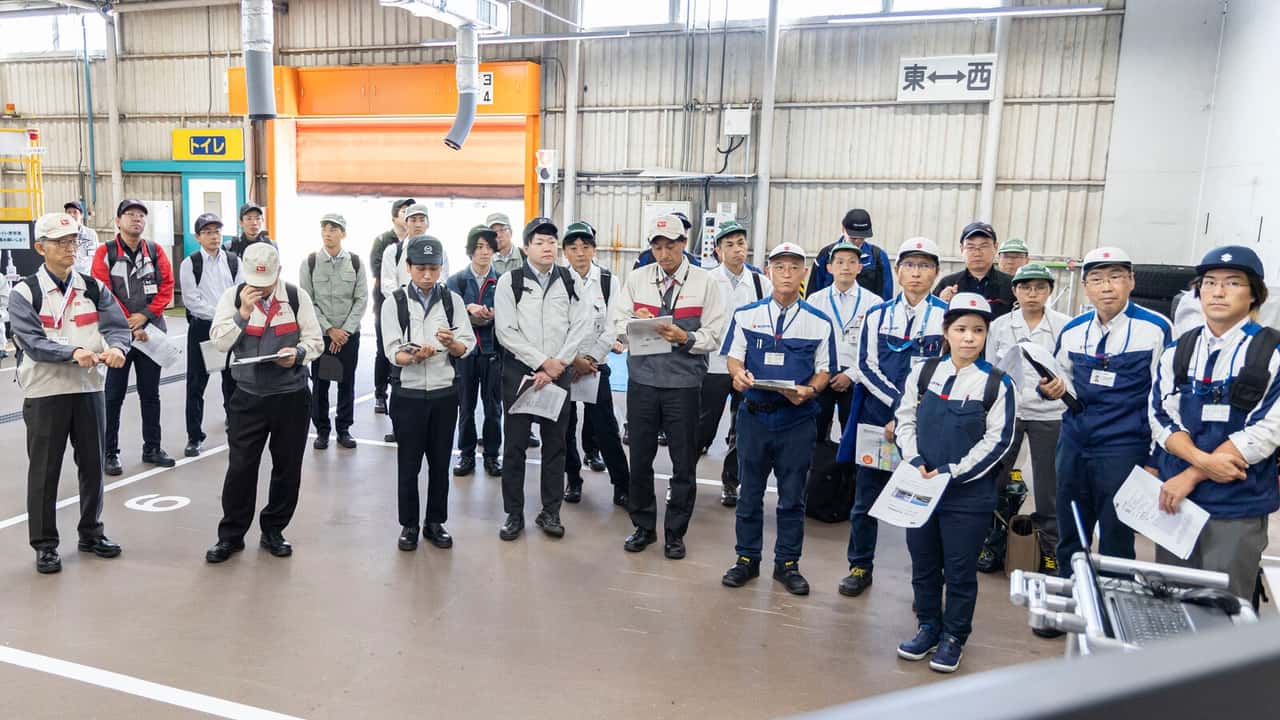
Toyota, Honda, Mazda, Suzuki, and Mitsubishi are sharing ideas on quality standards in an unusual display of cooperation.
You don’t see Toyota, Honda, Mazda, Suzuki, and Mitsubishi hanging out together without a racing helmet or a joint venture agreement getting in the way every day. But that’s exactly what happened in Japan this summer, when rival automakers gathered at Toyota’s Tahara factory to talk about something surprisingly mundane: quality standards.
More than 100 automotive industry professionals showed up for an unusual meeting in late July. Toyota’s quality-control teams and suppliers were joined by purchasing and quality personnel from its domestic rivals. Rather than arguing about who makes the better car, they looked at individual parts and discussed how manufacturers can make their production processes more efficient.
The gathering was part of Toyota’s Smart Standard Activity, or SSA, an initiative that dates back to 2017. The idea is fairly simple: don’t waste time and money rejecting or reworking parts over cosmetic imperfections that customers don’t actually care about (or do they?), while still fixing issues that genuinely affect quality.
Toyota, Honda, Mazda, Suzuki, and Mitsubishi joint meeting
For example, one rear-seat air-conditioning vent had tiny scuff marks on the underside of its vanes. The blemishes didn’t affect functionality and couldn’t even be seen from the normal seating position. Toyota therefore decided the part was perfectly acceptable rather than sending it to the scrap bin. That might sound like a small thing, but accountants would argue that if you multiply it across millions of components and thousands of suppliers, the savings can add up quickly.
The more interesting part is that Toyota eventually realized it couldn’t solve the problem by itself. Suppliers often build parts for several automakers, and each manufacturer can interpret what constitutes an acceptable component differently. That means a supplier producing parts on the same production line can end up following different requirements depending on which automaker is buying the part. It’s really that complex.
Toyota began working with other automakers on the issue about four years ago, and the industry has since taken things a step further. In April 2025, the Japan Automobile Manufacturers Association (JAMA) and Japan Auto Parts Industries Association (JAPIA) established a joint SSA working group. Earlier this year, they issued an SSA Promotion Declaration, effectively turning what started as a Toyota initiative into something much bigger.
Toyota, Honda, Mazda, Suzuki, and Mitsubishi joint meeting
It is somewhat unorthodox, given how automakers spend enormous amounts of time trying to differentiate themselves from one another. Toyota doesn’t want to build cars like Honda, Honda doesn’t want to build cars like Mazda, and none of them want to make life easier for a rival unless there’s something in it for them. Yet they’re now cooperating in areas where they don’t actually compete.
As you can imagine, the joint working group deliberately avoids sensitive subjects such as pricing, production volumes, transaction terms, in-house tech, and other finer details. Instead, it focuses on non-competitive areas such as appearance quality and manufacturing processes.
In other words, Toyota isn’t handing Honda the keys to the next-generation GR Supra, and Mazda isn’t giving Suzuki the secret recipe for the next Miata. They’re discussing things like whether a tiny mark on a plastic component actually matters. In 2026, every cent (well, yen) saved matters more than ever.
The automotive industry faces enormous pressure to cut costs, improve productivity, reduce waste, and manage increasingly complex supply chains. Having every automaker solve the same problems independently doesn’t make much sense when many rely on the same suppliers.
Toyota, Honda, Mazda, Suzuki, and Mitsubishi joint meeting
Toyota says its own SSA program had accumulated roughly 7,500 cases by the end of 2025, with 67 percent of proposals adopted. The company believes expanding the approach across the industry could make the Japanese automotive supply chain more competitive at a time when Chinese carmakers have become a real global threat.
It doesn’t mean that every Japanese automaker suddenly adopts one giant universal quality standard. Each company remains responsible for its own processes. The idea is to identify common problems, share solutions, and avoid making suppliers reinvent the wheel for each of the five Japanese brands. That’s a sensible approach in an industry where cooperation between competitors is usually limited to what absolutely requires it.
Toyota’s own people seem to understand the unusual nature of what they’re trying to do. The company’s stated goal is essentially to figure out where automakers should compete and where they should cooperate. There’s even talk of turning SSA into an “All-Japan” movement involving the country’s entire automotive industry, which Toyota estimates employs around 5.5 million people. The initiative is also spreading beyond Japan, with dedicated SSA activities already underway in North America and being expanded in Europe and Asia.
At the end of the day, Toyota, Honda, Mazda, Suzuki, and Mitsubishi aren’t about to form some giant Japanese super-company, although how interesting would that be? Anyway, they’re still very much rivals. But seeing so many of them gather around the same table to inspect the same parts and share manufacturing ideas is unusual. In an industry obsessed with beating the competition, sometimes the smartest move might be figuring out what not to compete over.
Toyota has taken a similar approach with engines, too. In 2024, it teamed up with Mazda and Subaru to develop next-generation combustion engines, but the three companies aren’t simply going to share one generic powertrain. Instead, each automaker is keeping its own “signature” technology: Toyota is developing new inline-four engines, Mazda is sticking with its rotary, and Subaru is working on its boxer.
More On Car Quality:
Source:
Toyota Times
We want your opinion!
What would you like to see on Motor1.com?
– The Motor1.com Team