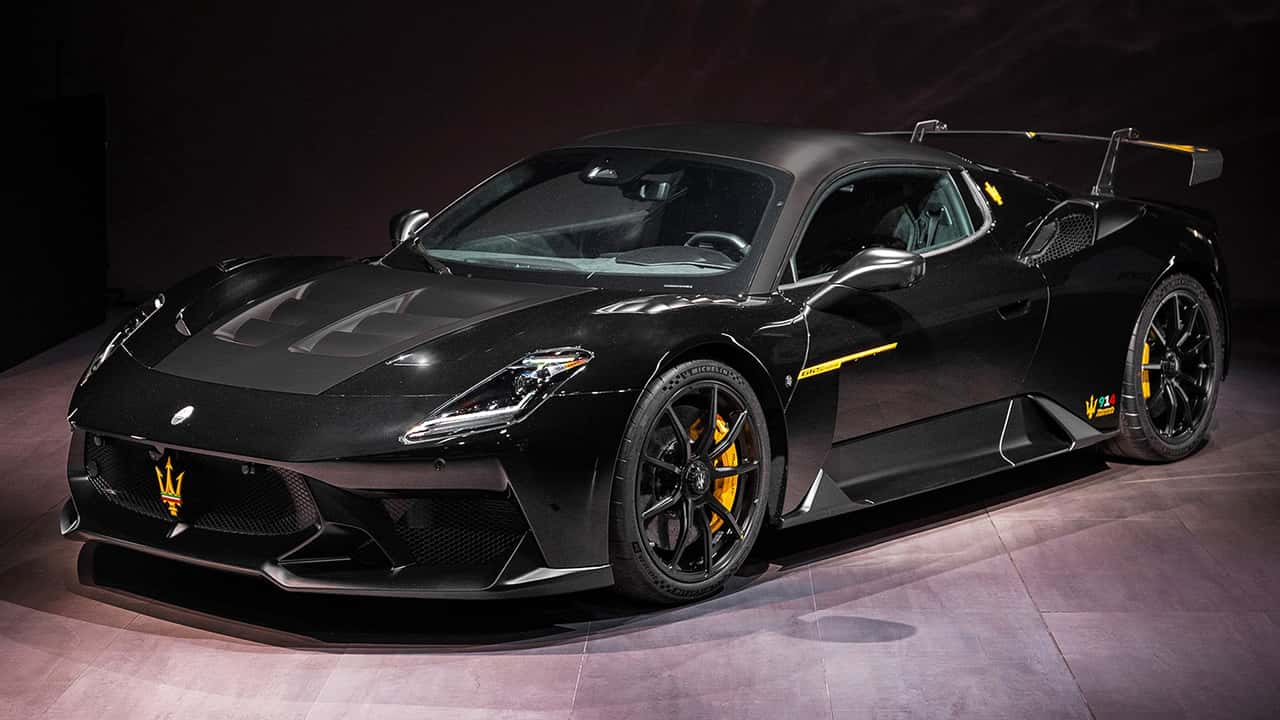
Antonio Filosa also rules out separating Euro and American brands.
Maserati isn’t going anywhere, at least not under Stellantis CEO Antonio Filosa. Despite persistent rumors about a possible sale of the struggling Italian luxury marque, the executive has reiterated that the company has no plans to sell it. He also dismissed the idea of splitting the group’s European and American brands, insisting that all 14 nameplates have a role to play within the sprawling automotive group.
Speaking with Bloomberg Television at the 2026 Paris Motor Show this week, Filosa was unequivocal when asked about Maserati’s long-rumored sale, responding, “Not at all.” It’s not the first time Stellantis has had to address speculation about the Trident brand’s ownership, but the latest comments reinforce the company’s intention to keep Maserati under its umbrella.
Rumors about a potential sale are hardly surprising. Maserati has struggled to find its footing in recent years, with declining sales and questions about its long-term future putting the fabled Italian marque under increasing pressure. Stellantis has also explored ways to improve the brand’s prospects, including discussions with potential partners, but that doesn’t mean it’s preparing to sell it.
Maserati MC Pura
For now, Maserati remains part of the group’s luxury portfolio. The bigger question is whether Stellantis can give the brand a clearer direction and the products it needs to regain momentum in an increasingly competitive market. To that end, Stellantis has already hinted at closer ties between Alfa Romeo and Maserati, with the two brands expected to work more closely together.
The idea is to capitalize on their shared heritage and premium positioning while cutting development costs and lead times through greater engineering collaboration. Both brands face an uphill battle in a crowded luxury market, so sharing resources could help Stellantis make better use of its investment without sacrificing their distinct identities. For Maserati in particular, closer cooperation with Alfa Romeo could prove useful as the Trident tries to regain momentum without changing hands.
Maserati GT2 Stradale
Filosa was just as firm about another idea that has surfaced amid Stellantis’ challenges: separating its European brands from its American marques. The CEO called such a move “not plausible at all,” arguing that the company benefits from developing key technologies globally rather than treating its regional divisions as separate businesses.
That shared approach covers everything from powertrains to platforms, which underpin vehicles sold under different badges. Fiat, Peugeot, Citroën, Opel/Vauxhall, Lancia, DS Automobiles, Abarth, Alfa Romeo, and Maserati operate alongside Jeep, Ram, Dodge, and Chrysler, with each brand expected to serve a distinct purpose. According to Filosa, all 14 brands play a unique role in the group’s strategy.
Of course, keeping all those nameplates under one roof doesn’t mean every brand will receive the same level of investment. Stellantis is reviewing how it allocates spending across its portfolio, particularly because several brands compete for similar customers. Its updated strategy prioritizes five key areas: Jeep, Ram, Peugeot, Fiat, and the Pro One commercial vehicle business.
The challenge is to maximize shared development costs without turning the lineup into a collection of rebadged vehicles. Stellantis needs each brand to retain its identity while benefiting from economies of scale, a balancing act that becomes particularly important as Chinese automakers ramp up competition in Europe and other markets.
The company is also pursuing partnerships to use its manufacturing capacity better. Collaborations with Chinese automakers Leapmotor and Dongfeng could help Stellantis fill underused European factories without resorting to plant closures, while expanding its access to electrification technology.
Still, Stellantis has plenty of work ahead. The automaker posted an enormous €22.3 billion net loss in 2025, and its shares have come under heavy pressure this year. Filosa told Bloomberg the group has already passed the point of returning to profitability, but the real test will be translating that confidence into sustained financial improvement.
For now, the message from the top is clear: Maserati stays, the European and American brands stay together, and Stellantis will try to make the whole group work better as one. Whether that strategy delivers remains to be seen.
More From Stellantis:
Source:
We want your opinion!
What would you like to see on Motor1.com?
– The Motor1.com Team