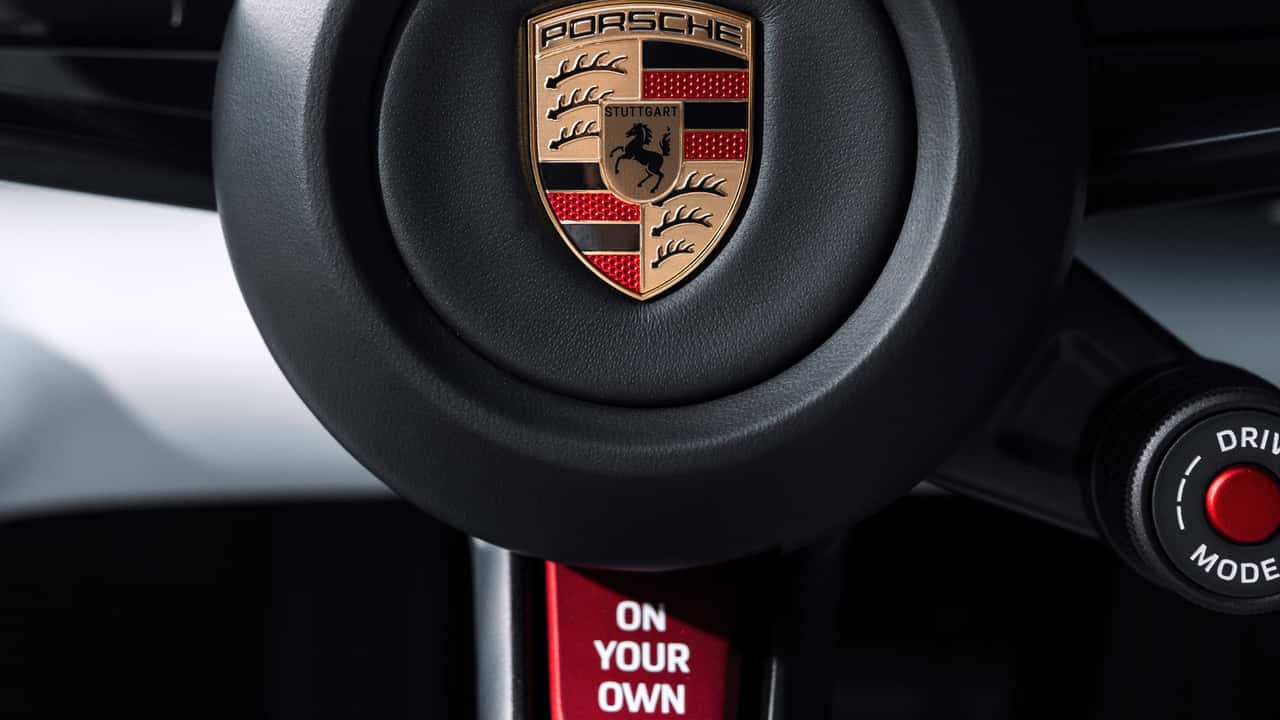
The Mission S puts the driver first, blending old-school sports-car charm with modern technology.
Porsche’s new Mission S concept previews a future flagship supercar, but some of its most interesting features have nothing to do with horsepower or top speed. Instead, the German automaker has focused on how drivers interact with their cars, creating a cockpit that blends old-school sports car details with clever modern technology.
We still don’t know much about the new supercar, but Porsche has made it clear that the production version will sit above the 911 and become a permanent member of the lineup, not a limited-run special. And no, this isn’t just another 911 variant. Its mid-engined layout is just one of several things that make it different.
Here are the most interesting details we uncovered after taking a closer look at Porsche’s upcoming flagship.
Porsche Mission S with ‘On Your Own’ button
Modern cars are increasingly eager to intervene, whether by nudging the steering wheel, adjusting the speed, or warning the driver about something happening nearby. The Mission S offers a rather appealing shortcut for those who would rather take matters into their own hands.
A dedicated red button on the steering wheel activates the “On your own” driving mode and switches off the driver assistance systems. It’s a straightforward idea that puts the driver in charge without forcing them to navigate multiple menus.
Every car (okay, maybe not all of them) should have a button to deactivate driver-assistance systems. As the years go by and new cars launch, these systems tend to get even more intrusive, until they inevitably become straight-up annoying. Porsche has a simple yet brilliant fix.
Porsche Mission S uses the smartphone as the infotainment
For anyone who thinks modern car interiors have become too obsessed with giant displays, the Mission S doesn’t have a permanently integrated central touchscreen. There’s no passenger display, either.
Instead, Porsche has developed a retractable smartphone holder compatible with Apple’s MagSafe technology. Your phone can serve as a navigation or information display when needed, then disappear when you want to concentrate on driving.
The My Porsche app gives owners access to the car’s functions and lets them customize the digital instrument graphics with designs inspired by the company’s heritage.
It’s an interesting alternative to the industry-wide race to install ever-larger screens. Porsche isn’t abandoning digital technology; it’s simply trying to make it less intrusive. And if you already carry a smartphone, why force you to use another screen for functions your device can handle? This feature is hardly new within the Volkswagen Group, having been used many years ago on the VW up! Fun fact: the humble Dacia models have this setup in the entry-level trim.
Porsche Mission S with adjustable gear shift lever
The Mission S also features a height-adjustable gear lever designed around tactile feedback. Porsche wants the driver to physically feel the interaction rather than treat gear selection as another digital command.
While the concept uses a PDK, Porsche has already confirmed it’s engineering the supercar’s platform to support a manual gearbox as well. Whether a third pedal makes it to the production car will ultimately depend on how many customers ask for one.
It’s encouraging to see Porsche thinking about the physical experience of driving. At a time when some automakers are replacing conventional controls with touch-sensitive surfaces, a substantial gear lever feels like a deliberate statement. Ideally, a proper manual is on the way.
Porsche Mission S with aluminum key
Car keys have become increasingly anonymous, often reduced to plastic fobs that look like household appliances. Porsche wants to make owning its future flagship feel a little more special.
The Mission S comes with a specially designed aluminum key that emphasizes the tactile connection between driver and machine. It slots into a dedicated holder to the left of the steering wheel, following a traditional Porsche layout rooted in endurance racing. Zuffenhausen removed this feature from the 911 facelift, so it’s nice to see it back.
It’s a small detail, but one that fits the car’s broader philosophy. Before the engine even starts, the key is meant to make the driver feel that they’re about to do something far more interesting than commute to work.
Porsche Mission S dials
The Mission S might ditch the central touchscreen, but that doesn’t mean it cuts corners on technology. Its five round instruments blend traditional sports-car styling with digital functionality, and they’re more than just graphics behind the steering wheel.
The central tachometer features an actual analog needle, with a digital display behind it. Depending on the selected driving mode, the tachometer physically moves closer to the driver, making engine speed easier to monitor.
The other round instruments also rearrange themselves. Depending on the mode, they sit side by side or move behind one another, changing the cluster’s layout to suit the driving situation.
It’s a clever way of making digital technology feel mechanical. Rather than merely changing on-screen graphics, Porsche designed a display that physically responds to the driver’s preferences, a feature that reminds us of the Lexus LFA.
Porsche Mission S seat with integrated seatbelt buckle in the center
This is the sort of detail you might overlook at first glance. Still, it says a lot about how Porsche approaches the Mission S. The sports seats feature an integrated seatbelt buckle in the center bolster, giving the seating arrangement a cleaner appearance while drawing inspiration from motorsport. Porsche has also repositioned the electric seat-adjustment controls.
The idea is to combine everyday usability with the purposeful feel of a competition car. Rather than adding decorative, racing-inspired touches for their own sake, Porsche has rethought the seat layout and its controls.
Whether the integrated buckle makes it to a production car remains to be seen, but it’s an unusual solution in an industry where many interior details are becoming increasingly standardized.
The Central Rear Fan Is A Functional Throwback To Porsche’s Past
The Mission S has a central rear fan that pays tribute to the legendary 917. Rather than adding a retro design flourish just for show, Porsche has incorporated a functional cooling solution inspired by the race car, blending motorsport heritage with the supercar’s futuristic styling.
It’s another example of how Porsche draws on its history while developing a new flagship that will sit above the 911. The original 917 helped cement the brand’s reputation in endurance racing, and the Mission S reinterprets that motorsport heritage with a modern take on a distinctive technical feature.
The fan also fits the concept’s broader philosophy: make functional components part of the design rather than hiding them away. As the saying goes, if you’ve got it, flaunt it.
For a closer look at the Mission S and the thinking behind its most interesting design details, check out the walkaround video below. Tobias Sühlmann, Head of Style at Porsche, takes us around the concept, explains the ideas shaping the brand’s future flagship, and highlights clever touches that might otherwise go unnoticed.
We want your opinion!
What would you like to see on Motor1.com?
– The Motor1.com Team