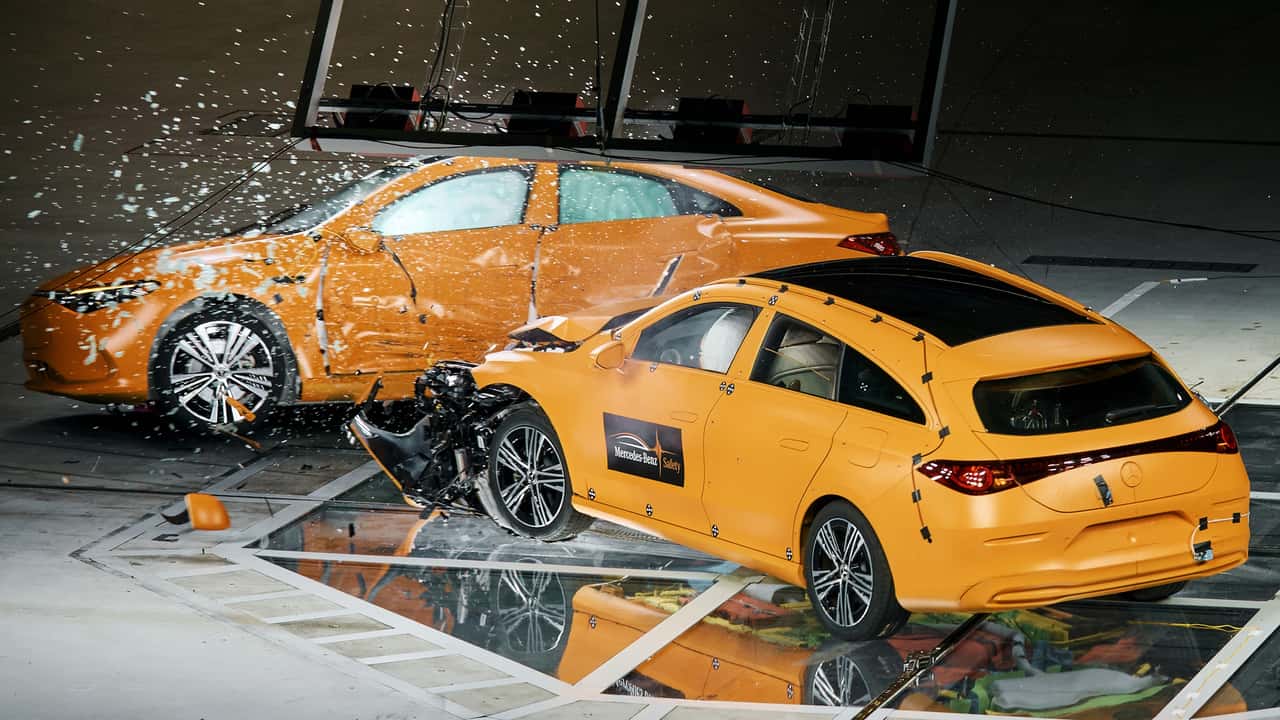
Engineers ram a hybrid CLA Shooting Brake into an electric CLA at 35 mph to watch occupant injuries and the high-voltage battery response.
Mercedes-Benz drove two CLA models into each other on purpose at 56 km/h (35 mph) with nobody touching the brakes. The automaker calls it the world’s first public high-speed side-impact test between two moving production vehicles.
A hybrid CLA Shooting Brake struck the driver’s side of a fully electric CLA, recreating a T-bone collision at an intersection. Each car weighed around two tonnes. Eight crash-test dummies rode inside to measure what the impact did to the people.
Mercedes-Benz CLA High-Speed Crash Test
The setup mirrored a real intersection crash with one car running perpendicular into the side of another, both moving, neither braking. The impact speed was 56 km/h, or about 35 mph. Mercedes-Benz describes that as the upper end of typical intersection crashes.
Mercedes-Benz says the passenger compartments of both CLA models stayed intact after the hit. That is the basic goal in any side-impact crash test, a cabin that holds its shape instead of folding in on the people inside.
“Mercedes-Benz’s ambition is to build the safest vehicles in the world,” said Jörg Burzer, the company’s chief technology officer for development and purchasing. He called the test “a powerful demonstration of that ambition” and presented it as proof the automaker designs for how crashes actually happen.
Paul Dick, Mercedes-Benz’s director of vehicle safety, linked the test to the brand’s long-running habit of feeding real crash lessons back into new designs. He calls that approach “Real-Life Safety” and says the two-CLA demo shows it working in practice. The company has reconstructed roughly 6,000 real-world accidents since 1969 for exactly this kind of development work.
The eight dummies represented four adults and four children, seated to capture how the impact loads differ by size and position. Every reading came back below the biomechanical limits Mercedes-Benz uses to judge occupant protection.
That is the headline result behind the electric CLA‘s structure. The battery was the real question mark going in, since a side impact aims straight at the pack sitting under the floor. Mercedes-Benz reported the high-voltage battery stayed intact with no breach of its cells.
The electric CLA’s high-voltage system also disconnected automatically on impact, a safeguard meant to cut electrical risk for occupants and first responders the moment a crash happens. Combined with an undamaged pack, that’s the result an automaker needs before it can call a T-bone survivable.
This single test sits inside a much larger program. Mercedes-Benz runs around 150 physical crash tests and roughly 15,000 crash simulations for every new model, well past what regulators require. Regulatory and consumer programs usually fire a moving barrier into a stationary car. This public demo used two moving vehicles to showcase that wider, mostly hidden validation effort.
Watch More Crash Tests:
Source:
Mercedes-Benz
We want your opinion!
What would you like to see on Motor1.com?
– The Motor1.com Team