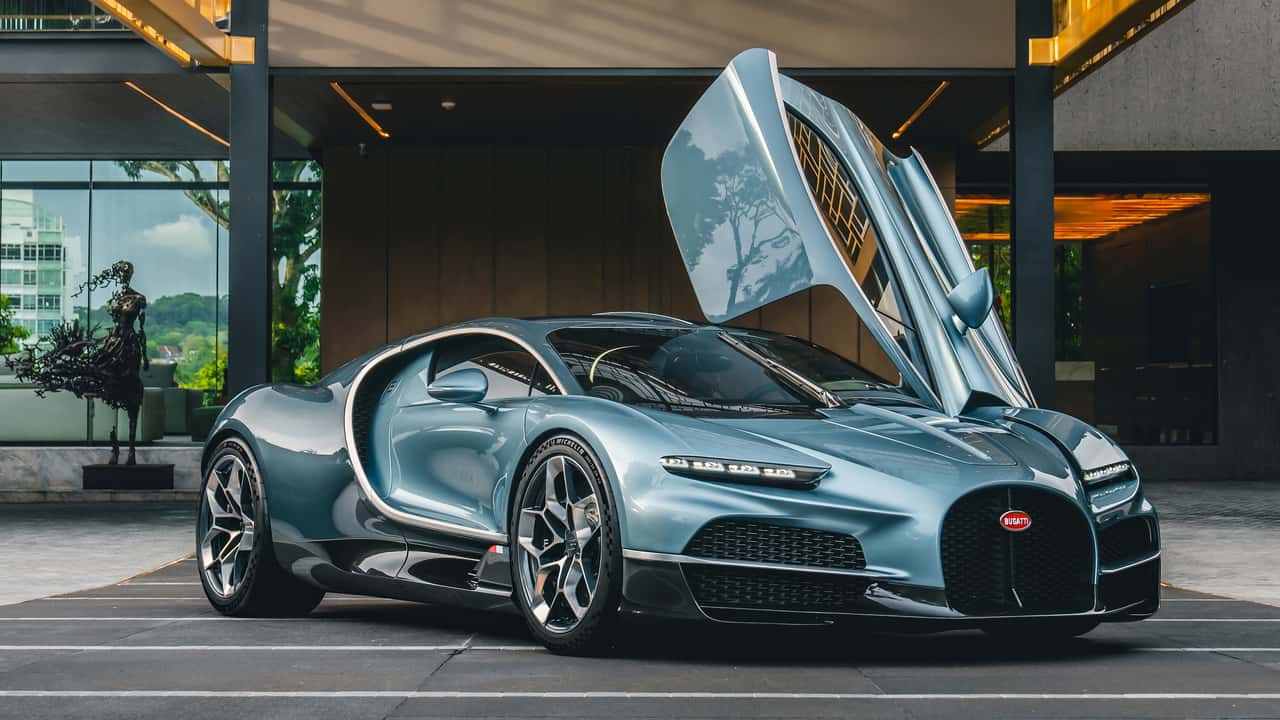
Bugatti’s former owner envisioned an electric successor to the Chiron before Rimac intervened.
The Volkswagen Group wanted Bugatti’s Chiron successor to be electric. Still, Mate Rimac pushed for a different approach: a clean-sheet design with a naturally aspirated V16 engine at the heart of a hybrid setup. His experience with the Nevera convinced him that demand for ultra-expensive electric hypercars was too limited to justify turning Bugatti’s flagship into a pure EV.
When Rimac took control of Bugatti alongside Porsche in 2021, the VW Group was moving aggressively toward electrification in the wake of the messy and immensely costly Dieselgate. In theory, an electric hypercar would have aligned with that strategy while allowing the French marque to benefit from Rimac’s expertise in high-performance electric powertrains.
However, Rimac wasn’t interested in taking the easy route. As he explained in an interview with Automotive News Europe, the quickest and most cost-effective solution would have been to put a Bugatti badge on the Nevera and call it a day. Instead, he wanted a completely different product that would offer customers something they couldn’t get from his own electric hypercar brand.
Bugatti Tourbillon’s V16 engine
‘When we started discussing with VW about our ownership of Bugatti and the future of Bugatti, they were pushing me to make the next Bugatti electric. I had an electric car platform already for the Nevera, which offered four-wheel drive, a 400-km/h top speed and the comfort of a cruiser that could be driven long distances.
On paper, it could be Bugatti [on the Nevera’s platform], right? Plus, it would be a lot easier than doing a completely new car with a new combustion engine. However, that is what I ended up doing with the Tourbillon because based on the feedback from the market on the Nevera I realized the market was going in a different direction. Thanks to the Nevera, we recognized this very early and we decided to make the Tourbillon a V16 plug-in hybrid, which was absolutely the right decision.’
The Nevera’s relatively slow sales reinforced his conviction. Although the 1,914-horsepower EV showed what electric performance could achieve, wealthy customers weren’t necessarily looking for another battery-powered machine, no matter how fast it was. Mate Rimac recently revealed on Instagram that only 71 Neveras had been sold, despite a planned production run of 150 units.
His determination to preserve the internal combustion engine in Molsheim’s next hypercar helped pave the way for the Cosworth-powered Tourbillon, giving Bugatti a distinct identity from Rimac Automobili. While the Nevera showcases the extreme performance possible with a fully electric powertrain, the Tourbillon combines electrification with the sound, character, and mechanical drama of a sixteen-cylinder engine.
Bugatti Tourbillon rear
For this clientele, exclusivity and emotional appeal matter just as much as outright performance. A battery-powered hypercar can deliver astonishing acceleration, but a bespoke V16 offers a different kind of experience.
The VW Group may have envisioned an electric future for Bugatti, but Rimac chose a different path. Rather than turn the Nevera into a French-badged EV, he developed a new flagship that keeps the combustion engine alive while embracing electrification on its own terms.
The strategy appears to be paying off, with all 250 Tourbillons already spoken for. Bugatti Rimac developed the hypercar without VW or Porsche involvement, according to Rimac. Porsche recently ended its involvement altogether, selling its stakes in Bugatti Rimac and Rimac Group in early September.
That marks the end of an era that began under Ferdinand Piëch, but Rimac sees a bright future for Bugatti:
‘There are so many cool Bugattis we have planned in the product portfolio. We know what we want to bring to the market for the next 10 years. I’m so excited. I can’t wait to show this to the world because what we are doing is incredible. It’s fine art on four wheels. With the independence that we have now and the freedom I have to run the company, I think it will be so enriching to the auto industry and enthusiasts of the world to see these cars.’
The most intriguing question is what those future Bugattis will actually look like. With Rimac promising a decade’s worth of new models, it’s hard to imagine every one of them being a multi-million-euro hypercar. There could be room for a more practical grand tourer like a spiritual successor to the five-door Galibier liftback, giving Bugatti a broader lineup without sacrificing its exclusivity. Whatever Rimac has planned, the prospect of a more independent Bugatti exploring new segments is certainly exciting.
Even with Bugatti out of the picture, the VW Group is still catering to the supercar crowd with Lamborghini, Audi’s Nuvolari, and the Porsche Mission S concept, which will become a permanent model above the 911.
More From Bugatti:
Source:
We want your opinion!
What would you like to see on Motor1.com?
– The Motor1.com Team