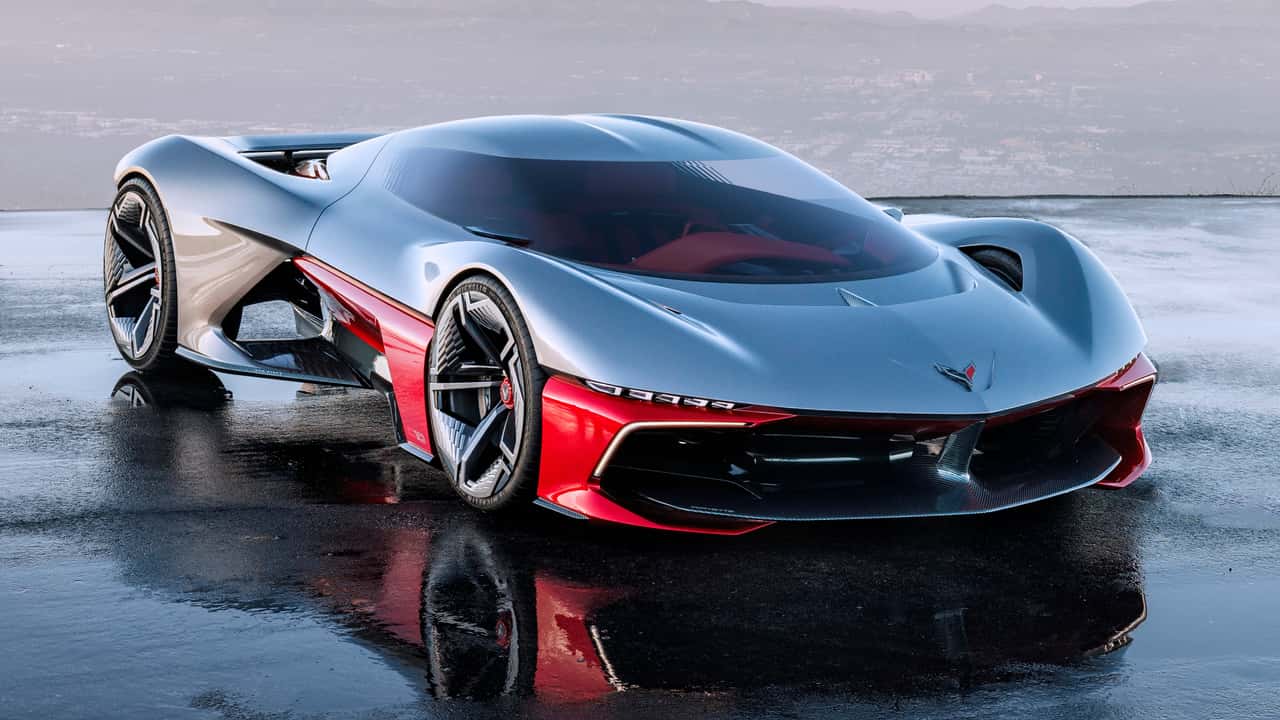
Tony Roma wants the next Chevrolet Corvette to outperform the C8 while keeping pricing clear of Ferrari and Lamborghini territory.
General Motors has drawn a line on how far the C9 Corvette can climb upmarket. Corvette chief engineer Tony Roma told The Drive the next generation has to beat the C8 on performance without turning into a prestige-priced exotic.
Roma has emphasized that stance as the C8 lineup expands. The current car already runs from a relatively attainable base model to a flagship that brushes supercar money, and he wants the next generation to keep the gap between entry-level and halo versions, not bridge it with a single sky-high price.
Chevrolet Corvette Concept Advanced Design Center Pasadena
Roma’s comments arrive while GM is still finishing the C8 range, which already spans a wide price ladder. The 2027 Corvette Stingray starts at $73,795 including destination, and the lineup tops out with the ZR1X at $227,695.
Even with the mid-engine layout, Roma is pushing back on the idea that Chevrolet has to chase Lamborghini and Ferrari sticker for sticker. A Corvette is still meant to be the value play in this space, not a car priced just because the engine moved behind the seats.
The 2027 model year already shows where GM’s engineering effort is going. The Grand Sport and Grand Sport X join the range, with the hybrid Grand Sport X replacing the E-Ray.
Grand Sport X pairs the sixth-generation LS6 small-block V8 with a front-mounted electric motor for all-wheel drive. The layout keeps electrification in the mix while building on GM’s own engine family.
The C9 will likely keep the dual-clutch transaxle, even though Roma personally wants something else. “I would love it as a driver, as a customer, I would love it. I just do not know if we can make it make sense,” he said of a manual gearbox.
A manual for a mid-engine Corvette is not a parts swap onto an existing case. The C8’s transaxle sits behind the engine, with the clutch pack and gear sets built around dual-clutch operation from the ground up.
Retrofitting a clutch pedal, linkage and a new gear case means new tooling, durability validation and emissions certification. It is the same three-step cost stack that applies to any new driveline, manual or not.
Roma noted the old front-engine manual setup took roughly 30 years to develop and refine. That timeline shows how much engineering sits behind what looks like a simple shifter and pedal.
“Transmissions are super expensive,” Roma said. He was openly skeptical that an aftermarket solution, like a Tremec gearbox adapted after the fact, could clear production validation.
Roma called manual demand part of a cyclical pattern in the industry: real, but not large enough to justify a cost that works against the value positioning he is defending for the C9.
More On Corvette:
Source:
We want your opinion!
What would you like to see on Motor1.com?
– The Motor1.com Team