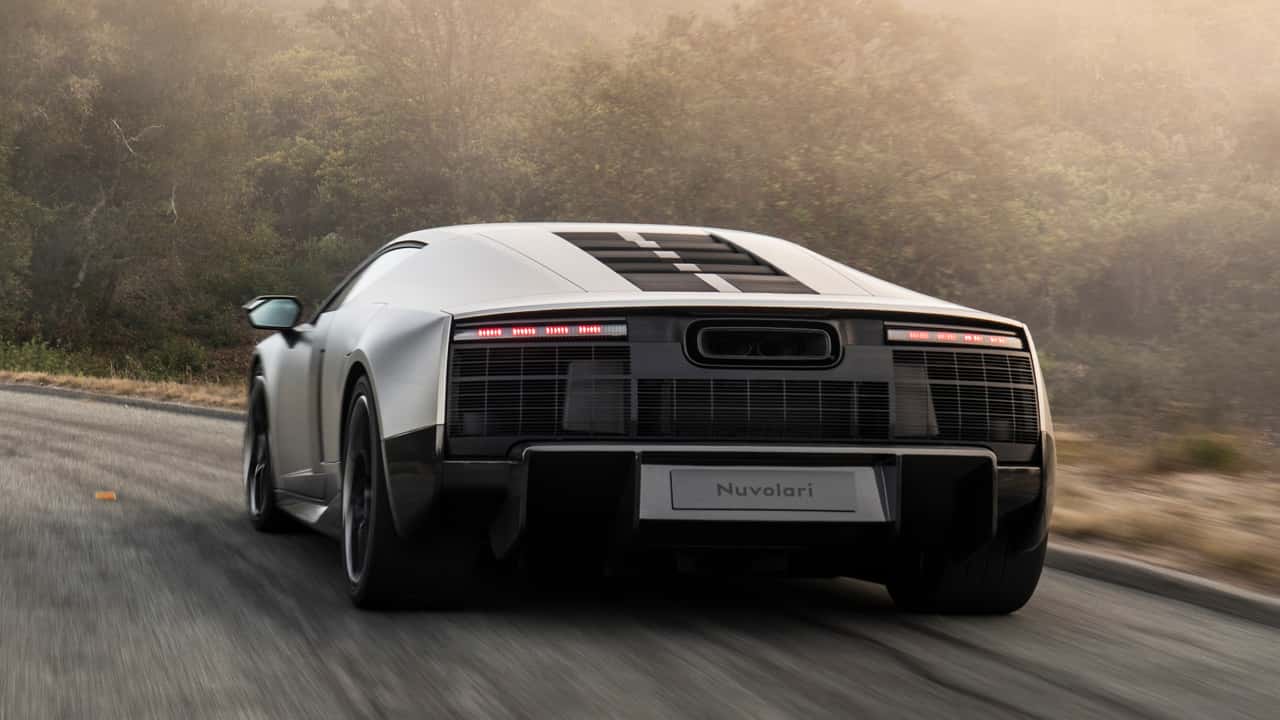
From F1-inspired aero to a carbon body, Audi says the Nuvolari brings plenty of upgrades over its Italian cousin.
Audi has some explaining to do when it comes to the Nuvolari’s eye-watering price tag. At approximately $700,000, the new supercar costs roughly $300,000 more than the Lamborghini Temerario it’s based on. So, what exactly does that extra money buy?
I put that question to Mark Dahncke, Director of Communications at Audi of America, and received a fairly extensive list of upgrades that set the Nuvolari apart from its Italian cousin. According to Audi, the differences go well beyond the design and the Four Rings, which are special in their own right. These aren’t ordinary badges: they’re milled from aluminum and integrated into the rear spoiler.
The company points to a full carbon-fiber exterior, a material more commonly associated with full-fledged hypercars, as a major differentiator. Buyers can also opt for exposed carbon-fiber bodywork. By contrast, its counterpart from Sant’Agata Bolognese sticks to the supercar norm with an aluminum body.
But here’s the kicker: the Temerario is actually still the lighter car. Lamborghini’s raging bull has a dry weight of 3,759 pounds (1,705 kilograms), compared with the Nuvolari’s 3,858 lbs (1,750 kg). The difference widens with the Lambo’s Alleggerita package, which sheds a further 55 lbs (25 kg).
2026 Lamborghini Temerario
Then there’s the active, Formula 1-inspired aero, which generates more than 882 lbs (400 kg) of downforce. Audi tells us that’s more than the Temerario is capable of, even if the latter has an optional Alleggerita pack that adds 67 percent more downforce than the base model. The Nuvolari’s aero advantage translates into “much faster lap times,” though we can’t imagine many owners taking their supercars to the track.
The Nuvolari is also the more powerful of the two. Although the twin-turbo 4.0-liter V8 produces the same 789 hp and 538 lb-ft (730 Nm) in both cars, the Audi’s combined output is higher once the three electric motors are factored in. Audi rates its R8’s spiritual successor at 987 hp, matching the original Bugatti Veyron. Meanwhile, Lamborghini’s Temerario makes do with “only” 908 hp.
The Nuvolari also has a slight performance edge over its Lamborghini counterpart. Audi quotes a 0-to-62-mph (100-km/h) sprint of 2.6 seconds, making it a tenth of a second quicker than the Temerario’s 2.7-second run. The Audi also has a higher top speed, exceeding 217 mph (350 km/h), compared with the Lamborghini’s 213 mph (343 km/h). Those aren’t massive differences on paper, but they give the Nuvolari another couple of bragging rights over its Italian cousin.
Although both cars come with carbon-ceramic brakes hugged by ten-piston front and four-piston rear calipers as standard, the discs are larger on the Audi. The Nuvolari gets 420 × 40 mm front and 410 × 32 mm rear discs, compared with the Temerario’s 410 × 38 mm and 390 × 32 mm setup.
Lamborghini Temerario
Audi Nuvolari
Audi told us the Nuvolari is its first car to feature a new Quattro predictive ride setup. This upgraded vehicle-dynamics system builds on the technology used in the Lamborghini. A central 6D movement sensor continuously monitors the car’s behavior and anticipates grip changes, allowing the system to coordinate the three electric motors, brakes, and active aerodynamics to maintain stability.
It can adjust torque distribution between the wheels and selectively apply the brakes to reduce wheel slip, while the front electric motors enable precise torque vectoring through corners. In other words, Audi has taken the Temerario’s already sophisticated vehicle-dynamics package and developed it further to help the Nuvolari stay composed under high lateral forces and on slippery surfaces.
Audi has also focused on the cabin, promising high-quality materials at every touchpoint. The driver-focused interior features anodized aluminum switchgear, door handles, and air vents. It’s a taste of things to come, as the company vows to improve interiors in future production models after admitting quality had slipped. Aside from nicer materials, expect more physical buttons and smaller screens.
There’s also the exclusivity factor. Production is limited to 499 units, of which just 182 are coming to the United States, making the Nuvolari exceptionally rare. The Temerario, on the other hand, has a long life ahead of it, given that its predecessors lasted many years. Both the Huracan and the Gallardo before it had a 10-year production run, so it’s reasonable to assume the newest model will remain on sale well into the early 2030s.
Lamborghini built just over 24,000 Huracans and 14,000 Gallardos, so the Temerario is more than likely to rack up a five-digit production run as well. That makes the Nuvolari’s limited run of 499 units look even more exclusive. While the Audi will be the more exotic supercar, its Lamborghini counterpart is expected to become a much more familiar presence over the coming years.
Nuvolari Vs. Temerario:
In other words, Audi wants the Nuvolari to be considerably more than a rebodied Temerario with a different badge. The company is pitching it as a more powerful, more aerodynamic, more extensively carbon-fiber-clad machine with bespoke hardware and a fancier interior.
Whether those changes justify a roughly $300,000 premium is another question entirely. After all, for $700,000, Lamborghini will happily sell you a V12-powered Revuelto. But at least Audi has now provided a detailed explanation of where it believes the extra money goes.
Of course, it’s easy to imagine future Temerario derivatives gaining more power, additional aerodynamic upgrades, and other tweaks that could help it catch up with its Audi sibling.
We want your opinion!
What would you like to see on Motor1.com?
– The Motor1.com Team