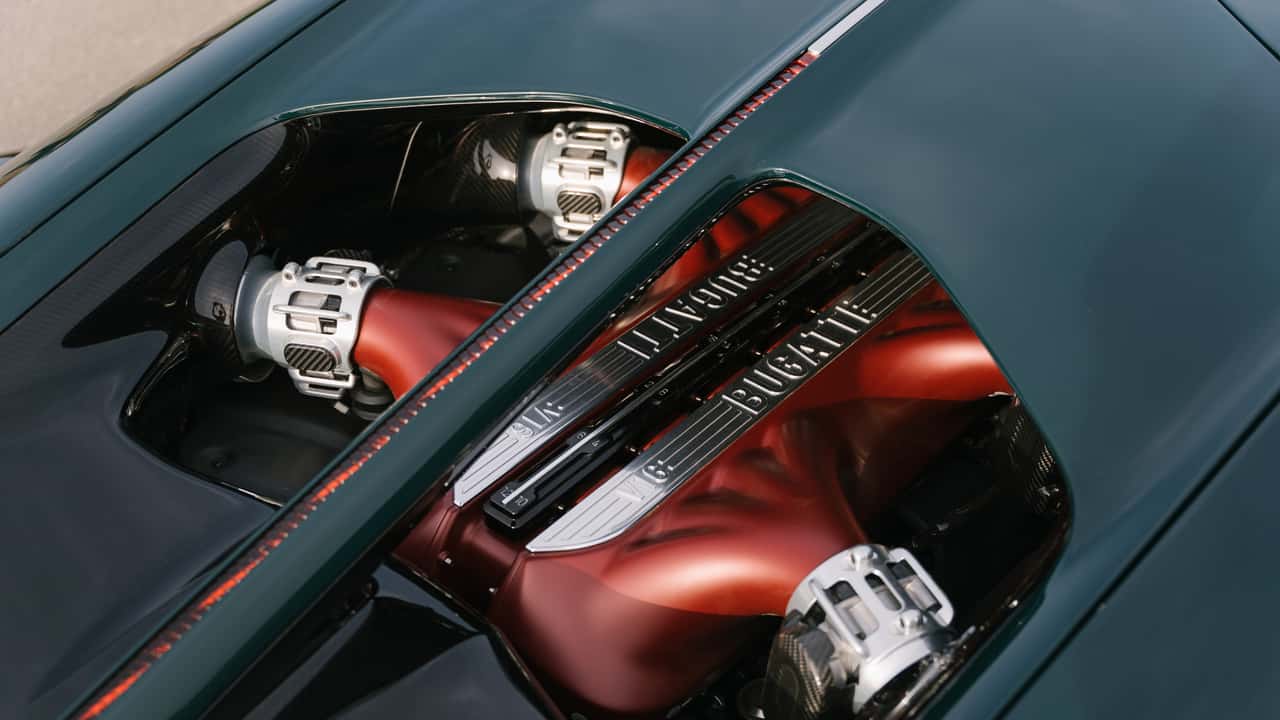
The company knows its new 8.3-liter engine doesn’t have the cleanest sound, but that’s part of its character.
The W16 is dead. Long live the V16. After more than two decades of powering Molsheim’s outrageous production cars, Bugatti’s legendary W16 has finally gone out of production. The final Mistral was completed a couple of months ago, officially bringing the curtain down on an engine that debuted with the Veyron and continued in the Chiron.
That would normally be the end of the story. Instead, Bugatti has done something that seems impossible to justify in today’s automotive landscape: it replaced one 16-cylinder engine with another. The Tourbillon’s naturally aspirated 8.3-liter V16 was co-developed with Cosworth and produces 1,000 horsepower, redlining at 9,000 rpm.
But building a V16 is one thing. Getting one to sound the way Bugatti wants while satisfying today’s increasingly stringent noise regulations is something else entirely. A new video released this week shows just how much work went into giving the all-new engine its own soundtrack, without resorting to artificial trickery such as pumping fake noise through the speakers.
The engineers didn’t simply develop an obnoxiously loud exhaust (with up to eight tips) and call it a day. They ran thousands of simulations involving the intake and exhaust systems to find the right balance between performance, refinement, and the mechanical character Bugatti wanted. The Tourbillon needs to be civilized when driven normally, particularly when the V16 isn’t doing much of the work.
But when the driver floors it, the engine needs to communicate what is happening mechanically. The end result isn’t the cleanest-sounding engine, but that was never the point:
‘Bugatti, from a sound perspective, has never had a very clean-sounding engine. It has always been a little bit dirty and raw, so we decided to keep that as one of the key points of the sound.’
Bugatti had to preserve the character of its enormous engine without letting it get too loud for homologation. The relevant test has a maximum permitted noise level of 72 decibels, and passing it isn’t as simple as taking the car to a test track and making sure the engine isn’t screaming too loudly. The microphones measure the noise generated by the entire vehicle, not just the engine.
Tires, bodywork, and aerodynamic components all contribute to the final result. That’s particularly relevant for the Tourbillon because its active aerodynamics can generate substantial noise of their own. Even the weather matters. Temperature and wind speed have to remain within specified limits, while a gust of wind can invalidate a run.
Bugatti Tourbillon’s V16 engine
Motor1’s Take: There’s something wonderfully irrational about Bugatti spending years developing an engine that most automakers would consider impossible to justify today. The Tourbillon’s V16 isn’t merely a technical exercise; it’s a reminder that one-percenters still want to pay for an experience an electric motor can’t replicate, no matter how fast the car is.
With Bugatti sold out until 2029, the V16 bet is already paying off.
Catch Up With Bugatti:
Source:
Bugatti
We want your opinion!
What would you like to see on Motor1.com?
– The Motor1.com Team