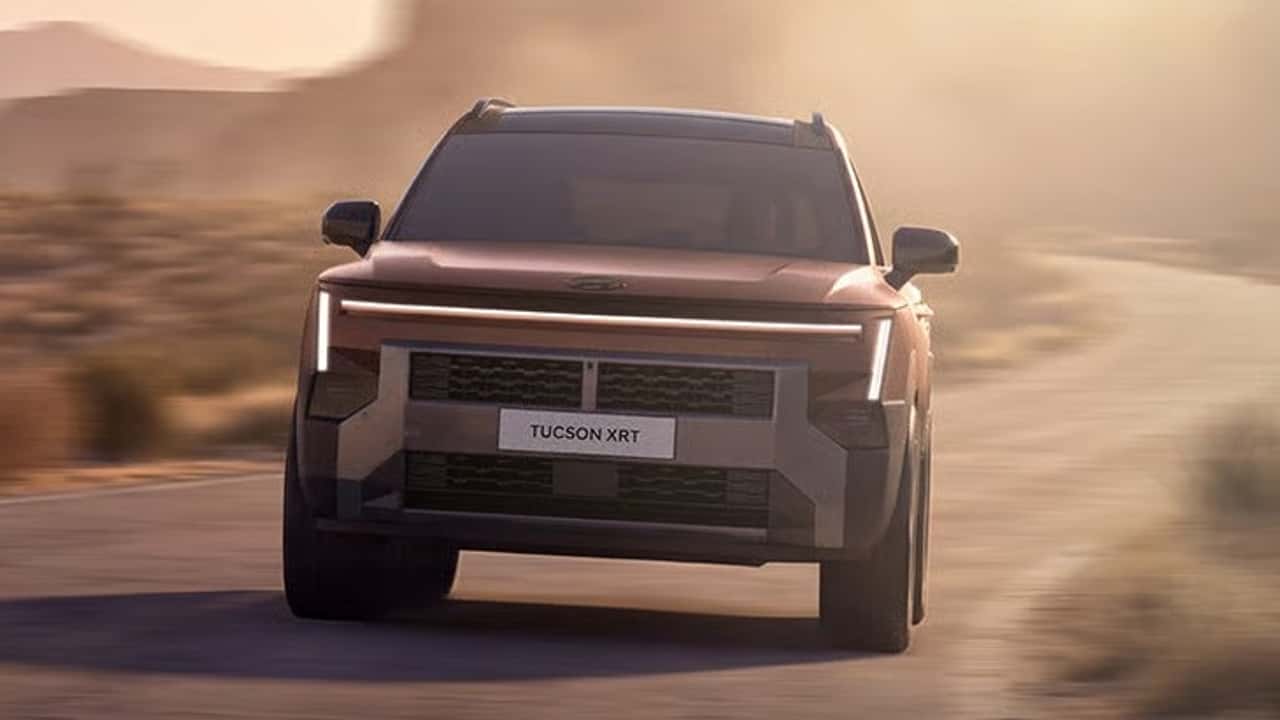
Dedicated off-roaders could crown the lineup.
Hyundai doesn’t seem content to sprinkle a few rugged-looking SUVs across its lineup. It wants XRT to become a proper sub-brand, with more models getting the tough-guy treatment and some of them graduating to the more serious XRT Pro specification. That’s hardly a surprise. SUVs with chunky styling, all-terrain tires and an apparent desire to spend their weekends somewhere without paved roads are having a moment.
Hyundai wants a piece of that action, and it looks as though Australia is expected to play a big role in that expansion. Jonathan Lam, general manager of product planning Down Under, told Drive magazine the intent is to expand the XRT and XRT Pro lineup beyond what’s currently available.
‘We’re considering factory-built XRT Pros or XRTs across basically any model across a range. Whilst we can’t confirm what will be available globally from factory, we’re going to take a very close look at it.’
2025 Hyundai Crater concept
2026 Hyundai Boulder concept
Then there’s the Crater concept, which takes things to the next level by potentially previewing a future range of rugged, off-road-focused models. It’s how Hyundai envisions a rival for the Jeep Wrangler, while the newer Boulder concept goes even further as a larger body-on-frame SUV.
In the meantime, Hyundai doesn’t need to develop an entirely new vehicle for every XRT derivative. Much of the visual treatment can be shared between models, while XRT Pro hardware can be tailored to the vehicles where it makes the most sense. That makes the strategy relatively easy to expand, and the company certainly has enough nameplates to keep the XRT badge busy.
2025 Hyundai Crater concept
2026 Hyundai Boulder concept
The Korean brand has already rolled out its fair share of adventurous derivatives based on the Santa Fe, Palisade, Santa Cruz, and even the electric Ioniq 5. Revealed a couple of weeks ago, the new Tucson is also getting the XRT treatment. The Ioniq 9 is also highly likely to spawn an XRT spinoff.
That gives Hyundai plenty of room to play with. The company has a growing SUV portfolio, and buyers seem increasingly willing to pay extra for vehicles that look like they spend their weekends climbing rocks, even if most never leave the asphalt. XRT lets Hyundai tap into that trend without reinventing every SUV from the ground up, which would be costly and time-consuming.
Making an SUV look ready for the wilderness is relatively straightforward. Making it actually perform better off paved roads costs considerably more and can compromise ride comfort, efficiency, tire noise, and on-road manners. A base XRT trim lets Hyundai capture the visual appeal without all those trade-offs.
Motor1’s Take: Hyundai hasn’t revealed exactly which models will receive the treatment next, but the direction is becoming increasingly obvious. XRT is evolving from a niche appearance package into a broader sub-brand. At the same time, XRT Pro gives Hyundai a way to add genuine off-road capability without turning every rugged-looking model into a hardcore trail machine.
And if the Crater and Boulder concepts are any indication, there could eventually be some proper off-roaders in the mix, positioned separately from the myriad of unibody SUVs.
Catch Up With Hyundai:
Source:
Drive
We want your opinion!
What would you like to see on Motor1.com?
– The Motor1.com Team