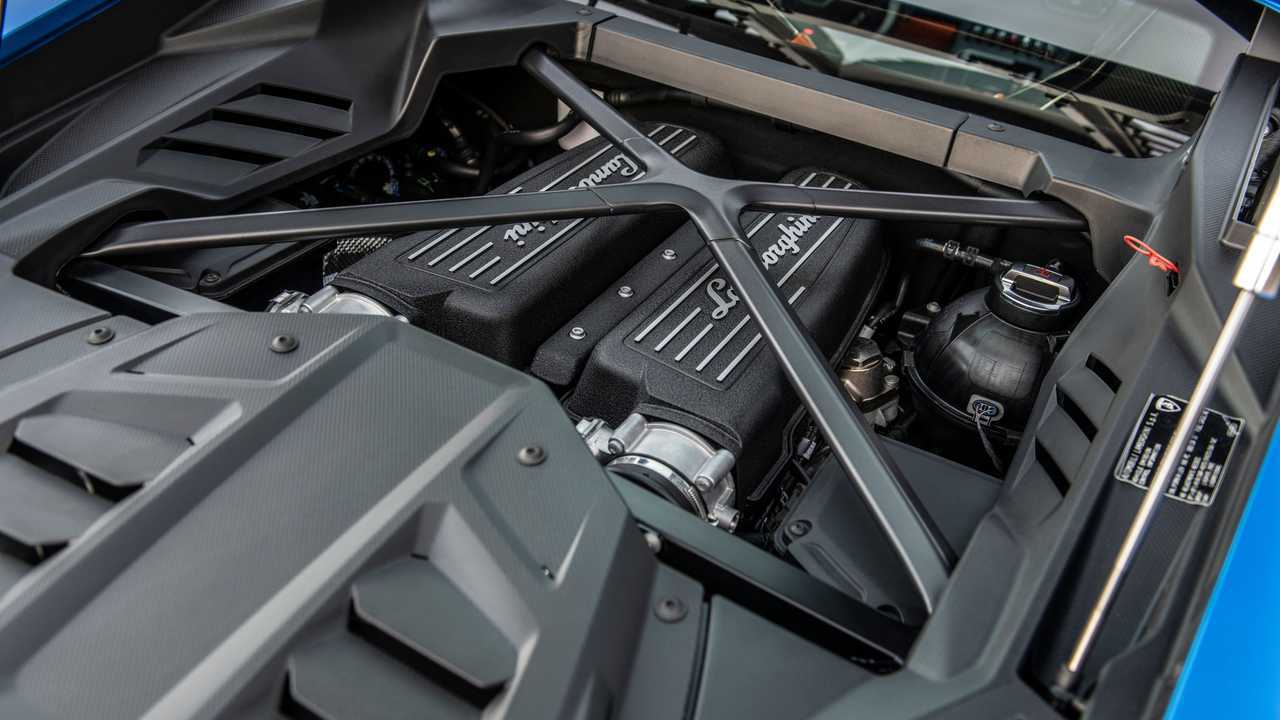
But the Temerario product line’s director argues its V8 replacement is a bit “more rock-and-roll.”
Lamborghini knew it was taking a gamble when it replaced the Huracan’s naturally aspirated V10 with a smaller V8, a turbocharged and hybridized engine at that. The exotic Italian automaker also knew deep-pocketed enthusiasts wouldn’t quietly accept the death of one of the most iconic engines of the modern supercar era, which it shared with the now-defunct Audi R8.
As Lamborghini’s Temerario product line director Paolo Racchetti put it, “We were expecting some kind of criticism.” He was speaking to CarExpert in Milan, where he acknowledged that the company knew exactly what it was giving up when it chose to sunset the high-revving V10.
‘I mean, it’s not criticism, it’s a bit of nostalgic behavior, because we knew that we were leaving something really valuable. We knew that the naturally aspirated V10 was an asset for the Huracan. It was basically defining the whole car, the sound of the car itself.’
The Lamborghini Huracan’s V10 engine
That’s really the heart of the controversy. A V10 didn’t merely power the Huracan; the engine was arguably its defining characteristic. It revved to the moon, delivered its power without forced induction, and made a noise that has become synonymous with the “entry-level” Lamborghini supercar, if we can call it that.
The Temerario is a very different animal. Its 4.0-liter twin-turbocharged V8 works with three electric motors, yet it still has a screaming 10,250-rpm redline. The company with the raging bull isn’t pretending the V8 sounds the same, either. Racchetti freely admits the V10 had a more melodic soundtrack. The new engine, thanks in part to its flat-plane crankshaft, is supposedly sharper and more “rock-and-roll.”
That might sound like marketing fluff, but serious hardware sits underneath it. Let’s also not forget that this engine is going into Audi’s not-quite-R8-successor, the limited-run Nuvolari. Circling back from Ingolstadt to Sant’Agata Bolognese, Lamborghini also argues that the Temerario’s character changes dramatically as the revs climb. Below 7,000 rpm, Racchetti says it behaves like a refined supercar. Above that point, the racing character comes out.
The Lamborghini Huracan’s V10 engine
Of course, Lamborghini didn’t ditch the V10 to annoy people. Increasing emissions and noise regulations made it increasingly difficult to keep a naturally aspirated 10-cylinder engine competitive while meeting global requirements. The same goes for pretty much all large-displacement engines, which are gradually making way for smaller powertrains with a heavy dose of electrification. There are a few exceptions, including Lamborghini’s own V12 in the Revuelto, but even that is a hybrid.
And so far, the strategy of downsizing and electrifying appears to be working from a business perspective. Lamborghini says the Temerario has generated enough demand to build up roughly a year’s worth of orders, suggesting buyers aren’t rejecting the car simply because it has two fewer cylinders and two more turbos than its predecessor.
Of course, that doesn’t mean enthusiasts have suddenly stopped missing the V10. Some things can’t be replicated with clever hybridization, and a naturally aspirated engine is nearly impossible to mimic.
But Lamborghini has moved on, and apparently so have the people buying its cars. The V10’s chapter is likely closed, and the Temerario represents a new formula: fewer cylinders, turbochargers, and the inevitable electric assistance.
It’s refreshing to hear a company admit it knew enthusiasts would be upset. Automakers often talk about replacing beloved engines as though nobody could miss them. Lamborghini isn’t doing that. It openly acknowledges that the Huracan’s 5.2-liter V10 was special and that its sound helped define the car.
At the same time, the Temerario shows why the old formula had to evolve. A 10,250-rpm twin-turbo V8 with three electric motors is hardly the automotive equivalent of giving up and going home. The V10 may have been more melodic, but Lamborghini is clearly determined to make sure its replacement is anything but boring.
More From Lamborghini:
Even at what seems to be the dawn of the electric era, combustion engines remain central to Lamborghini’s modus operandi. The 2+2 grand tourer originally intended to be purely electric will ultimately get a gas engine when it enters production closer to the end of the decade.
The reasoning is simple: Lamborghini’s internal studies found “close to zero” customer interest in an EV. CEO Stephan Winkelmann went even further, calling electric cars nothing more than an “expensive hobby” in the high-end supercar segment.
Source:
We want your opinion!
What would you like to see on Motor1.com?
– The Motor1.com Team