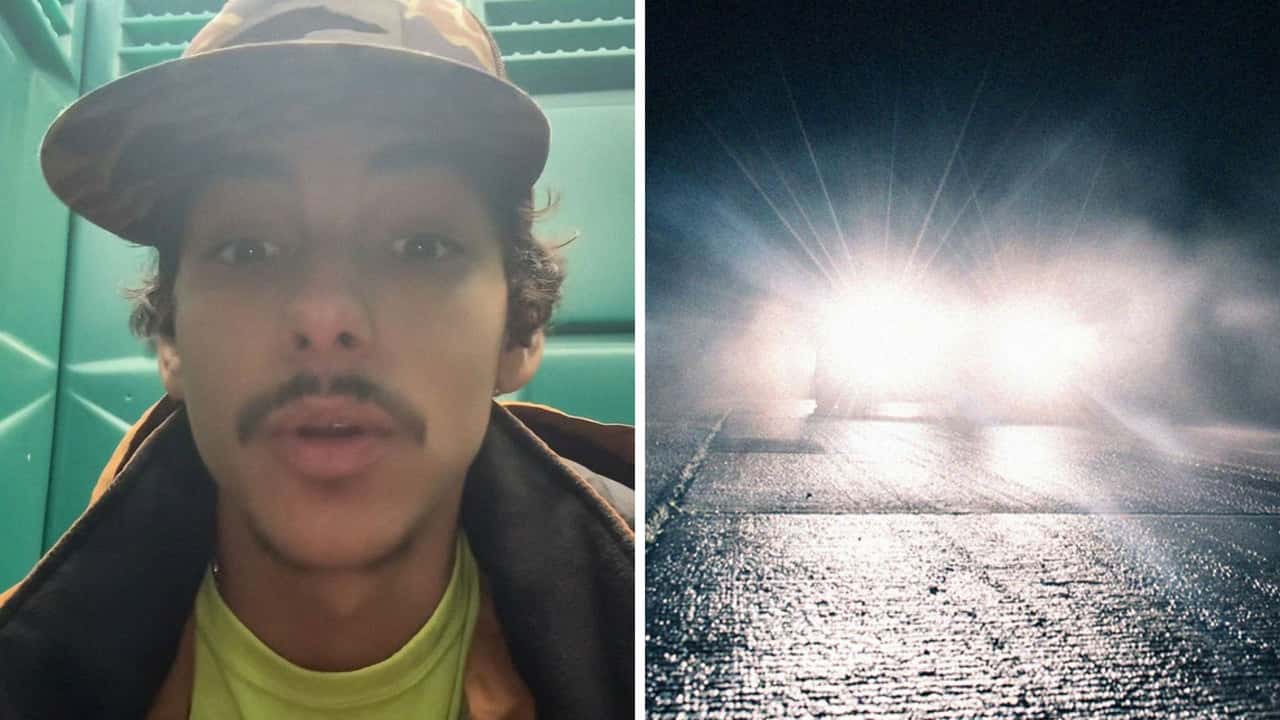
“LED headlights need to be banned. They are genuinely dangerous!!!”
A frustrated driver’s profanity-laced rant about LED headlights struck a nerve with millions of viewers who share his struggle. His animosity towards the lights is clearly resonating with others who feel victimized by the lighting arms race on American roads.
Ryan (@ryan__556) posted a TikTok complaining about the blinding brightness of newer headlights, particularly for drivers with astigmatism.
The video has racked up more than 2.7 million views since it was posted on Jan. 14.
“I hope you sons of [expletive] with y’all’s new [expletive]—I don’t know what they putting in these headlights. They are getting [expletive] light from heaven itself and installing it in these headlights,” Ryan says in the video. “Bro, I have astigmatism. I can’t [expletive] see!”
Filmed from the driver’s seat in poorly lit conditions, the young, mustachioed Ryan delivers his complaint in a southern accent with enough attitude and humor to make the video entertaining, even as it highlights a serious safety concern shared by many drivers.
Ryan’s frustration is far from unique. The transition from traditional halogen bulbs to high-intensity LED and HID (high-intensity discharge) headlights has created a genuine visibility crisis for oncoming drivers, particularly those with astigmatism. Research published by AAA in 2022 found that 89% of drivers surveyed think that some or most vehicle headlights are too bright, with 88% saying they get dazzled while driving.
Astigmatism is a common eye condition where the cornea or lens has an irregular shape, causing light to focus unevenly on the retina. This makes bright point sources of light, like modern LED headlights, appear to scatter and create starbursts or halos. For the estimated one in three Americans with astigmatism, driving at night has become potentially more hazardous as LED headlights have proliferated.
The problem isn’t necessarily that LED headlights are inherently dangerous. When properly aimed and installed in vehicles designed for them, LEDs can provide excellent illumination. The issues arise from several factors, including aftermarket LED bulbs installed in housings designed for halogen bulbs, lifted vehicles with headlights that haven’t been adjusted downward, and manufacturers pushing brightness levels to extremes without adequate consideration for oncoming traffic.
LED headlights produce a much whiter, bluer light compared to the warmer yellow tones of older halogen bulbs. Halogen bulbs have a color temperature around 3000K, while LED headlights typically range from 5000K to 6500K, closer to daylight. This color temperature makes road signs and obstacles more visible to the driver using them. However, that same quality makes them exponentially more painful for oncoming drivers, especially those with astigmatism.
At night, pupils dilate to allow more light in, but for an eye with astigmatism, a dilated pupil means that light enters through a larger area of the uneven cornea, causing more light to scatter into multiple focal points and making visual distortions more noticeable.
The focused, directional nature of LED light also contributes to the problem. Unlike the more diffused glow of halogen bulbs, LEDs create intense points of light that can overwhelm the vision of oncoming drivers, particularly when misaligned or installed on lifted vehicles where they shine directly into the mirrors and windshields of smaller cars.
The comments section of Ryan’s video became a support group for drivers struggling with the same problem. Thousands shared their own experiences of feeling blinded and unsafe on nighttime drives.
“Heavy on I have astigmatism,” wrote Maria Jadelyn, whose comment received over 38,800 likes, suggesting tens of thousands more silently agreed.
“I have them in both eyes!!” responded MillerUnfiltered.
“Same!!! And I refuse to drive at night unless I have to cause ya girl cannot see,” wrote Malia Robinson.
Many commenters described dangerous coping mechanisms they’ve developed to survive nighttime driving. “Me looking for the yellow line on the side of the road,” wrote jaszmunnn with laughing emojis, earning over 9,400 likes.
Another user, amanda_lriver, revealed an even more concerning reality: “I can’t see the white line anymore when these cars drive past. I’m staying in my lane on pure vibes.”
“Just went and got food for my family and it was raining so with the rain, the lights, and my astigmatism I was just praying I would get home,” wrote Destiny Paige, highlighting how weather conditions compound the visibility problems.
Several commenters described the particular terror of mailboxes at night. “As someone with astigmatism I’m already fighting with mail boxes thinking they are flying deer… the rage I feel with the bright lights,” wrote Steph, earning 3,580 likes. Her comment spawned an entire subthread of drivers admitting they regularly mistake roadside objects for animals or pedestrians when blinded by oncoming headlights.
Several Jeep owners confirmed what Ryan’s video implied: their vehicles’ factory headlights are notoriously bright. Multiple Jeep Wrangler owners report getting flashed by oncoming traffic who think their high beams are on when using low beams, with family and friends describing driving past a Jeep with LED headlights as “a terrible blinding experience.”
Some owners take perverse pleasure in proving it to drivers who flash them. “I flashed a jeep when the low beams were on the whole time!! he turned on his high beam and i thought i saw god,” wrote one commenter whose experience earned over 38,300 likes.
“My husband and I have a lifted jeep. I HATE it when he drives behind my car but it makes me giggle when I am driving the truck and someone brights me thinking my brights are on then BOOM let me light up that car baybeeeee,” wrote Tommie Cheyenne, earning 238 likes despite the admission of deliberately blinding other drivers.
Some Jeep owners offered constructive solutions. “I have a jeep with the new lights and I had to adjust them look it up on YouTube it helps,” advised Ricky Howell, whose comment received 44 likes. Some owners on forums found their headlamps were aimed too high from the factory and were getting flashed regularly, but the issue was resolved after readjustment.
The most-liked top-level comment on Ryan’s post called for regulatory intervention. “The[y] need to be banned & recalled. It’s not safe,” wrote Sherry, earning nearly 3,000 likes.
“Yep as someone with astigmatism and LED’s trigger ocular migraines for me, its horrible and so unsafe,” responded Jen.
“They’re definitely not safe and when people drive with the brights on makes it a thousand times worse,” added another user.
One commenter suggested the problem often stems from improper installation: “Tell people to fix the position of their lights, it does make a big difference! Most people don’t and then out here blinding everyone,” wrote Sky.
The comment hints at a broader issue: While some LED headlights are factory-installed and properly aimed, many of the worst offenders are aftermarket bulbs installed in housings not designed for them. Halogen housings are specifically designed for halogen bulbs, and installing LEDs in them creates dangerous glare for oncoming traffic, even if the LED bulbs themselves are DOT-approved.
Lights on lifted vehicles often haven’t been adjusted downward to compensate for the increased height, which is required in most states.
For drivers like Ryan and many of the millions who viewed his video, the LED headlight problem feels like automotive innovation at the expense of practical safety concerns. While manufacturers tout improved visibility for the vehicles equipped with these lights, that benefit comes at the expense of everyone else on the road.
Several potential solutions exist, though implementation has been challenging. Adaptive driving beam (ADB) headlight systems that automatically adjust beam direction based on steering input and oncoming traffic were legalized in the United States in February 2022. However, as of April 2025, only Rivian has managed to offer fully compliant ADB headlights that meet the stringent U.S. regulations. The technology has been available in Europe since 2012.
Stricter regulations on aftermarket headlight modifications and mandatory headlight adjustment following vehicle lifts could help. Most states require headlights to be mounted between 24 and 54 inches from the ground, and owners must check their lights after height alterations to ensure they fall within legal guidelines.
Interestingly, while complaints about headlight brightness have surged, data from the Insurance Institute for Highway Safety shows that from 2015 to 2023, headlight glare was cited as a factor in only one or two out of every thousand nighttime crashes across 11 U.S. states, with essentially no increase despite brighter headlights proliferating during this period.
For now, drivers with astigmatism are largely left to fend for themselves, developing their own coping strategies: avoiding night driving, slowing down when blinded, using the edge lines to maintain lane position, and hoping they don’t mistake a mailbox for a deer.
“It’s just me, Jesus, and my astigmatism against the world at this point,” wrote one commenter, summing up the resignation many drivers feel about a problem that seems to worsen with each new model year.
Motor1 reached out to Ryan via TikTok direct message. We’ll be sure to update this if he responds.
We want your opinion!
What would you like to see on Motor1.com?
– The Motor1.com Team