“They didn’t even speak English…”
For all the technology built into modern cars, one of the most effective ways to ask for help hasn’t changed in decades: pull into a parking lot, pop the hood, and stand there looking concerned. A Dallas woman recently turned that old signal into a TikTok and set off a comment-section firestorm in the process.
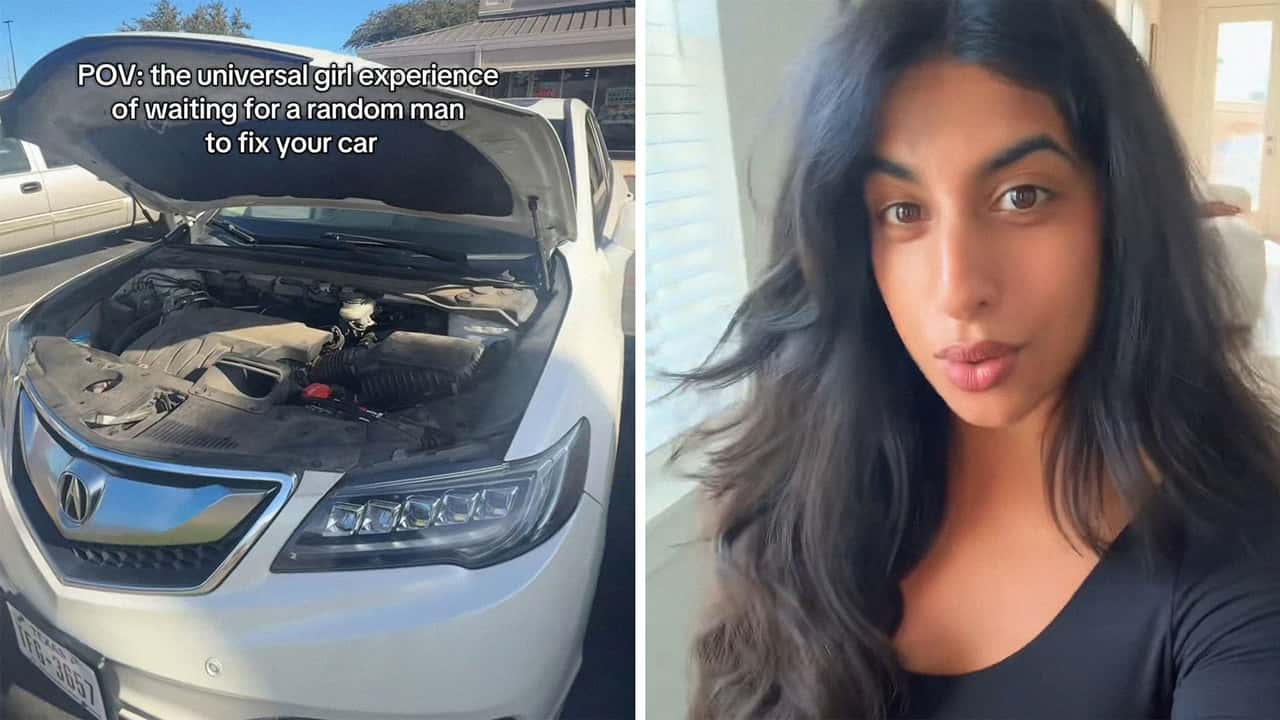
The viral clip from creator Harika Talluri (@rikasays) doesn’t try to disguise the fact that she’s using some well-timed social engineering to attract mechanically minded passersby who are willing to assist a young woman in mild distress.
“I literally walked into Subway and asked someone how to open the hood of my car, and then they opened it, and I stood here acting like I knew what I was looking at,” she said in the clip that’s been viewed more than 46,000 times.
The ploy worked, as we see a pair of men working under the hood to get the car running again.
Whether it’s a dead battery, an overheated engine, or a loose cable, many common breakdowns still present the same way they did years ago: sudden silence, warning lights, and a car that won’t move. According to roadside assistance data from organizations like AAA, battery-related failures remain one of the most common reasons drivers call for help, especially in urban areas where short trips and stop-and-go driving are hard on charging systems.
An open hood in a parking lot often signals a problem that can be quickly diagnosed by someone with tools and experience, even if the owner doesn’t know where to start.
That’s part of why Talluri’s tactic resonated with viewers. It wasn’t flashy or elaborate. It relied on a shared understanding among drivers that an open engine bay usually means someone needs help.
What could have remained a lighthearted clip quickly turned into a broader debate, with some commenters praising the strangers who stopped. Others criticized Talluri for not using YouTube tutorials or her owner’s manual, and many framed the interaction as a referendum on independence, gender roles, or both.
Talluri leaned into the humor, responding to one commenter, “Empowerment is knowing when to let a man become useful.” That line generated a flood of replies, with reactions ranging from playful agreement to outright hostility. As is often the case with viral car-related content, the mechanical issue itself became secondary to the cultural argument happening around it.
The backlash also raises a more practical question: how much should the average driver realistically know about their vehicle? While modern cars come with detailed owner’s manuals and an endless supply of how-to videos on platforms like YouTube, real-world breakdowns don’t always leave time or space for calm research.
Automotive experts generally recommend that drivers understand a few basics, like how to open the hood, identify the battery, recognize warning lights, and check fluid levels. Beyond that, many repairs require tools, replacement parts, or diagnostic equipment that most people don’t carry. Even something as simple as a dead battery can be challenging to resolve without jumper cables or a portable jump starter.
What’s missing from much of the online criticism is context. Talluri wasn’t attempting a full roadside repair or claiming mechanical expertise. She needed assistance in the moment and strangers offered it. That dynamic is still common, particularly in parking lots, gas stations, and other places where drivers congregate.
Studies on bystander behavior suggest people are more likely to help when a problem appears visible, contained, and solvable. An open hood fits that pattern, signaling a specific need without requiring conversation or confrontation, making it easier for someone with knowledge to step in.
In that sense, the video highlights a quieter reality of car ownership: despite apps, tutorials, and advanced onboard diagnostics, drivers still rely on each other more than they might admit. Roadside assistance culture hasn’t disappeared; it’s simply less visible until moments like this go viral.
Talluri’s TikTok captured a familiar scene of car trouble, uncertainty, and unexpected help, and reframed it for a social media audience. The reaction says as much about online discourse as it does about mechanical competence.
Cars break, and people improvise. Sometimes that improvisation involves a phone screen. Other times, it means popping the hood and hoping someone nearby recognizes the problem faster than a search engine can.
Motor1 reached out to Talluri via email and direct message. We’ll update this if she responds.
We want your opinion!
What would you like to see on Motor1.com?
– The Motor1.com Team