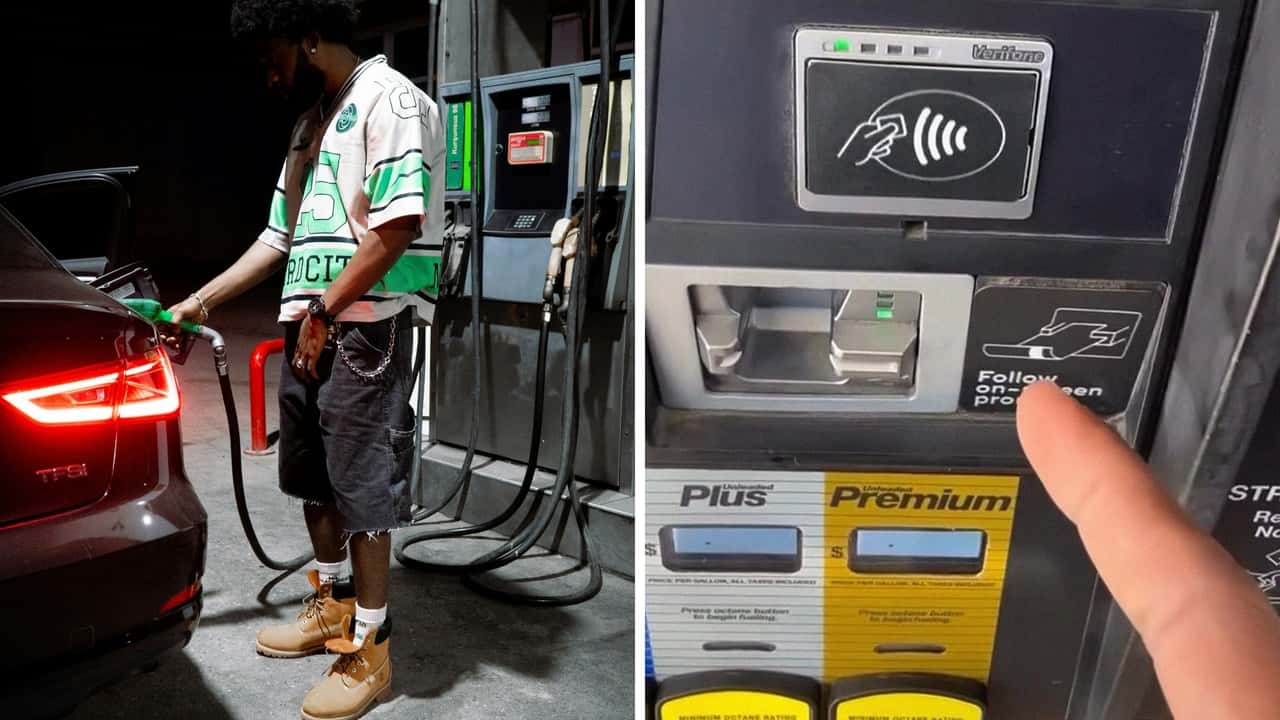
“They trying to get your info.”
A warning about gas station credit card scams is making the rounds online after a retired police officer re-shared a video urging drivers to take a closer look at the pump before paying.
Michael Arterburn, who regularly posts safety tips, reposted on Facebook a clip from another man who says he spotted a scam in action at a gas station.
“Don’t look down, look around,” the original, unnamed poster says.
In the video, the man explains that someone had “put the fake sticker” over the credit card reader at a station he visited. He then peels back the sticker—designed to mimic a tap-to-pay symbol—that looks nearly identical to the real one underneath.
“They trying to get your info,” he warns. “Look out for this.”
According to the original poster, there are a couple of ways to spot the difference. For one, he says a legitimate card reader will have a light, while the fake one won’t. The symbol’s orientation can also be a giveaway.
“The real one faces the right,” he explains. “The fake one faces the left.”
Arterburn then adds his own advice, telling viewers that if something feels off, they should tug gently on the face plate of the card reader—it shouldn’t be loose or appear tampered with.
He also notes that during busy travel periods and holidays, people may rush through stops at the pump and miss these details. But that’s exactly when extra caution matters.
As of this writing, the video has been viewed more than 3.9 million times.
If you’re worried about gas pump skimmers—and you probably should be, given that the Federal Bureau of Investigation estimates skimming costs banks and consumers more than $1 billion a year—it’s worth slowing down and actually giving the pump a quick once-over before you pay.
The Florida Sheriffs Association says to start with the card reader itself. It should feel solid and firmly attached when tugged. So, if it wiggles or seems like it was placed on top of the machine, that’s your cue to leave and use another pump—perhaps even one at a different gas station altogether.
Take a quick look at the pump’s access door as well. Many stations use security seals over the access panel. If there are uneven gaps in the casing, that could indicate that it’s been tampered with.
If you’ve got a moment, compare the pump you’re using with nearby ones as well. If one card reader or keypad looks thicker, newer, or a different color than the others nearby, that inconsistency matters. Skimmers often stand out once you know to look for them. The Florida Sheriffs Association also advises scanning the area around the keypad for anything unusual, including tiny pinholes that could hide a camera aimed at capturing PINs.
How you pay matters, too. According to Canvas Credit Union, tap-to-pay or mobile wallets are generally more secure than swiping or inserting a card. But if you do need to enter a PIN, always shield the keypad.
And if anything feels off, abandon the pump entirely. Of course, on your way out, let station staff know and keep an eye on your bank and credit card statements for anything out of the ordinary.
Plenty of people who watched Arterburn’s clip thanked him for highlighting how these scams work, but many used the comments to share another workaround: skipping the pump entirely and paying inside.
“This is why, regardless of how long the line behind me is, I go inside and prepay at the register,” one woman wrote. “Those machines never get access to my cards.”
Another commenter took the idea further, musing, “Just imagine if you went back to paying for things with cash,” while someone else added, “That’s why I pay inside.”
A fourth viewer echoed the same advice, arguing that doing so is safer.
“Always go inside much less likely to have a scammer’s plates on the card reader,” they wrote.
Others said they’ve managed to sidestep the problem altogether, either because of where they live or what they drive.
“Good thing I have a Tesla,” one man joked. “Have not been to a gas station in 10 years.”
Another Tesla owner chimed in with a similar point, explaining, “As a Tesla owner, I just get charged thru my Tesla app for charging.”
Geography also came up, with one commenter noting, “At least in Jersey, we don’t have to worry about that.”
Motor1 has contacted Arterburn via a direct message on Facebook. We’ll be sure to update this article if he responds.
We want your opinion!
What would you like to see on Motor1.com?
– The Motor1.com Team