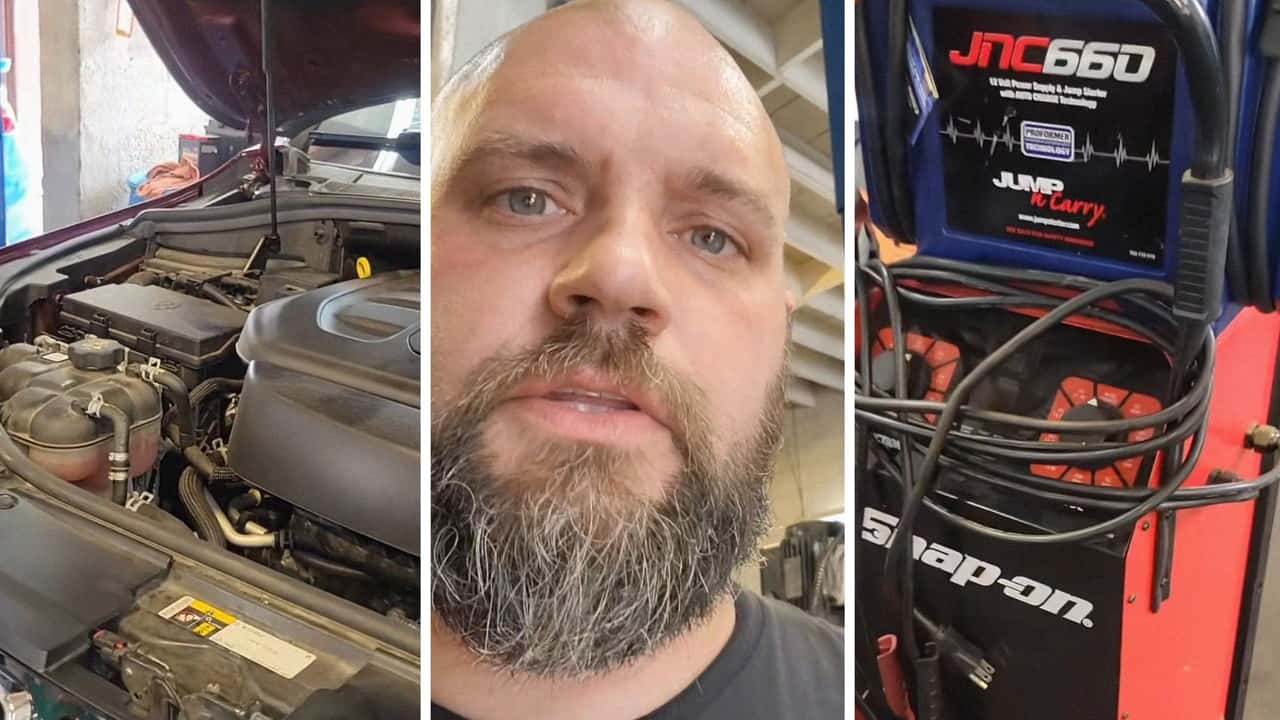
“They definitely have your best interests in mind…”
A mechanic rallied against the idea that automakers intentionally design cars to be difficult to repair.
The service tech, who posts online under the handle Old Snap (@oldsnap85), points to a 2020 Jeep Grand Cherokee in order to drive his point home.
“People like to act as if automotive engineers do not have the consumers’ best interest in mind while designing vehicles. I’m here to prove that wrong,” he says. “Twenty-twenty Jeep Grand Cherokee has a dead battery. All you gotta do is pop the hood, get a charger, a jump box, set of cables—it doesn’t matter. They give you so many options,” he tells his viewers.
Following this, he points out where the terminals are located, and they are, indeed, easy to access. But there are a few other steps one needs to take to complete a jump or replacement. He heads over to the right side of the car and pops open the front passenger door.
“Come back here to the passenger door. Pop that open. Slide your seat all the way forward, all the way up. You come back here,” he states, opening the rear passenger door. “Come back here. You just have this little plastic tray. Four clips, pops right out. Get to your auxiliary battery. Thirteen millimeter nut, 13mm nut. Boom, terminals are off. Tie down, 10mm. Boom, that’s off. Slide your battery right out. Underneath is a tray. Thirteen, 13,” he says, pointing out that they are the same size fasteners, cutting down on the amount of tools one needs. “Boom, that pops right out. That’s your tie-down for the main battery, too.”
“Then you just got a 10mm. Ten millimeter, two drains. Then your battery just slides right up and out. I don’t think they could design it any easier. They definitely have your best interests in mind,” he says.
Motor1 has reached out to story subjects. We will update this story if they respond.
There’s an argument to be made that in terms of convenience, placing the battery under a seat is a real pain. It’s difficult to beat the ease of just cracking open the hood.
But is this the best design for a car? Why did auto manufacturers start putting batteries inside of the vehicle?
One reason is weight distribution and space efficiency. As Motor1 points out in this 2025 piece, relocating batteries to the inside of a vehicle assisted in freeing up space “for emissions control systems, turbochargers, or other engine-accessory packaging.”
Additionally, it allows “engineers [to] shift weight toward the center of the vehicle.” This can give a car greater balance and, subsequently, improve driving dynamics.
But unlike Old Snap’s video, the same piece indicates that there are “serious drawbacks for access and maintenance.” Ventilating these batteries in closed compartments can also add further complications. This is why many automakers are rigging their vehicles out with designated vent tubes.
Jalopnik also penned that trunk and under-seat battery placements are frustrating to access but conceded that they’re not particularly difficult once you figure out how to get to them. This does speak to Old Snap’s point, but are the extra steps worth it?
They could be. CTEK states that prolonged exposure to elevated temperatures can shorten a battery’s lifespan. So, keeping this battery away from engine heat could very well extend how long one’s battery operates.
It’s also worth considering the potential safety benefits of keeping battery packs away from car hoods. Front-end collisions could damage these large batteries, causing their corrosive acid to spill onto other components. Or, if it’s struck hard enough, it could culminate in a scary fire.
We want your opinion!
What would you like to see on Motor1.com?
– The Motor1.com Team