“Learned about that in shop class.”
A parts-store diagnosis is usually a useful starting point, but it’s not always the last word. Even an experienced mechanic can get sent down the wrong path at first, and solving something as deceptively simple as a hard-starting car can require a little detective work.
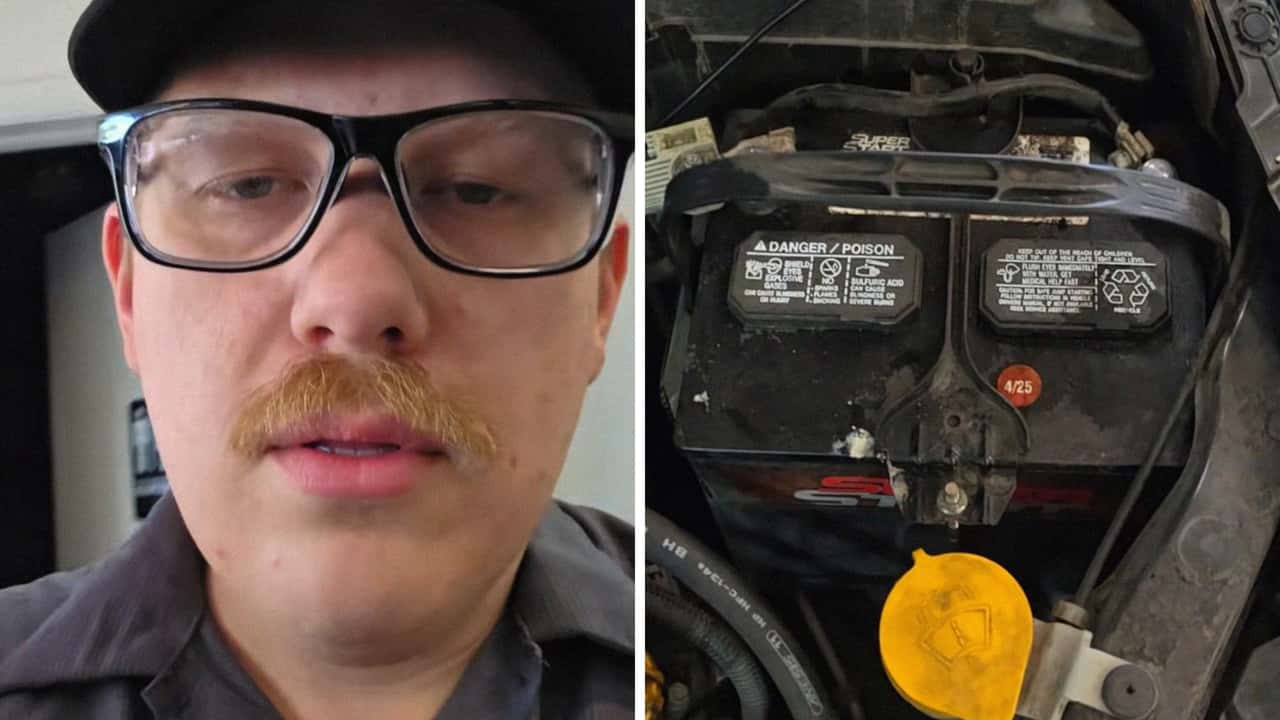
In this case, a recent TikTok clip showed the parts store said the battery was good, and creator Kyle Grodkowski’s (@methodmechanic) own test seemed to agree. But then he noticed something on top of the battery that made him reach for his multimeter again.
“So, normal little battery. It’s a little crusty,” he said in the clip that’s been viewed more than 1,100 times. Grime and corrosion were visible around the case and terminals, but at first glance they looked more cosmetic than consequential.
What looked like ordinary grime became more interesting once Grodkowski put a multimeter on it. With one lead touching the battery connection and the other touching the top of the case, the display climbed to more than 3 volts.
“I’ve got almost 3.5 volts going across the battery,” he said. “Yeah, that’ll drain a battery real fast.”
A few viewers immediately recognized what he was demonstrating. One supplied the term in two words: “surface discharge.”
What viewers were describing is a documented source of battery drain, which is why battery manufacturers recommend keeping more than just the terminals clean. Dirt, moisture, and other contamination allowed to collect on top of a battery can create an unwanted conductive path across the case.
Battery Master warns that accumulated water, oil, and dirt can cause electrical tracking and current leakage, which can contribute to self-discharge. Interstate Batteries similarly recommends keeping the case free of heavy dirt and oil, as contamination can allow electrical activity between the positive and negative posts, leading to faster discharge.
Battery-testing guidance calls for checking the case for dirt, moisture, corrosion, damaged posts, and loose connections before proceeding to more involved electrical testing.
Grodkowski, who told Motor1 he’s been working as a mechanic for more than a decade, said he sees this kind of surface leakage fairly often.
“It’s usually not over a volt. That was 3.5,” he said. “I actually had one yesterday that was 5.5.”
He said the buildup often comes from owners failing to clean around the battery. In this case, the battery’s cleanliness wasn’t the only issue: Grodkowski also found it was loose.
“We did a battery service: We tightened the clamps, cleaned off the corrosion, washed it off. But that was the main thing,” he said.
Grodkowski recalled that the vehicle was a 2013 Kia Forte and said cases like this are a reminder that seemingly minor neglect under the hood can create electrical problems that aren’t immediately obvious from a standard battery test.
There is an important wrinkle to Grodkowski’s demonstration, though.
“But almost no amps,” one commenter pointed out.
That’s significant because the roughly 3.5 volts shown on Grodkowski’s meter indicate the electrical potential across the contaminated surface. But voltage alone doesn’t establish how much current is actually flowing or how quickly that path could discharge the battery.
Fluke notes that modern digital multimeters have very high input impedance, allowing them to register voltage across a weak electrical path that may carry only a small amount of current.
So, Grodkowski’s reading is a meaningful clue that unwanted electrical leakage was present, but the clip doesn’t quantify the drain well enough to say exactly how fast it was depleting the battery.
The battery itself could still have tested as healthy at the parts store, while contamination on the case contributed to discharge, and corrosion or loose clamps interfered with power delivery during starting.
Universal Technical Institute notes that excessive terminal corrosion can weaken an electrical connection enough to cause starting trouble even when the battery is healthy internally. So the initial “battery good” diagnosis may have been technically correct; it simply didn’t account for the problems surrounding it.
For some viewers, none of this qualified as a revelation. One commenter said they had learned the lesson in shop class and used to sell a battery-cleaning service that included neutralizing corrosion with baking soda and cleaning the terminals.
Interstate still recommends essentially that approach today, using baking soda and water to neutralize corrosion before cleaning and thoroughly drying the battery.
Another viewer was more succinct: “mind not blown.”
The more useful lesson, though, may be that the solution to a starting problem doesn’t always begin with replacing the part that seems most obvious.
We want your opinion!
What would you like to see on Motor1.com?
– The Motor1.com Team