“Bigger isn’t always better.”
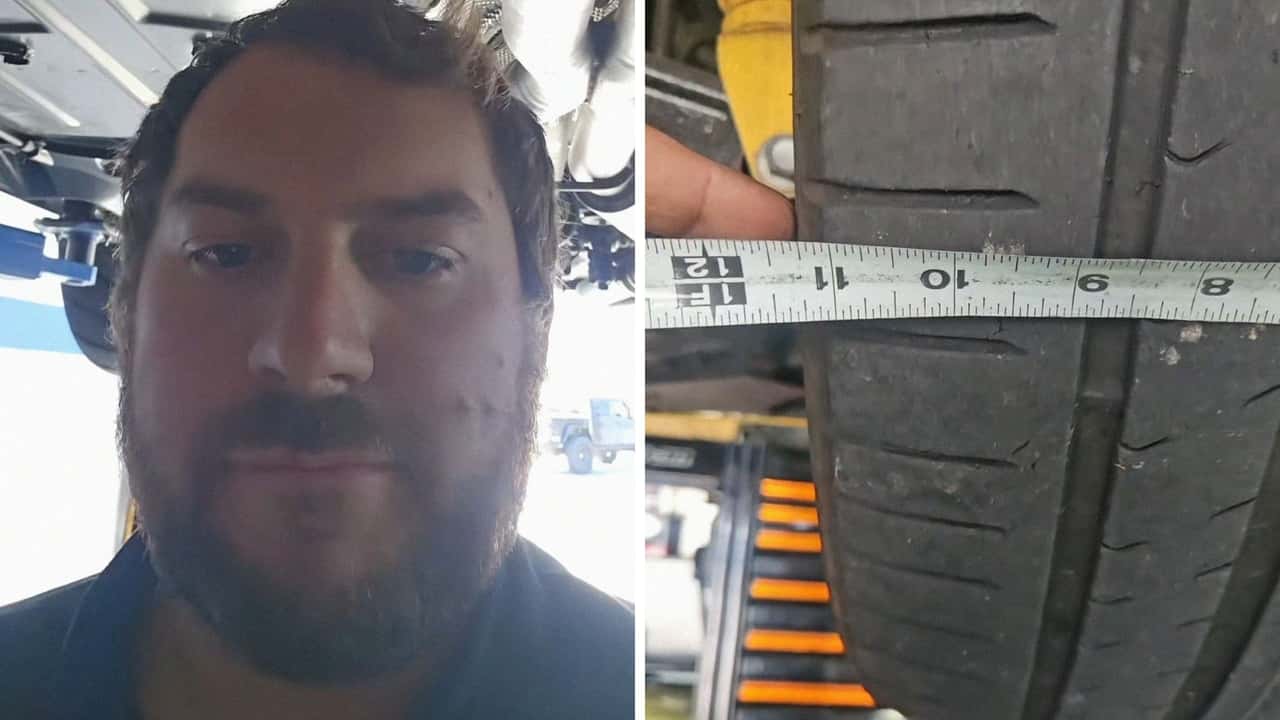
A master technician working under a Dodge Challenger SRT Hellcat Redeye pulled out a tape measure to precisely measure how much of the tire is actually touching the road, something most vehicle owners never check.
Sacrilegious car mods (@sacrilege454), whose channel documents his own builds and the work that comes through his shop, shared his finding in a four-minute TikTok that has drawn more than 9,319 views.
“I just want to kind of make a point about bigger isn’t always better,” he begins, “and knowing what the [expletive] you’re doing will typically work out a lot better than just throwing [expletive] at your car thinking you’re smart.”
He warms up on the intake. “The guy’s got a cold air intake on his car. He’s removed all the Ram Air hardware, so it actually makes less power now because it’s not getting as much air as it used to.”
Then he gets to the tires.
The front tires are the car’s stock Pirelli P Zeros in 305/35ZR20. He reads off the band of tread that meets the pavement.
“Measuring the actual contact patch gives you about 11 and a quarter [inches],” he says, “accounting for roughly, you know, three-eighths of an inch or so on either side.”
At the back, the owner has fitted Toyo Proxes R888Rs in 325/30ZR20, a size 20mm wider.
“This is where you look like a [expletive],” he says. The tape gives him 10.75 inches.
“There is less traction in the rear than on the front now, though it’s a wider tire,” he says. “Why? Because the tire has to roll in.” The wider tire, on his reckoning, is pinched at its edges until the tread crowns and lifts away from the road.
Motor1 reached out to story subjects. We will update this story if they respond.
The most-liked reply in the comments section granted the measurement but disputed its significance.
“That all is true, but people run R888 for the tire compound,” wrote ben_p_1le.
Sacrilegious car mods answered that it is not a trade anyone has to make: “A 305/35ZR20 with the same compound would have a larger contact patch and proper sidewall profile. And it would have more traction.”
Others raised the same issue but put it in terms of physics. “Contact patch isn’t the only factor in traction. Compounds matter,” wrote reaver_guardian.
Xyrior wrote, “Surprisingly enough, contact patch has much less of an effect on traction than most people believe.”
Several commenters proposed the same simple solution. “Lower the pressure,” wrote huntg212, while zebrolova opined, “That car owner obviously isn’t lowering the tire pressure.”
When emills24 suggested “a taller sidewall would help and less tire pressure,” Sacrilegious car mods pointed at his own car.
“My pro touring car runs 285s squared, and I have an effective contact patch of 9.5 inches on 9-inch wheels with proper pressure and sidewall profile,” he wrote. “And it feels very planted.”
Ericsmith0394 suggested that the difference might come down to the engine’s weight spreading the front tire wider.
Sacrilegious car mods, who said he went and measured his own SRT Widebody afterward, was not convinced by any of this.
“This has everything to do with the tire being too wide for the wheel and curling up on the sides as a consequence,” he wrote.
His advice does have the benefit of deterring unnecessary spending. “Having a good sidewall profile that’s matched to your tire size is going to give you better traction than just throwing the fattest tire you can on a wide wheel,” he says. “Just because it’s a wider tire doesn’t mean it’s going to be better. Everything is relative on cars, and people really need to learn this.”
Dodge builds the Widebody version of the SRT around a specific pairing of 20-by-11-inch “Devil’s Rim” forged wheels with 305/35ZR20 Pirelli P-Zero tires. That is what Sacrilegious car mods measured at 11.25 inches.
Both the Pirelli and Toyo tires are legal on an 11-inch wheel, but they do not sit on the wheel in the same way. The Pirelli carries an approved rim width range of 10 to 12 inches, with a measuring rim of 11 inches.
The Toyo carries a range of 11 to 12 inches and a measuring rim of 11.5 inches.
On the factory wheel, the Pirelli sits on exactly the rim it was measured on. The Toyo is on a wheel half an inch narrower than its own measuring rim, which is also the skinniest it’s rated for.
Tire Rack explains that tires “have a range of rim widths they can be mounted on while still performing as designed,” each with “a measuring rim width from which the tire’s specs are taken.”
Drop below it, and the tire changes shape. One mounted on a narrower rim “has a slightly skinnier section width as a result,” with the industry rule of thumb putting the change at approximately 2/10″ for every half inch of rim width.
Ironically, Toyo sells the R888R on the size of its footprint, crediting its lap times to a tread design and “an improved contact patch that puts more rubber on the track,” and listing an “optimized contact patch” among its headline features.
We want your opinion!
What would you like to see on Motor1.com?
– The Motor1.com Team