“The tailgates with ‘YODA.'”
If you found a Toyota part stamped “TOYODA,” you’d be forgiven for assuming somebody at the factory had a bad day. Or maybe that the part came from some questionable aftermarket supplier. Neither explanation would be right.
The natural question is, is it a mistake or treasure? That single D lands the part somewhere between mechanical oddity and pre-globalization artifact, and opens up a history lesson to the days before Toyota was actually Toyota.
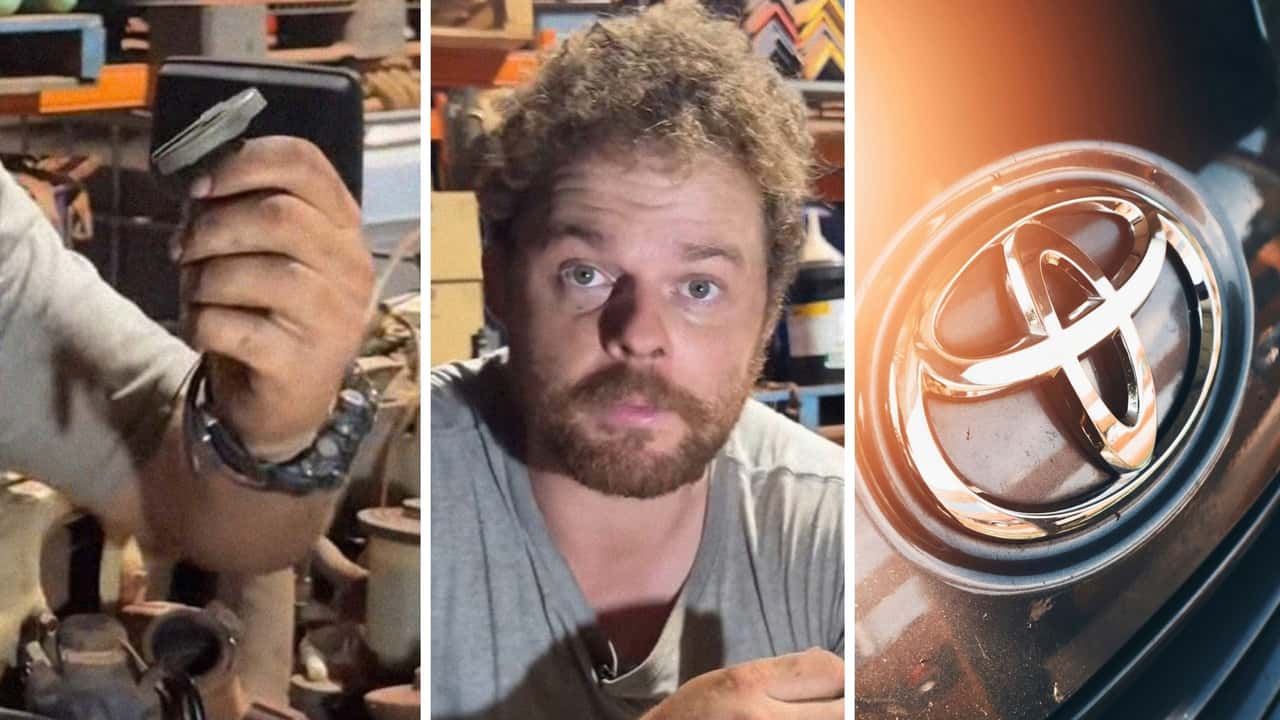
In a Facebook Reel from Australian automotive creators 4WD 24/7, we see a power steering cap from an earlier era, before the automaker had become a dominant global player.
“They changed it to ‘Toyo-tah’ for a number of reasons, one of them being this was easier to pronounce for Westerners, and the other one was this is actually easier to write in Kanji,” the narrator said. (Kanji is a Japanese writing system.)
The clip has been been viewed more than 500,000 times.
Toyota’s version of its story is a little more specific, tracing its name to founder Sakichi Toyoda and noting that its earliest vehicles bore the Toyoda name. In 1936, as the automotive business was taking shape, the company held a public contest for a new logo and received more than 27,000 entries. The winning design used “Toyota.”
The new spelling sounded cleaner in Japanese, created some distance between the company and the Toyoda family name, and could be written in katakana in eight brush strokes, a number traditionally associated with good fortune in Japan.
That last detail sparked its own argument in the Reel’s comments. Some viewers took “eight” to mean the number of Japanese characters in Toyota, but both Toyoda and Toyota use three katakana characters. The difference is in the stroke count used to write the now well-known name.
The change came before Toyota had much of a brand to worry about protecting, since Sakichi Toyoda built his business around textile machinery. Toyoda Automatic Loom Works was established in 1926, and his son Kiichiro later pushed the company into automobiles.
Toyota Motor Co. was formally established in 1937. Its first production passenger vehicle was the Toyoda Model AA, meaning the version that looks wrong on a steering cap was once the name customers were supposed to see.
The old spelling didn’t disappear from Toyota hardware when the company changed its name. The 4WD 24/7 narrator says “Toyoda” can still be found on steering boxes and other components because some of the original tooling stayed in use long after the switch.
Viewers offered their own evidence of how long that carryover may have lasted. One commenter said the steering rack on his 2000 4Runner is stamped Toyoda, while another reported the same marking on a 1999 JZS161. A 4Runner owner who already knew the company history said he was surprised the old tooling had apparently remained in service for so long.
That makes the 1975 power steering cap less of an isolated curiosity than it first appears. Toyota had been operating under its current name for nearly four decades by then, yet the Toyoda name was still hanging on as a curiosity when it turned up on parts seemingly at random.
The eye-catching “D” never disappeared from the family, which maintains a prominent role in the corporation. Toyota’s current chairman is Akio Toyoda, a descendant of the family that gave the company its original name. Speaking on his connection to the family legacy, Toyoda said, “I am not the founder of Toyota. I am merely continuing what others have passed on.”
That helps explain why seeing “Toyoda” on an old part feels stranger than it really is. The name never went away. It just stopped being the one stamped across the cars.
Of course, the original name is easy to connect to some lore that is very unautomotive.
“The tailgates with ‘YODA’ … I thought it was aftermarket for Star Wars fans,” one viewer wrote.
Without the company history, “Toyoda” looks close enough to both a typo and a bit of enthusiast customization to invite the wrong conclusion. The truth is less fantastical, but still fun since it’s one of those manufacturing leftovers that can make an ordinary old component more interesting than the vehicle owner ever expected.
Motor1 reached out to the creator via direct message and comment on the clip. We’ll update this story if they respond.
We want your opinion!
What would you like to see on Motor1.com?
– The Motor1.com Team