“Well, surely I didn’t mess nothing up.”
A truck owner who thought he was facing a four-figure repair bill got good news when a second opinion revealed the real source of an ominous knock. It wasn’t a lower-end failure as one shop had told him, but a single loose bolt making contact with the back of the engine.
So was the dealership trying to swindle him into paying for a hefty repair? Or was it an honest mistake?
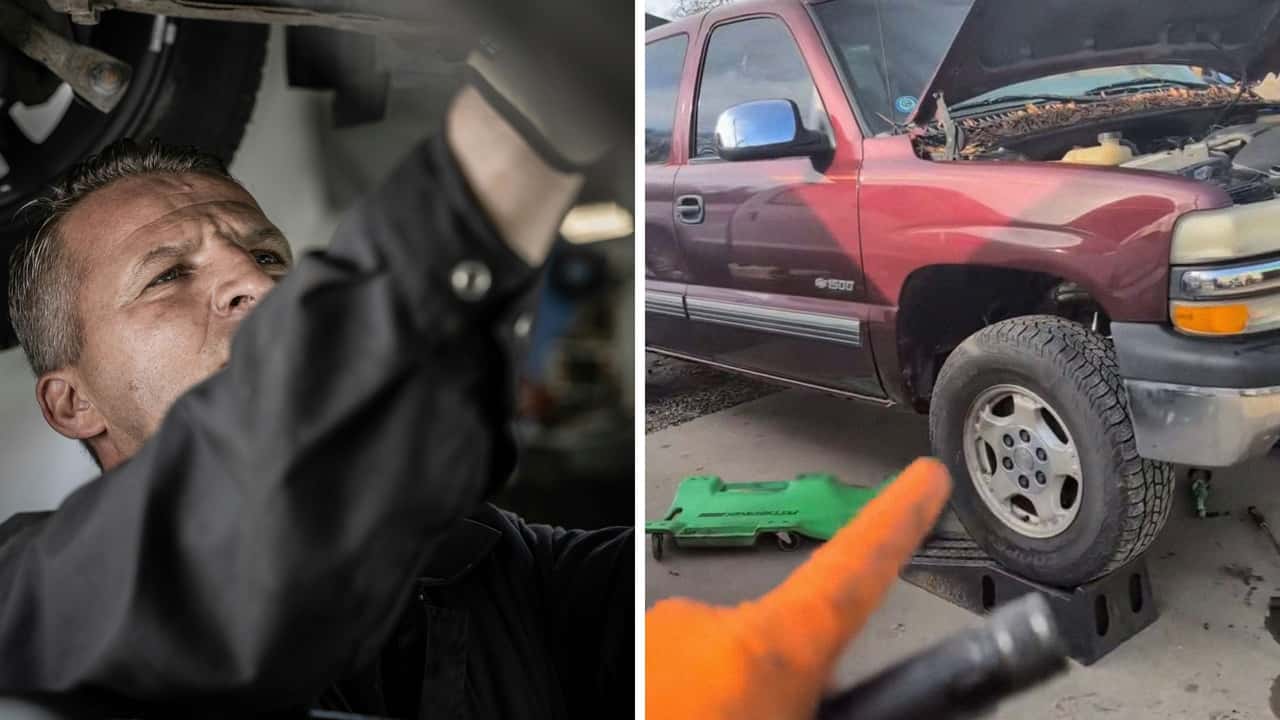
Twisted Automotive and Diesel (@twistedautodiesel), an automotive and diesel shop based in Jacksonville, Arkansas, posted a TikTok documenting the diagnosis. The video starts with a purple 2002 Chevrolet Silverado with its front wheels on risers, then takes us on a journey under the car to the source of the noise.
According to the tech, the truck’s owner had recently tackled a rear main seal replacement himself—no small feat on a four-wheel-drive vehicle. The job necessitates separating the transmission from the engine, and moving the transmission or cross member to access the seal, a labor-intensive process that can cost $600 to over $1,200 at a shop.
“Props to him, he did his four-wheel drive,” the mechanic says in the video, acknowledging the owner’s can-do approach. “So he dropped the transmission.”
The problem started immediately after the repair was complete. “This guy, as soon as he started up, he had a knock,” the mechanic explains. “And he’s like, ‘Well, surely I didn’t mess nothing up.’”
The owner first took the truck to a different shop, where he got a grim prognosis. “The other shop had quoted him a motor, per what I’ve been told, a lower end knock,” the mechanic says.
Rather than taking the high-dollar diagnosis at face value, Twisted Automotive started again from first principles. “I checked everything outside as best I could, you know, listen with a stethoscope,” the mechanic explains. “There’s nothing in that engine that is knocking.” (The mechanic is likely speaking metaphorically about using a stethoscope to diagnose an engine problem.)
The video then takes viewers underneath the truck for an extreme close-up of the engine components, and a look at the real problem.
“Well, looky here. Can you see right here? Do you see that torque converter stud or that bolt? See how it’s making contact?” the mechanic points out, with his phone flashlight illuminating the area. “That sucker’s spinning around and just bang, bang, bang, bang, bang, bang. That’s the knock.”
The problem turned out to be remarkably simple. A bolt that came loose after the rear main seal job was now spinning freely and striking the back of the engine block with every revolution. According to automotive diagnosis site CarAraC, a loose torque converter bolt makes noises that sound like a connecting rod knock or piston slap—exactly the kind of sound that could lead to a misdiagnosis.
“This guy was just quoted an engine, and all we have here is a bolt that was not there, and it’s sitting there whacking against the back of the engine just enough to make a tappy, tap, tap, tap, tap, tap,” the mechanic says.
AAA recommends getting a second opinion for unexpected, expensive repairs, noting that “even the most seasoned mechanics aren’t immune from mistakes.”
The tech’s discovery avoided what could have been an eye-watering bill for a customer with an older model truck. “A second opinion is always good, you know, because who can afford another five grand plus labor for an engine?” the mechanic notes.
That estimate tracks with real-world costs. Advance Auto Parts lists remanufactured engines for a 2002 Chevrolet Silverado 1500 at prices ranging from $2,300 to $4,600—and that doesn’t include labor.
Asked by a commenter whether the bolt was cross-threaded or simply loose, Twisted Automotive responded: “Just loose. He didn’t use any lock tight when he put them back in.”
It’s an easy oversight to make in the midst of a complicated DIY repair, but it’s a good reminder that tiny missteps can have dire consequences. Automotive forums recommend using blue Loctite on torque converter bolts to prevent exactly this kind of problem.
As user hillbillyherman3 remarked in the comments, “You have got to lock tight them bolts. They back out.”
In the comment section, viewers posted about similar situations in which sinister knocks turned out to have causes that were easily fixed.
“Just saw something similar week before last. Sounded like a knock but it was a loose flywheel. Tightened it up and it’s perfect now,” wrote robbob.
Another commenter recounted a strikingly similar DIY mishap. “A few days after finishing my first overhaul on my 75 Chevy Malibu 350, the engine developed a lower end knocking,” they wrote. “It turned out to be that I’d forgotten to torque the flex plate bolts to the crankshaft. I’m glad nobody bought it for $300.00 I tried to sell it for.”
Several commenters aired suspicions about the original shop’s diagnosis. “The mechanic shop saw that bolt. They just wanted to sell a new engine,” wrote David.
Others offered tips on faults that can masquerade as lower end knocks. “Cracked flexplate sounds just like a rod knock too. Never hurts to confirm what might seem like an obvious diagnosis,” wrote Pops2190.
For DIYers, the video shows that the devil is in the details—properly torque all fasteners and use thread-locking compound where appropriate. For vehicle owners facing catastrophic repairs, it shows that a second opinion can save thousands.
For everyone, it shows that methodical troubleshooting can work wonders.
As user cbreisen wisely noted: “If I take something apart to fix it and incur an additional problem after I reassemble it, I’m gonna retrace my footsteps.”
Motor1 reached out to Twisted Automotive and Diesel via email. We’ll update this if either responds.
We want your opinion!
What would you like to see on Motor1.com?
– The Motor1.com Team