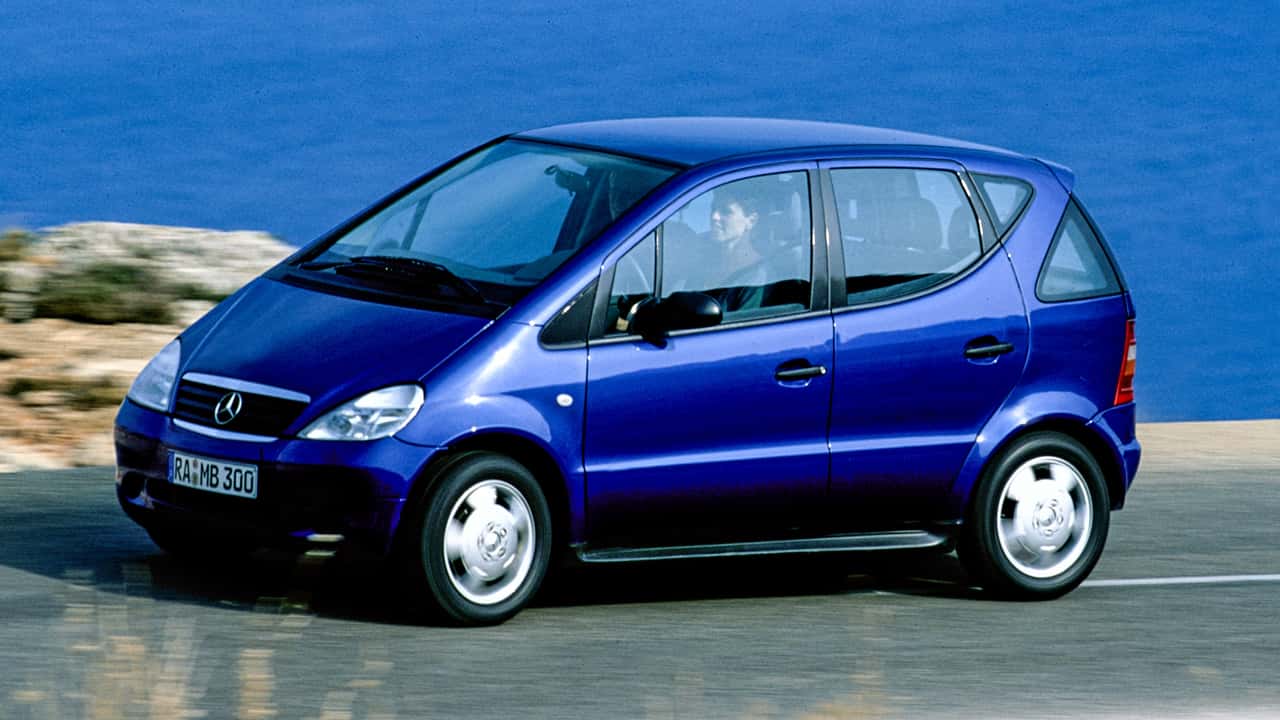
No, this is not a joke. However, Mercedes built only a few in 1997 before the infamous moose test prompted it to stop production.
Somehow, every new model year that becomes eligible for Germany’s historic plates makes us feel old. But the coveted classic-car status comes once a vehicle reaches 30 years old. That means 2027 will put the 1997 model year in the spotlight, including one of that era’s most controversial cars: the Mercedes A-Class.
Early examples of the Mercedes M-Class, A-Class, and CLK Coupe can qualify for historic “H” plates in Germany in 2027. To be registered as a historic vehicle, a car must be at least 30 years old and pass an inspection under Section 23 of Germany’s Road Traffic Licensing Regulations (StVZO).
For the maintenance and repair of the brand’s youngtimers and classics, Mercedes-Benz Classic oversees roughly 160,000 different genuine parts. They play an important role in keeping classic vehicles on the road long-term. The range focuses on components relevant to drivability and safety. Many parts are available within 24 hours through around 3,000 authorized Mercedes-Benz dealers in 170 countries.
Mercedes M-Class model series 163 (1997)
The Mercedes M-Class of the 163 series, introduced in 1997, helped shape what was then the young sport utility vehicle (SUV) segment. Mercedes unveiled the M-Class in April 1997 at its new plant in Tuscaloosa, Alabama, built specifically for its production. With independent front and rear suspension and permanent all-wheel drive, the off-roader combined on-road comfort with off-road capability. On the rear, however, the badge always read ML after BMW objected.
Available replacement parts for the 163 series include the Mercedes star emblem (A 163 888 00 86, €119.52) and the front fenders (left: A 163 880 01 06; right: A 163 880 02 06; €566.34 each), as well as the transfer case (A 163 280 08 00, €5,651.57), automatic transmission (A 163 270 23 00 80, €7,120.34), and the V8 engine from the ML 500 introduced in 2001 (A 113 010 83 02 80, €24,831.10).
The A-Class of the 168 series represented a fundamentally new vehicle concept. It was presented in March 1997 at the Geneva Motor Show. The A 140 and A 160 were available at launch, with additional engine variants following later. Only four examples of the wild, twin-engine A 38 AMG were built.
Still, only a small number of A-Class models are likely to qualify for an H plate as early as 2027. Sales began on October 18, 1997, but production was halted less than four weeks later. The reason was the famous “moose test” conducted by a Swedish automotive magazine, during which the A-Class tipped over. Production did not resume until late February 1998. The A-Class then became the world’s first car to come standard with the Electronic Stability Program (ESP).
A defining feature of the body structure used by the first A-Class generations is the sandwich concept: In a frontal crash, the drivetrain can slide beneath the passenger cell, helping reduce the risk of injury to occupants. Mercedes-Benz Classic offers replacement parts for the first A-Class ranging from the hood release cable (A 168 880 00 59 64, €42.63) and third brake light (A 168 820 00 56, €128.53) to a complete automatic transmission (A 168 370 45 00 88, €7,000.21).
Mercedes-Benz CLK Coupé model series 208, photo from 1997
Mercedes debuted the CLK Coupe of the 208 series in January 1997 at the North American International Auto Show (NAIAS) in Detroit. It followed in the tradition of the E-Class coupes, but was developed as a standalone model series using the 202-series C-Class as its technical basis. Engine choices ranged from the CLK 200 to the CLK 320 and CLK 430. One year after the coupe, the CLK Cabriolet was introduced in 1998. Available replacement parts include the instrument cluster (A 208 540 39 11 80, €817.74) and the trunk lid (A 208 750 01 75 28, €994.36).
The Modern A-Class:
We want your opinion!
What would you like to see on Motor1.com?
– The Motor1.com Team