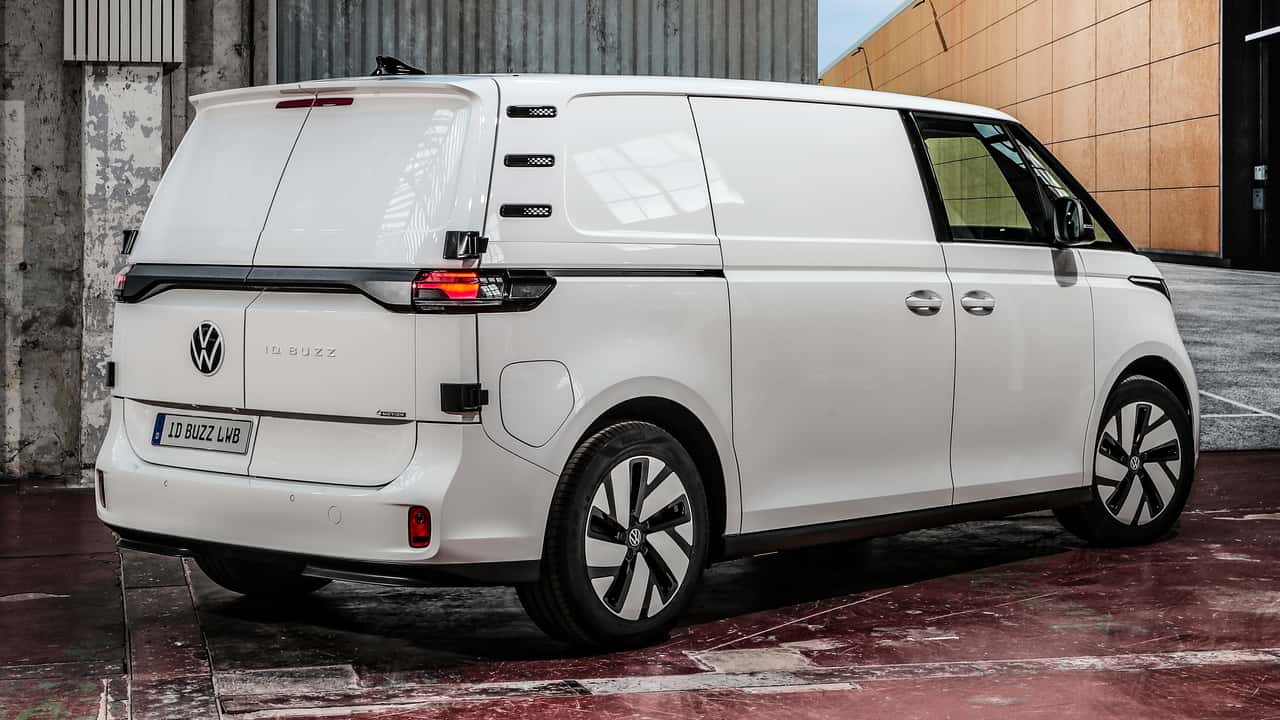
The electric work van just got bigger, more practical, and better suited to getting the job done.
Better late than never, Volkswagen Commercial Vehicles is giving the ID. Buzz Cargo a little more room to stretch its legs. The electric van is now available with a long-wheelbase configuration, adding 250 millimeters (9.8 inches) to the wheelbase and giving cargo capacity a useful bump. Thanks to the LWB treatment, the zero-emission workhorse can now swallow up to 4.4 cubic meters (155.4 cubic feet) of stuff, or 0.5 cubic meters (17.7 cu ft) more than the standard-wheelbase version.
The load floor is now 2,458 mm (96.8 inches) long, while the width between the wheel housings remains 1,230 mm (48.4 in). And because one sliding door wasn’t enough, the LWB now comes standard with a second one. Better yet, it’s 190 mm (7.5 in) wider than before, meaning a Euro pallet can now be loaded through the side door. That’s the kind of upgrade that matters a lot more to a van operator than another ambient lighting color or screen.
The ID. Buzz Cargo LWB is rated to pull up to 1,800 kg (3,968 lb) with a braked trailer, regardless of whether it’s the rear-wheel-drive or all-wheel-drive version. It gets its juice from a slightly larger battery than the standard-wheelbase Cargo, with 86 kWh versus 79 kWh. Stick with the single-motor variant, and the RWD model packs 286 horsepower. Upgrade to the dual-motor configuration, and you get 4Motion all-wheel drive with 340 hp.
2027 VW ID. Buzz Cargo LWB
Be careful which one you choose because payload depends on the drivetrain. VW quotes up to 700 kg (1,543 lb) for the RWD model and 606 kg (1,336 lb) for the AWD version. The LWB Cargo also comes with a wooden load floor as standard and can be configured as either a two- or three-seater. A manually adjustable lumbar support has also recently joined the options list, because even van drivers deserve something resembling proper back support.
The longer body isn’t the only major change. The ID. Buzz Cargo LWB arrives with an upgraded driver-assistance system that can now recognize traffic lights and, when approaching a red light, automatically brake the van to a standstill. Another notable update is the introduction of one-pedal driving. For an electric van that spends much of its life in urban traffic, that could be particularly useful.
2027 VW ID. Buzz Cargo LWB
There’s also Vehicle-to-Load (V2L) functionality, which effectively turns the ID. Buzz Cargo LWB into an enormous mobile power bank. It can supply electricity to external equipment at a continuous output of 3 kW, with peak power reaching 3.6 kW.
Perhaps we’ve saved the best for last, as the steering wheel finally gets proper buttons, replacing the touch-sensitive keys that no one seems to like. We saw this change coming, considering the regular ID. Buzz built to carry people recently received the hard keys it should have had from day one. It’s nice to see VW admitting that sometimes a real button is, in fact, just better.
The ID. Buzz Cargo LWB is already on sale in Germany from €50,630 net for the 4Motion-equipped model, while the rear-wheel-drive version will follow next week at a slightly lower €48,490 net. VW says the long-wheelbase configuration commands a €2,340 premium compared with the standard-wheelbase Cargo.
Motor1’s Take: The new LWB flavor makes a lot of sense. The extra length isn’t there to make the Buzz look bigger. It directly translates into more cargo space and a more useful side door. The new tech goodies are welcome bonuses, too. And then there’s the return of physical steering-wheel buttons. It might sound like a tiny detail, but after years of VW pushing touch-sensitive controls, we’re glad to see the company rediscover the humble button.
The ID. Buzz Cargo LWB isn’t reinventing the electric van, but it’s becoming a much more convincing tool for people who actually use one as a work vehicle.
What’s The Buzz?
We want your opinion!
What would you like to see on Motor1.com?
– The Motor1.com Team