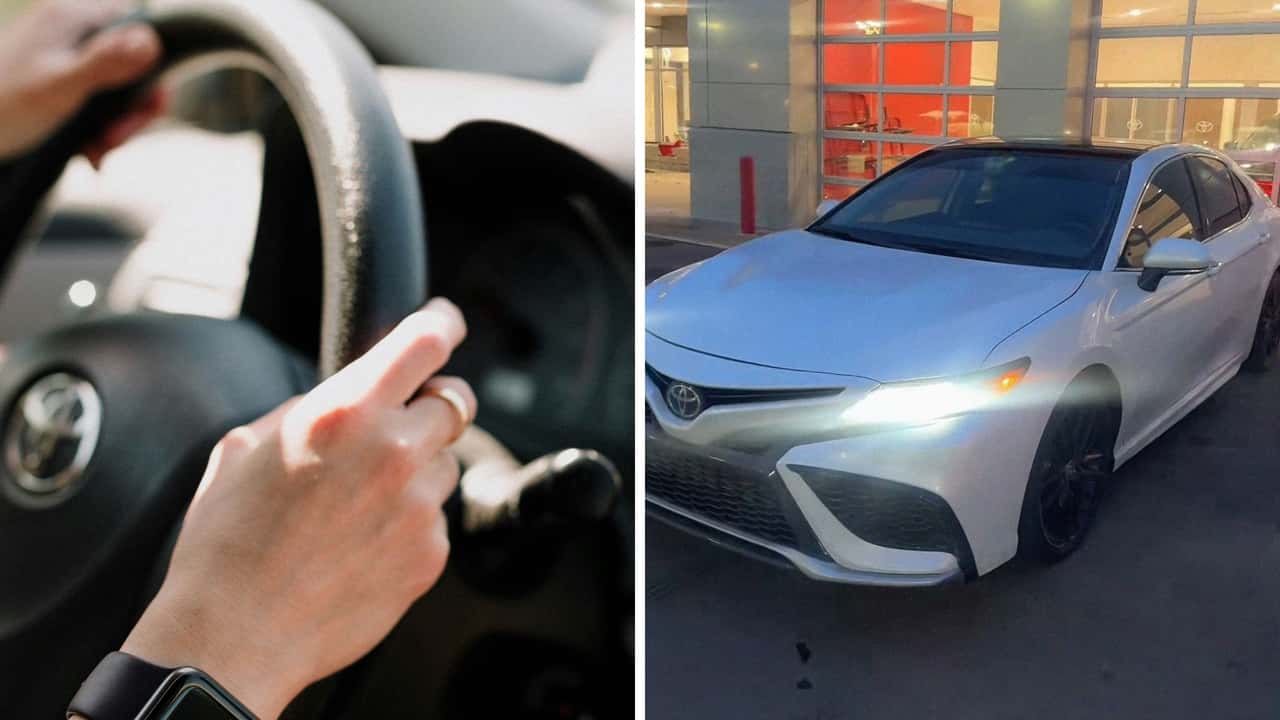
A new deal for the new Toyota Camry XSE.
Personal finance advice often starts with the same list of cliches: skip the $10 lattes, sacrifice a few small indulgences, and debts start to disappear. But when a car dealer frames an upgrade as just $37 more a month, the math suddenly feels different.
In a TikTok posted by Toyota salesman Schneider Lincifort (@schneiderlincifort) in Columbus, Ohio, we hear about how one Camry driver traded in their leased sedan for a brand new 2026 Camry XSE and barely moved the monthly payment needle.
“Would you upgrade for just $37 more a month?” he asks in the caption of the clip that’s been viewed more than 8,600 times.
In the clip, Lincifort explains that the customer had been paying $463 a month for their leased Camry. Instead of finishing the lease, they traded the car in and signed a new deal for the new XSE for $500 a month total.
On paper, the jump sounds small, roughly the cost of eating out at a casual restaurant once a month. Framed that way, the decision starts to feel almost trivial.
But as with most content focused on car buying and automotive economics, viewers quickly started asking questions about details that the salesman didn’t mention. Some focused on the one factor that can dramatically change the math: the length of the contract.
“For an additional 60 months,” one viewer speculated, while another guessed the deal could stretch even longer to 72 months.
Others were less concerned about the financing and more interested in mechanical differences between the cars. The latest generation of Camry models leans heavily on hybrid powertrains, and that quickly became its own debate in the comments.
“One of these cars has an engine in it and the other is hybrid,” wrote one commenter who was strongly opposed to the deal. Another countered, “What do you think a hybrid is? It’s gas and electric.”
The exchange illustrates how quickly conversations about car deals drift away from the numbers and into broader arguments about technology, reliability, or personal preference.
Still, the small payment increase is what made the clip resonate in the first place.
Modern car dealership sales tactics tend to emphasize manageable monthly increments, often with longer loan terms, rather than the total cost of the vehicle. Rather than asking a customer if they’d like to spend thousands more on a new car, the question becomes whether the upgrade is worth a few dozen dollars more per month.
For drivers already leasing, that framing can be especially persuasive, particularly when the result is improved design, upgraded technology, and the feeling of starting fresh with a brand-new vehicle.
Deals like the one described in the video are part of a common strategy in the leasing world known as an early turn-in or pull-ahead. Automakers and dealerships periodically encourage drivers to trade out of their current leases before the contract ends, often when a new generation of a vehicle arrives or when inventory needs to move.
For Toyota loyalists, part of the appeal of the newer model is that the latest Camry represents a fairly substantial refresh for the long-running sedan. Notable improvements on the newest Camry include sharper styling, a more modern cabin, and Toyota’s hybrid powertrain designed to boost fuel economy while preserving the model’s driving experience.
For someone already familiar and comfortable leasing a Camry, the jump to a new model can feel less like we’re placing a car and more like upgrading to a noticeably more modern version of something we already like.
From the dealer’s perspective, the arrangement can work on several levels. The customer gets into a newer vehicle sooner, the dealership secures another transaction, and the previous car can often be resold as a certified pre-owned vehicle.
For drivers, the decision usually comes down to how much value they place on always having the newest version. Auto leasing already functions a bit like a subscription model for transportation, or a very-long, locked-in rental agreement. The upside: predictable payments, limited long-term commitment, and a built-in upgrade path every few years.
But that convenience can come with trade-offs since starting a new lease resets the clock on payments and mileage limits. That means the overall cost of driving new vehicles continuously can add up over time.
That reality is part of why reactions to deals like the one in the video tend to fall firmly into two camps. Some viewers see a modest monthly increase as an easy way to enjoy the newest features and styling. Others instinctively focus on the bigger financial picture behind the numbers.
That stark divide is likely why such a short clip keeps drawing attention and comments. A $37 difference may sound small on paper, but for many drivers, the real question isn’t the price of the upgrade. It’s whether upgrading is worth it at all.
Motor1 reached out to Lincifort via phone and email. We’ll update this if he responds.
We want your opinion!
What would you like to see on Motor1.com?
– The Motor1.com Team