‘They should teach this in drivers ed.’
Brake failure is one of those nightmare scenarios most drivers assume (or at least hope) will never happen to them. And if it does, most people are likely to panic and won’t actually know what to do to safely get out of the situation.
One man had firsthand experience with this, but thankfully knew what to do. Now he’s passing that on in a TikTok PSA.
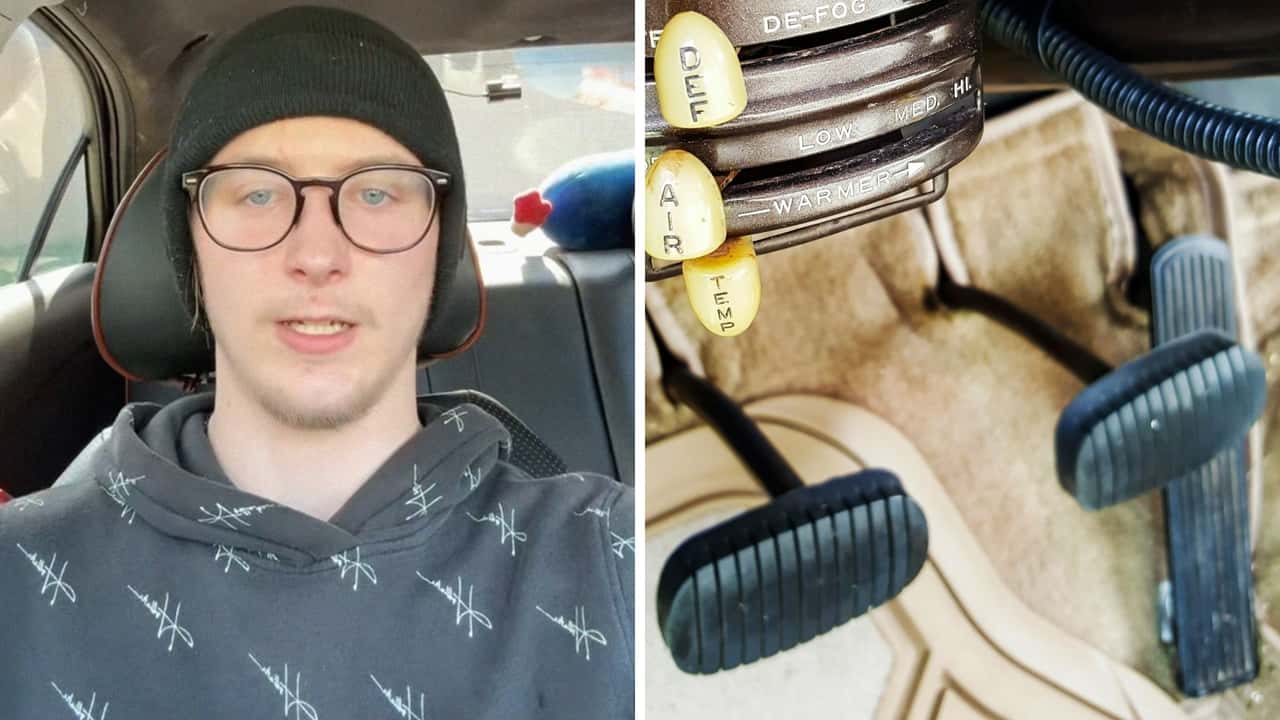
In a viral TikTok with more than 2.1 million views, Pennsylvania content creator Michael (@night_runner_g6) explains that in a previous video, his brakes completely failed while he was exiting the freeway.
“I had no brakes in my car whatsoever,” he says.
He realized how many people had no idea what to do in that situation or didn’t even know what an emergency brake was; hence, the current video.
“Losing brakes can happen like that,” he says, snapping his fingers, “and the warning signs aren’t very clear before the pedal goes to the floor. And it’s a very terrifying experience once that happens.”
His first piece of advice: use the emergency brake carefully. Most cars have a hand lever, a pedal near the floor, or, in newer vehicles, a button. Whatever form it takes, Michael says the key is to apply it slowly.
“You don’t want to pull it up very fast because you’ll lock the rear wheels on the car,” he says.
He explains that the e-brake is a cable mechanism that manually compresses only the rear brake calipers, so it won’t stop you as quickly as your regular hydraulic brakes, but it will slow you down. Apply it gradually, let off a bit, then apply again to avoid overheating the pads.
The second move he recommends is downshifting. Whether you’re in an automatic with a manual mode or driving a stick, dropping into a lower gear creates resistance between the engine and transmission that naturally slows the car.
“Do not shift into neutral,” he says. “Engine braking is way better. It will slow you down much faster.”
And if none of that is working fast enough?
“You’re probably not gonna like it,” he says, “but you need to find a way to stop the car. Your life is way more valuable than anything you have in that car. You need to either ride the guardrail slowly, go into some bushes, go into some grass. Whatever you need to do to slow that car down and keep you safe.”
He closes with a practical suggestion: go practice in an empty parking lot before it ever becomes an emergency. Get up to 15 or 20 miles per hour, take your foot off the brake, and try it.
“It doesn’t hurt to practice,” he says.
Michael’s advice lines up pretty closely with what safety experts recommend. According to Allstate, here’s what to do:
Rare, but not rare enough to ignore. According to data compiled by LookupAPlate, brake failure accounts for roughly 0.44% of all passenger car accidents in the United States, which translates to an estimated 264,000 collisions per year.
Among crashes caused by vehicle defects specifically, brake malfunctions are the second-leading cause, behind only tire failures. The risk also isn’t evenly distributed: brake failure is 1.4 times more likely in summer, when heat accelerates wear, and vehicles older than 15 years are nearly twice as likely to be involved in a brake-failure crash resulting in injury or death.
“This is stressing me out,” a top comment read.
“New fear unlocked,” a person said.
“This happened to me once as a teen and I just drove around in a circle until I ran out of gas,” another shared.
“Mine lowkey scares me cause it’s just a button…,” a commenter added.
Motor1 reached out to Michael via TikTok direct message and comment. We’ll be sure to update this if he responds.
We want your opinion!
What would you like to see on Motor1.com?
– The Motor1.com Team