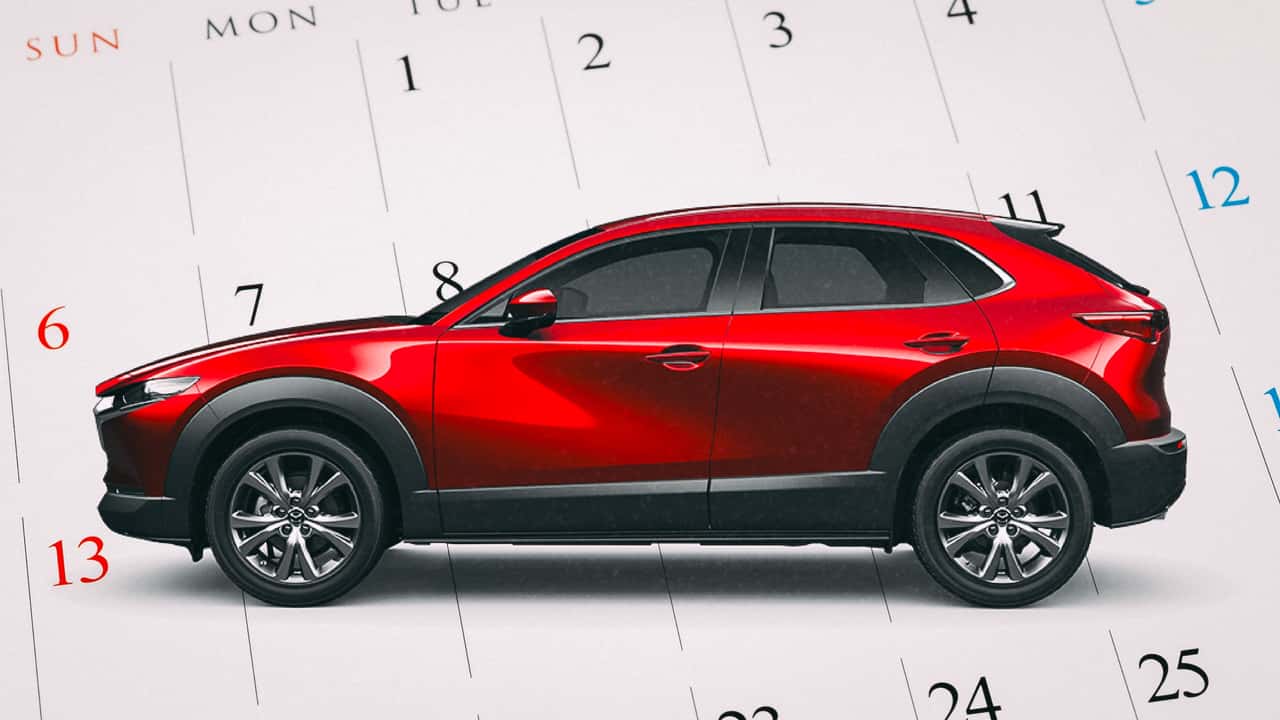
The automaker has no plans to replace the aging CX-30 until at least 2030. That could be better in the long run.
The Mazda CX-30 is getting old—but that’s not necessarily a bad thing.
The tiny crossover debuted in the US for the 2020 model year and has gone largely unchanged since then. Yet it remains Mazda’s second-best-selling vehicle, second only to the CX-5. And for now, the company doesn’t seem to be in any rush to mess with a good thing.
Mazda says a CX-30 replacement isn’t expected until at least 2030. If that timeline holds, the current model will be more than a decade old before its successor arrives. Some of its competitors could already be on their second or even third generations by then.
Mazda CX-30
That may sound like an eternity in the modern auto industry, where automakers seem to redesign everything every few years. But in the CX-30’s case, waiting until the end of the decade might actually be a good thing. As we’ve noted in the past: automakers need to slow down.
The CX-30 is still a very good subcompact SUV. Its design has aged remarkably well, it’s fun to drive, and its relatively old-school interior is arguably more appealing today than it was when the vehicle launched. And while automakers have spent the last decade cramming bigger screens into their vehicles, there’s now growing pushback against the idea that everything needs to be controlled through a touchscreen.
And Mazda itself provides a pretty good example of why.
The redesigned CX-5 was supposed to bring Mazda’s best-selling SUV into the modern era, but its interior has received a lukewarm reception. Much of that criticism centers on the new infotainment system, which relies heavily on a large touchscreen while reducing the number of physical buttons and controls that Mazda owners had become accustomed to.
For a brand that spent years hyping up its “driver-focused” interiors, the CX-5 represents a pretty significant shift. The previous model’s combination of a screen, rotary controller, and physical HVAC controls made it easy to use without constantly reaching toward the dashboard.
The new setup looks more modern, sure, but modern doesn’t automatically mean better. And if buyers are already telling Mazda they preferred the old arrangement, the CX-30 has an opportunity to go in the opposite direction.
Granted, the CX-30 isn’t perfect. Rear-seat space isn’t as generous as some competitors, and fuel economy could be better—especially as hybrids become increasingly common in this segment. But those shortcomings don’t mean the current CX-30 will be completely obsolete a few years from now.
Compared with its competitors, Mazda has generally been less aggressive about redesigning its vehicles. Given that it’s a smaller automaker than Honda, Toyota, and Kia, with fewer resources to throw around, that slower turnaround makes some sense.
Taking more time also allows Mazda to figure out what actually works instead of constantly starting over. With consumers increasingly becoming beta testers for new technology, there’s something to be said for letting other automakers discover what doesn’t work first.
Mazda has the time to see what works—and, more importantly, what doesn’t.
Yes, the CX-30 is starting to show its age. But it’s still a very solid crossover, and Mazda doesn’t need to throw away the entire formula to make it better. It can keep the styling, driving dynamics, cabin character, and physical controls while addressing the areas where the CX-30 genuinely falls short.
The next CX-30 needs more rear-seat space, a hybrid powertrain, and updated safety technology. What it doesn’t need is a giant touchscreen simply for the sake of having one. Mazda should keep the physical controls for the infotainment and HVAC rather than following the CX-5 down a more screen-heavy path.
That’s especially important now that the CX-30’s sales are starting to soften. It remained Mazda’s second-best-selling vehicle in 2025, but US sales have declined since peaking in 2024. That suggests the CX-30 can’t stay exactly as it is forever. But Mazda doesn’t necessarily need to reinvent it, either.
If the next CX-30 can add some much-needed rear-seat room, improve fuel economy with a hybrid option, and bring its safety tech up to date without burying everything behind a touchscreen, it could be one of those rare cases where waiting actually pays off.
The CX-30 may be getting old, but Mazda has something many automakers would love to have: a product that still works. Now it just needs to resist the urge to fix what isn’t broken.
Here’s What We Think
We want your opinion!
What would you like to see on Motor1.com?
– The Motor1.com Team