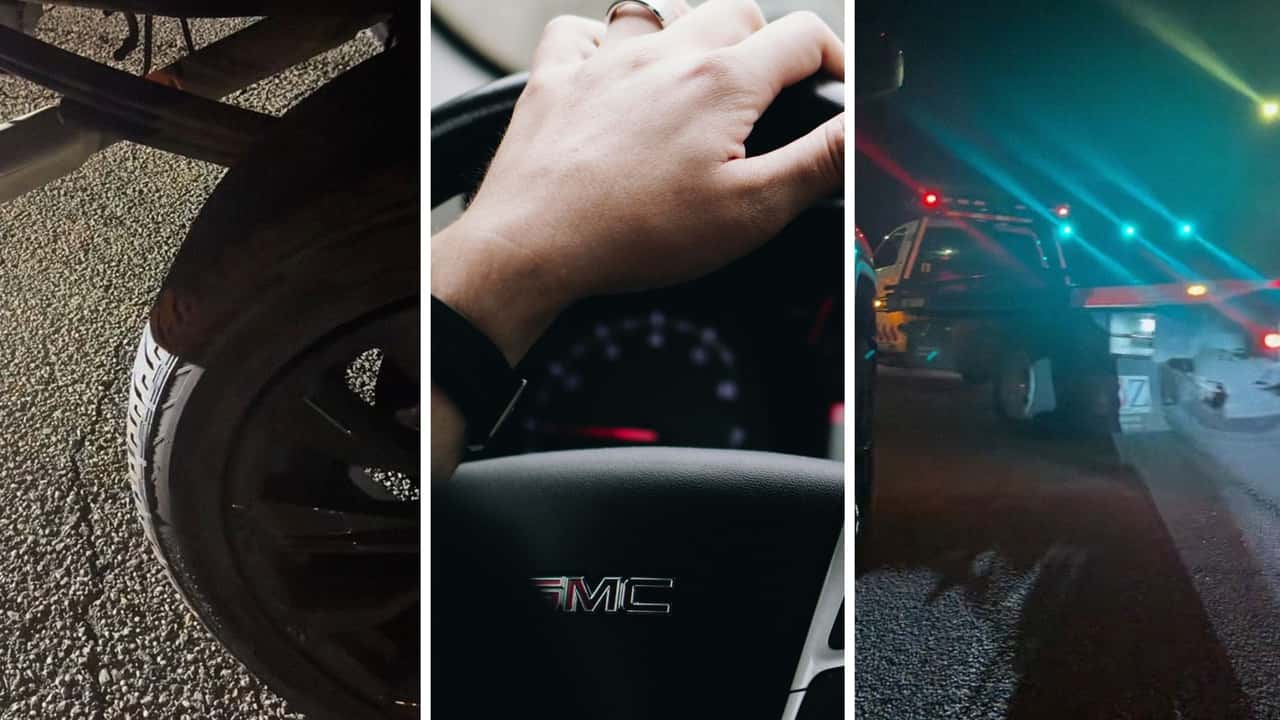
“You might be asking, why is my wheel that far forward?”
Automotive novices don’t need to know much about the inner workings of a truck to recognize when a heavy-duty pickup doesn’t look quite right. In a viral video, it’s clear from the start that the GMC Sierra’s rear wheel has been shoved unusually far forward in the wheel opening.
Alabama used-car dealer and creator Ahmed Bids (@ahmed.bids) quickly realizes that onlookers can tell something is drastically wrong with his truck. “You might be asking, why is my wheel that far forward?” he said in the clip that’s been viewed more than 1,800 times.
A smartphone scan underneath reveals the problems pretty quickly: the snapped driveshaft is hanging loose on the pavement, and the rear differential appears tilted sharply upward.
While looking underneath, Ahmed initially identified the component sitting at the odd upward angle as the transfer case, but viewers quickly caught the mistake.
“I thought that was the differential and the transfer case was connected to the transmission,” one commenter wrote.
“My brain it was late… yes that’s the diff,” Ahmed replied.
By that point, the terminology probably wasn’t his biggest concern because he was responsible for a very heavy truck that was sitting immovable on the road. A tow truck had arrived, prompting Ahmed to announce that “the whole cavalry” was there, while the GMC waited for a much closer inspection.
A driveshaft has a relatively straightforward job that’s performed under significant stress. On a rear-wheel-drive or four-wheel-drive truck, the shaft carries torque rearward through the drivetrain to the differential, which sends that force to the wheels.
Universal joints allow the shaft to continue rotating as the suspension moves and the angles between drivetrain components change.
That means a driver saying a driveshaft “snapped” doesn’t necessarily mean the large steel tube itself broke in half. A universal joint, yoke, or other connection can fail, leaving the shaft hanging loose, much like the one visible in Ahmed’s clip.
A shaft can be bent by an impact or thrown out of balance, which can produce vibration and accelerate wear on joints, bearings and seals. Worn U-joints can create clunks and additional vibration before eventually failing. Dana, which manufactures Spicer driveline components, says inadequate lubrication is the most common cause of premature U-joint and slip-assembly failure.
One viewer raised another possibility while thinking about his own modified 1979 Chevrolet C10, which he said would soon be producing nearly 500 pound-feet of torque from a diesel engine.
That general concern makes sense: modifications that substantially change drivetrain loads or geometry can create problems. There’s nothing in Ahmed’s video, however, showing that excessive torque or a modification caused his failure.
If the failure is confined to a replaceable U-joint, the repair can be contained to a small portion of the vehicle. RepairPal estimates U-joint replacement on a GMC Sierra 2500HD at about $440, including roughly $160 in labor.
Some U-joints can be replaced individually, while vehicles with non-serviceable joints may require replacement of the entire driveshaft.
Ahmed’s truck appears to have more going on than a driveshaft simply coming loose. The rear wheel is sitting far forward in the opening, and the damage underneath looks serious enough that there could be more to sort out once the truck is on a lift.
“I’m scared to even put it on the lift and check,” he said in the comments. “If you heard the absolute destruction that was happening to the undercarriage.”
That means one broken part can escalate into a much bigger repair. NAPA notes that when a driveshaft comes loose, it can damage other parts underneath the vehicle and even make the truck harder to control.
A shop would need to inspect the surrounding drivetrain, suspension, and exhaust components, looking for any other components that may have suffered follow-on damage.
A damaged driveshaft can continue producing vibration, which can damage bearings and seals. And worn drivetrain components can create clunking when shifting between forward and reverse.
The lesson to remember is that simply bolting in a new part without determining why the original one came loose can set the stage for the same problem to return.
For Ahmed’s GMC, the driveshaft lying on the pavement is obvious. Whatever it was that moved enough to put the rear wheel far from where it was designed to be may be the more costly and consequential part of the repair.
Motor1 reached out to Ahmed via direct message and commenting on the clip. We’ll update this if he replies.
We want your opinion!
What would you like to see on Motor1.com?
– The Motor1.com Team