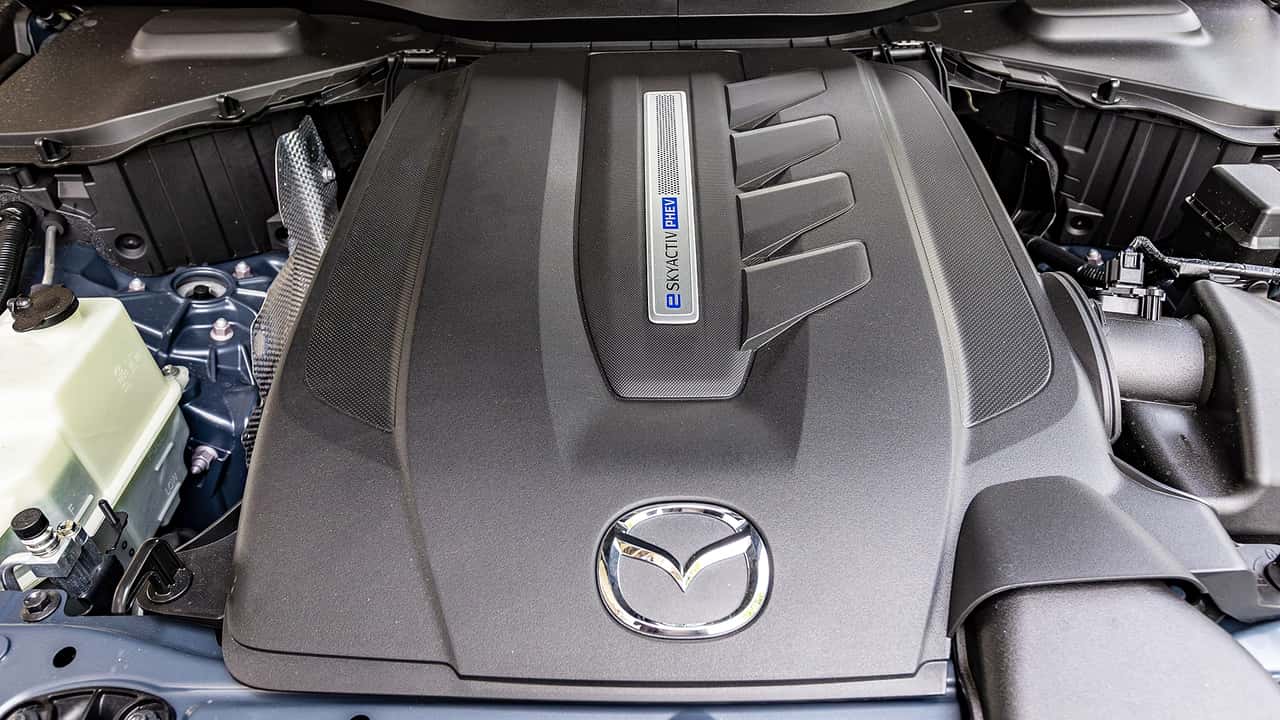
Mazda isn’t quite ready to give up on combustion engines, arguing that gasoline power still has plenty of life left.
Mazda has never been particularly interested in following the automotive herd. While much of the industry has spent the last few years rushing toward an electric future, the Hiroshima-based automaker is perfectly happy doing things its own way. And it apparently has a name for that approach: being a “rebel with a cause.”
That cause is keeping the internal combustion engine alive for as long as it makes sense. Speaking with Car Magazine, Mazda Europe’s Project Manager for Product Planning and Co-Creation, Moritz Oswald, made it clear the company isn’t about to abandon gasoline and diesel engines just because EVs are getting more attention: “Part of our strategy is that we want the right engine for the right customer.”
That means Mazda will continue investing in what it calls a multi-solution approach to electrification rather than betting everything on batteries. As Oswald put it, “We will not kill the combustion engine tomorrow.” And Mazda doesn’t think that would make much sense anyway. “Combustion engines are still, globally, super relevant,” pointing to markets such as the United States and Japan, where EV adoption remains relatively low compared with Europe.
2026 Mazda CX-5
It’s a refreshingly blunt position in an industry that spent years making increasingly ambitious promises about going electric. Mazda isn’t saying EVs don’t have a future. Instead, it’s arguing that the world isn’t a single market with identical needs, charging infrastructure, electricity mixes, or customer preferences. In other words, why force everyone into the same solution?
BMW and Toyota have taken a similar approach, keeping their options open instead of putting all their proverbial eggs into the EV basket. But most other automakers rushed to set end dates for ICE, only to backtrack a few years later after realizing that moving everyone to electric would take much longer than expected.
Mazda3 with Skyactiv-X engine
Looking back, Mazda has a long history of doing things differently, from sticking with naturally aspirated engines when rivals downsized and turbocharged, to developing the unconventional Skyactiv-X gasoline engine and repeatedly flirting with a rotary-engine comeback. The rotary eventually returned, but only as a generator in a range-extending EV.
According to Oswald, he joined Mazda after his boss described the automaker as a “rebel with a cause.” That’s a fitting description for a company that continues to spend money developing combustion technology while much of the industry increasingly focuses on battery-powered cars.
However, there is a fine line between being a rebel and simply falling behind. Oswald acknowledged as much, saying Mazda must keep up with developments because “going from being a rebel with a cause to losing sight of your competitors is a thin line.”
That’s why Mazda isn’t simply freezing its powertrain lineup in time. The company is working on hybrid technology and plans to use electrification to make combustion engines more efficient rather than treating the two technologies as mutually exclusive.
Mazda Skyactiv-Z engine
The Skyactiv-Z is arguably Mazda’s biggest argument for keeping combustion engines around. The new 2.5-liter naturally aspirated four-cylinder will debut in the CX-5 in late 2027, paired with the firm’s first in-house hybrid system. Mazda says it will deliver higher thermal efficiency and a wider operating range than the Skyactiv-G and Skyactiv-X engines it replaces, while meeting tougher emissions standards without losing power.
The company also plans to use what it learns from Skyactiv-Z for its larger inline-six engines and rotary technology. Whether the new engine will go into the Miata is unclear, but a new MX-5 is definitely coming. Well, eventually…
Meanwhile, Mazda has taken the Chinese shortcut to roll out two EVs. The 6e liftback and CX-6e are products of the Changan Mazda joint venture, heavily based on existing models but wrapped in a Zoom-Zoom package.
Motor1’s Take: Mazda’s strategy might look a little rebellious in an industry that spent years racing toward an electric future, but there’s a certain logic to keeping combustion engines in the toolbox. The company isn’t betting against EVs; it simply isn’t betting everything on them. And with Skyactiv-Z coming, Mazda is putting some actual engineering muscle behind that philosophy rather than merely kicking the can down the road.
At the same time, Mazda knows it can’t ignore the EV market. The 6e and CX-6e show that the company is willing to borrow some Chinese know-how while it develops its own path forward. In typical Mazda fashion, it’s trying to have its cake and eat it too: keep the combustion engine alive, add electrification where it makes sense, and hope that being the industry’s black sheep pays off.
More From Mazda:
Source:
Car Magazine
We want your opinion!
What would you like to see on Motor1.com?
– The Motor1.com Team