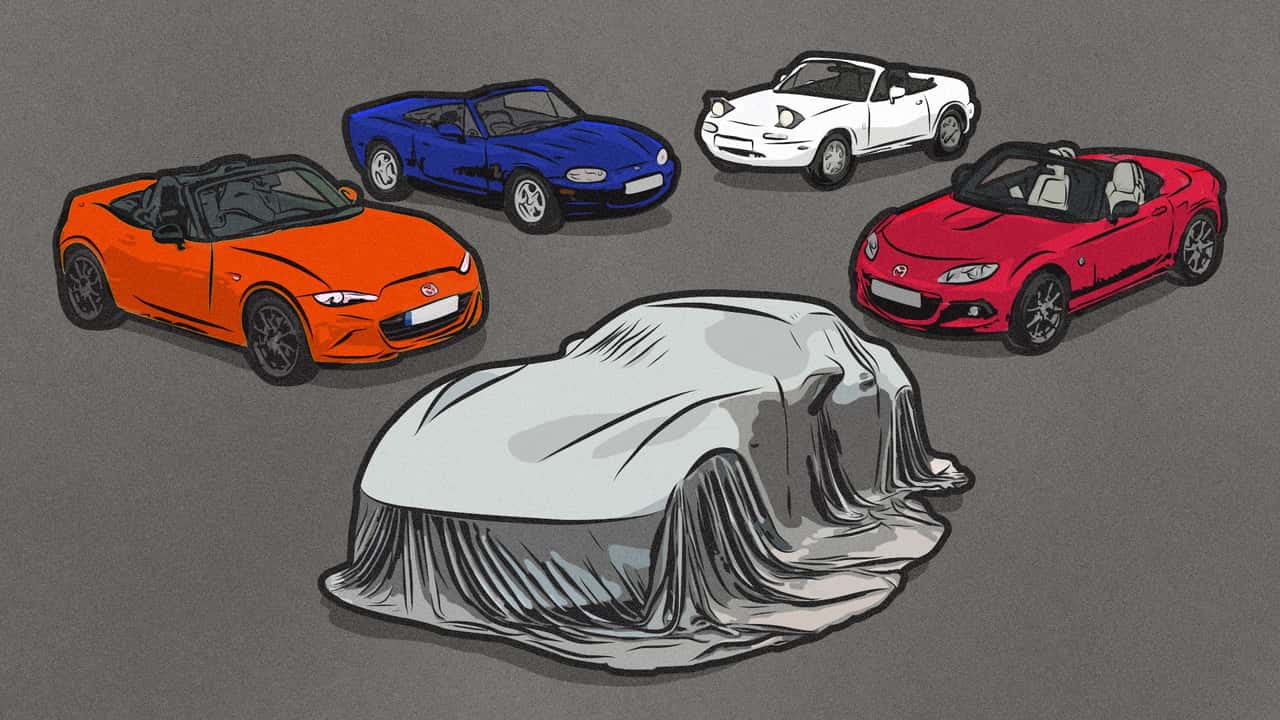
In today’s shocking news, customers aren’t asking for an electric MX-5. Instead, enthusiasts want the Miata to stay light and analog.
Mazda knows better than most automakers that the MX-5 Miata isn’t about having the biggest engine, the quickest acceleration, or the latest technology. It’s about being small, light, relatively affordable, and pure fun. And judging by what customers are telling the company, they want the next-generation roadster to stay that way.
Speaking with CarExpert at the Australian launch of the new electric CX-6e, Mazda Australia managing director Vinesh Bhindi said local customers aren’t exactly lining up to ask for an electric MX-5. Quite the opposite, actually.
‘We don’t see that many customers coming into the showroom and saying, ‘An electric MX-5? That’d be for me.’ At this stage, it’s MX-5 owners… who are all saying, ‘When can I get the pure analog version of the next generation?’ That’s probably more the conversation on the showroom floor, as opposed to electrification.’
Mazda Miata RF
That makes perfect sense for a car whose entire appeal revolves around mechanical simplicity and low weight. Against all odds, Mazda has previously said it’ll get a bigger engine, pointing to the naturally aspirated 2.5-liter unit it’s been working on for a while.
Still a work in progress, the Skyactiv-Z will debut in the CX-5 with an in-house hybrid powertrain next year, and all signs point to the Miata getting it as well. Engineers are targeting a curb weight of roughly 2,205 pounds (1,000 kilograms) or even less for the future roadster.
However, hitting that number won’t be easy, since some form of electrification might be necessary to comply with stricter emissions regulations.
Now comes the part where I begin to speculate. A plug-in hybrid is highly unlikely, since a sizeable battery would add a massive weight penalty. There would also be packaging issues, given how small the Miata has always been. A Toyota-style full hybrid doesn’t seem like a good fit for a sports car, either.
Consequently, Mazda could make the smallest compromise and take the mild-hybrid route while living up to its promise of keeping the manual gearbox and rear-wheel-drive setup.
Mazda Miata RF
Regardless of the path Mazda chooses, the message is pretty clear. People buying an MX-5 aren’t showing up at the dealership asking for fewer engine noises, more battery cells, and a heavier vehicle. They’re asking Mazda to leave the recipe alone, but something must change to keep the car on sale worldwide.
The ND generation has already lost its 2.0-liter engine in Europe for failing to comply with stricter emissions regulations, leaving buyers stuck with the smaller 1.5-liter unit. Yes, that’s the engine the car was primarily developed around, but speaking from personal experience, having the choice of a beefier setup was always good to have.
There haven’t been any credible spy shots of the next-generation MX-5 yet, which suggests the new Miata is still a fair way from reaching production. Given how early prototypes typically show up ahead of a launch, the next-generation roadster is likely at least two years away, if not longer. That gives Mazda plenty of time to figure out how to add whatever electrification is necessary without messing with the Miata’s lightweight, back-to-basics formula.
Hopefully, Mazda won’t have to neuter the next-generation model for Europe’s overly regulated car market. While they’re at it, a return of the Japan-only elusive coupe, but with global appeal, would be just dreamy. A proper coupe would be lighter than the Miata RF by ditching its complicated hardtop-folding mechanism and would be a good option to have, but it’s wishful thinking at this point.
Even if the ND sticks around a while longer, you won’t hear many people complaining. It’s about as close to perfect as a sports car gets, as long as you can fit inside…
A New Miata Is Coming (Eventually):
Source:
We want your opinion!
What would you like to see on Motor1.com?
– The Motor1.com Team