Toyota expects to make $1.7 billion a year selling its next-generation engines to other automakers.
Toyota has long said combustion engines won’t disappear anytime soon, even as much of the automotive industry shifts toward electric vehicles. In 2026, developing an entirely new family of internal combustion engines is practically unheard of, making the Japanese automaker’s commitment to gasoline power all the more unusual.
Most automakers are updating existing engines to comply with increasingly strict emissions regulations, including the upcoming Euro 7 rules. All-new engine families have become rare as manufacturers pour money into electrification and try to cut development costs. Toyota, however, is taking a different approach: developing a new generation of combustion engines and trying to sell them to other automakers.
According to Automotive News, Toyota expects to generate around €1.5 billion ($1.7 billion) annually from external powertrain sales by 2032. The company is targeting €500 million ($562 million) in orders this year, with deliveries of its next-generation engines and hybrid powertrains expected to begin as early as 2027.
Toyota’s new 2.0-liter, four-cylinder engine
Toyota hasn’t named potential customers, but it already has close ties with several domestic brands. Daihatsu is a wholly owned subsidiary, while Toyota holds 21.5 percent of Subaru’s voting rights and a 5.1 percent stake in Mazda. Those relationships could give the company access to a combined production ecosystem of roughly 16 million vehicles annually, more than half of which wear Toyota, Lexus, or Daihatsu badges.
The company already supplies components and powertrain technology to some of its partners. The Mazda CX-50 uses Toyota hybrid technology, and the Mazda2 sold in Europe has also used Toyota’s hybrid system. Subaru, meanwhile, uses electrical components from Toyota in its latest hybrid tech, and Suzuki has adopted various Toyota engines.
However, that doesn’t mean every partner will rush to adopt the new engines. Mazda is developing its own hybrid system for the redesigned CX-5, paired with a next-generation four-pot called Skyactiv-Z, aka the “ideal internal combustion engine.” Subaru also plans to keep developing its signature horizontally opposed boxer engines, with engineers targeting 50 percent thermal efficiency. In 2024, the three companies teamed up to develop engines together.
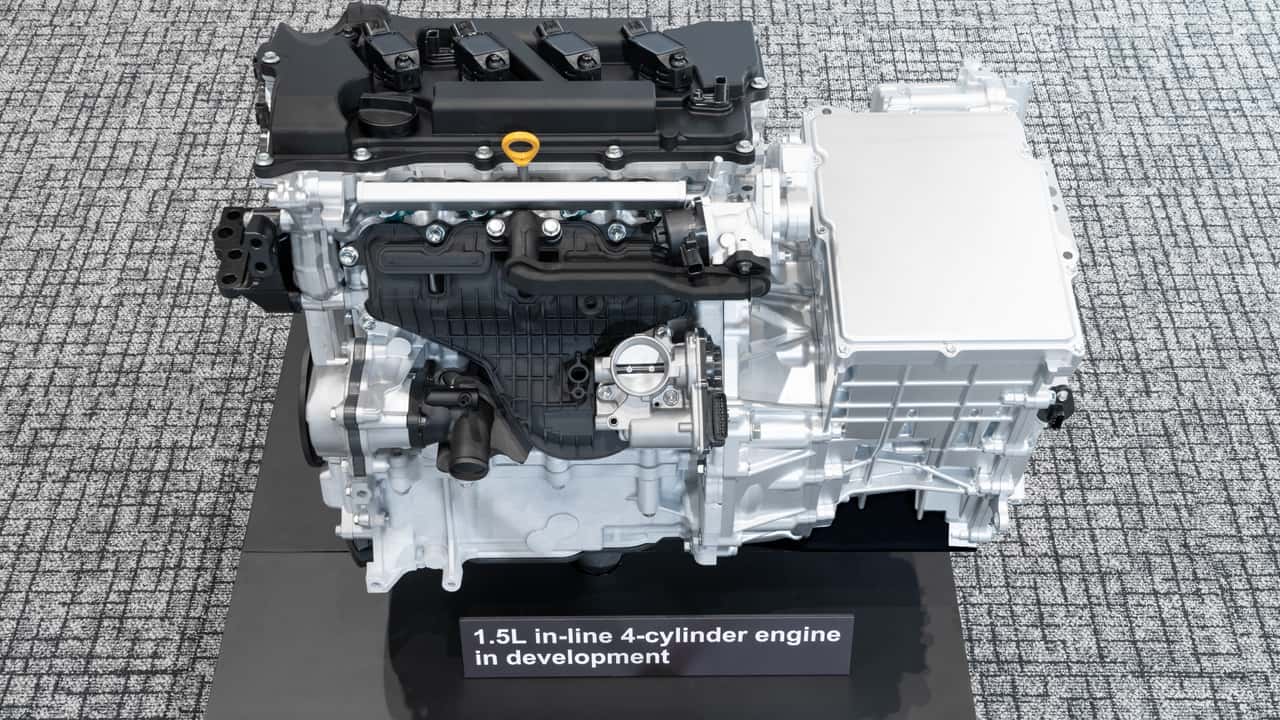
Toyota’s new 1.5-liter gasoline engine
Mazda and Subaru have their own engineering priorities and brand identities to protect, so Toyota will need to make a compelling financial and technical case for its new powertrains. Still, sharing development costs and increasing production volumes could make the deal attractive to manufacturers that don’t want to shoulder the expense of developing an entirely new engine family themselves. Toyota, meanwhile, could spread its investment across a much larger customer base.
For now, Toyota’s priority is clear. While the industry races to electrify, the world’s largest automaker is betting that cleaner combustion engines will remain relevant for years to come. Rather than keeping its latest technology to itself, Toyota wants to turn it into a lucrative business by getting other automakers to buy in, too.
Toyota previewed its next-generation combustion engines in 2024, and we’ve covered their development here. The new family includes a naturally aspirated 1.5-liter four-cylinder, a turbocharged version of the same engine, and a 2.0-liter turbocharged four-cylinder. Toyota says the new units will be more compact and efficient than their predecessors, with the turbocharged 1.5-liter targeting the same power output as a conventional 2.5-liter naturally aspirated engine. The larger 2.0-liter turbo, meanwhile, aims to deliver more power than today’s 2.4-liter turbo while improving fuel economy.
Toyota is developing these engines with electrification in mind, rather than treating combustion and electric power as mutually exclusive technologies. The smaller engines will work with hybrid systems, while the 2.0-liter turbo can also operate independently or as part of an electrified setup. Their compact dimensions should make them easier to package across different vehicle platforms, including those designed to accommodate multiple powertrain options.
As for the twin-turbocharged 4.0-liter V8 developed for the GR GT, Toyota isn’t currently including it in its external powertrain sales plans. The engine could power something other than a supercar, so we won’t rule out seeing it in a Lexus or, especially, a Century. The latter is now a standalone brand at the top of Toyota’s hierarchy, so it clearly deserves the best.
Toyota’s New Engines:
Source:
We want your opinion!
What would you like to see on Motor1.com?
– The Motor1.com Team