Excavators might be the ultimate base machine to modify — there is certainly no limit to the creativity that can be infused into customizing an excavator. While OEMs do offer custom configurations and options, contractors and modification specialists around the world are the best at tailoring machines to unique local applications.
I've been fortunate to travel in Canada and to other countries to see some incredible customized excavators that work in the dirt, on the rails, on the water, and in the woods. Most designs start with a phone call from a contractor, a challenge that presents itself on a project, or an initiative to better serve a contractor and improve their bottom line with a tailored equipment solution.
What fascinates me most about custom excavators is that they are the ultimate reflection of the builder — how they see a problem and the solution to that problem — translating their thoughts into steel, welds, and hydraulics. While some customizations may be repeated by other operations, each of these machines is unique in the way it was built to address the specific problem it was tasked with. Because, as we all know, no two job sites are exactly the same.
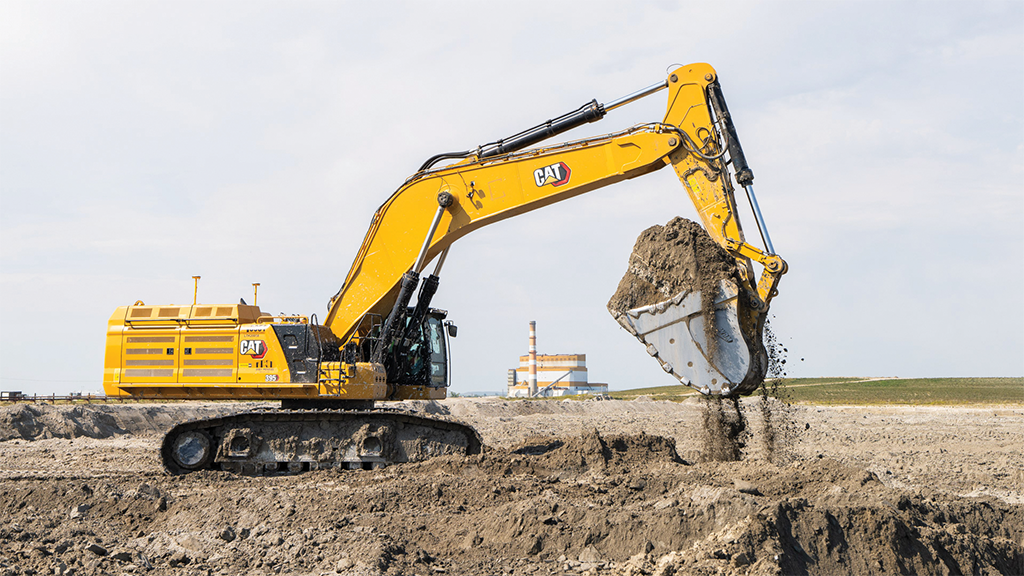
How do you move a lot of material in a hurry? A bigger bucket usually does the trick. KPCL Dirt Movers' (Kelly Panteluk Construction) two Cat 395s are a fine example of why bigger buckets can really make a difference on large earthmoving projects.
KPCL was tasked with excavating 1.6 million cubic yards of fly ash at a coal-fired power generating station in southern Saskatchewan. Fly ash is the byproduct of burning lignite coal to generate electricity; it is captured and turned to a slurry for long-term storage in ash lagoons.
The reality is, OEMs tend to be conservative when outfitting their excavators with standard buckets, but contractors often encounter materials and conditions where a much larger bucket would be a better pass match for the haulage fleet and would increase production.
For this project, KPCL outfitted the two mass excavation configuration Cat 395s with 10-cubic-yard muskeg buckets built by Weldco-Beales Manufacturing out of Edmonton, Alberta. Muskeg buckets were designed for northern Alberta's muskeg (boggy peat), yet have found their way into other applications due to their wide applicability for earthmoving. A muskeg bucket is deeper than it is wide, allowing for higher capacity. A spade nose lip increases ease of penetration. The larger bucket proved to be an ideal pass match for loading KPCL's fleet of Cat 745 ADTs.
When you think of configuring a mass excavation machine, 3D machine control might not come to mind, but both excavators are fitted with Trimble 3D. The technology is used to track excavated quantities; take point shots in the pit bottom, which surveyors can't access due to water; and ensure the underlying clay liner is not excavated through. Once the project is complete, the machines will find their way onto KPCL's other large earthworks projects in Saskatchewan.
While excavators are usually associated with digging, T & A Rock Works outfitted a Volvo EC300EL excavator with a Junttan Excadrill 51A rock drill for specialized drill and blast projects. Sourced from Finland, the Junttan Excadrill 51A is a unique attachment that turns a conventional excavator into a machine capable of drilling blast patterns in steep and challenging terrain found in urban quarries and residential development projects.
This Volvo EC300EL began its life as a conventional excavator before its conversion at Junttan's facility in Lacombe, Alberta, where the rock drill and an X-125 dust collector system were installed. The drill can reach depths of 29 metres with a 64- to 127-millimetre-diameter bit. The set-up requires 340 to 475 litres per minute of hydraulic flow to operate the drill, compressor, and dust collector system. This drill package also includes Junttan's AutoDrill function and anti-jamming technology to improve drilling performance.
In the cab, an indicator on the monitor shows the orientation of the drill mast, and the operator can drill vertical or angled holes to match the drilling plans. Compared to a dedicated rock drill, T & A Rock Works' excavator-mounted drill can reach more holes without repositioning, is safer to operate on steep slopes, and requires less site preparation work for access to drilling locations.
When I visited the machine, it was completing drilling work on a private residential driveway project on the steep rocky slopes above Okanagan Lake in southern B.C. The machine successfully drilled blast patterns for cuts over 12 metres deep.
In order to build up high, you have to dig deep, really deep. BelPacific Excavating & Shoring has been digging deep in Vancouver, B.C., since 1994 and has completed excavation and shoring work on some of downtown Vancouver's most identifiable skyscrapers. Deep excavation work in this area is incredibly complex: adjacent active roadways, vertical excavation walls, inclement weather, groundwater, developer project schedules, and underground infrastructure all have to be contended with. So how do you excavate material from 100-plus feet deep in a bustling downtown core where space is limited? That's where BelPacific's custom-built Cat 349E Telestick excavator came in for the excavation of 1515 Alberni Street.
To reach the necessary depth for this project, the conventional stick and bucket on BelPacific's Cat 349E were replaced with a Cosben SRL TA-3550 three-stage telescoping stick and a 1.7-cubic-yard clamshell bucket. To accommodate the telestick, BelPacific worked with Van-Ed Equipment to modify the Cat 349E with an additional 4,500 pounds of counterweight, OEM hydraulic lock valves for the boom and telestick attachment, and a secondary auxiliary hydraulic tank for added capacity to operate the telestick. An internal hydraulic ram extended the telestick in three stages down into the hole where the clamshell bucket could scoop loosely piled dirt. In the cab, a 7-inch Brigade monitor provided a live feed of the bucket from a camera mounted on the telestick.
The modified Cat machine removed material from more than 120 feet deep and loaded trucks and pups at street level to make way for the 42-storey 1515 Alberni Street residential tower. In the excavation pit, Cat 349 and 352 excavators were used to dig material and pile it in a central location for the telestick to pull to the surface. The modified Cat 349E averaged 215 cubic yards of dirt removal per day, and the excavation was completed in 15 months. In total, more than 60,000 cubic yards of dirt were removed to make way for eight levels of parkade, the elevator core, and other key building footings.
One of the more surprising applications for excavators is on the railway, where they are extremely useful for maintenance of way work. Given how remote railways often are, and that road infrastructure often doesn't parallel railroad infrastructure, getting machines to the specific area where track maintenance is required can be a challenge. That is, unless you put the excavator physically on the railway tracks.
That's exactly what Saskatoon, Saskatchewan–based contractor Acadia Group of Companies did with their Cat 325 Hi-Rail excavator. The factory-standard Cat 325 was converted by Vancer, a company that engineers and builds maintenance of way equipment for the railroad industry.
The Cat 325 Hi-Rail is made rail-worthy by a pair of flanged wheel sets that lower down onto the tracks and raise up the excavator. A separate pedal in the cab controls the travel direction, forward or reverse, allowing the machine to travel up to 25 mph on the tracks. While you wouldn't expect an excavator to be seen shuttling train cars about, this machine can do that thanks to a built-in vehicle-mounted air compressor for release and controlling of train brakes and a knuckle for connecting to cars.
The Cat 325 Hi-Rail is outfitted with a Rototilt R6 tiltrotator used for ditch work, grading ballast, and other excavation duties. Attachments include a Ballast Tools Equipment (BTE) undercutter bar for cutting out ballast beneath wooden ties, a tinbin dry hydro-vac system, a cold air blower for clearing switches in winter, and an AMI Attachments Graptor Bucket with integrated thumb. A benefit of the Vancer-modified machine is that every attachment needed for railway maintenance is installed on Vancer's in-cab computer system, which makes it easy to switch between and use attachments. With its complete array of attachments, Acadia's Cat 325 Hi-Rail excavator can be seen travelling across central Canada's railway network doing maintenance of way work all year round.
Can excavators float? With the right modifications, they sure can. When it comes to modifying excavators, the Dutch are experts, and Van Tunen's reputation is known around the world. When Van Tunen got the call for excavators capable of working in open water and shallow marsh, they started designing their first amphibious excavators.
Van Tunen acquired Cat 323 and 330 excavators, removed the OEM undercarriages, and replaced them with custom-built pontoons and tracks. While conventional excavators rely on track pads for flotation on soft ground, amphibious excavators rely on airspace in pontoons for flotation on the water. Cleats allow the machine to travel, and the pontoons also have spuds mounted to the outside. These allow the excavators to anchor in place as required. Van Tunen also outfitted these machines with a long-reach front, enabling them to reach 14.5 metres.
But why build machines capable of floating? Amphibious machines don't require barges to work off of, nor do they require road infrastructure. They can transition from dry land to water easily and reach areas that other machines cannot.
The two Van Tunen amphibious excavators were tasked with building artificial islands to provide habitat for birds and additional filtration of water draining from Europe. To do this, both machines were outfitted with Trimble 3D machine control and wrist buckets. Van Tunen also added 600-litre fuel tanks in the counterweights to increase the time between fuelling. There are few machines that can match the amphibious capabilities of these two.
Since building their first triple-boom excavator on a Cat 375 in 1996, Van Tunen has been perfecting the recipe for success and today builds some of the world's largest triple-boom excavators.
A recent project is a Cat 6015 Triple Boom build for an underwater tunnel project in Antwerp, Belgium.
From the factory, the Cat 6015 is a 150-ton machine designed for mining and heavy civil construction projects. Van Tunen purchased the 6015 and removed the OEM boom, stick, and bucket, replacing them with a three-piece boom arrangement. They added four boom cylinders in place of the two OEM cylinders and outfitted the machine with two stick cylinders in place of the original one. Other modifications included additional counterweight and wider and longer track frames.
But why a triple boom? Compared to a long-reach excavator with a typical longer boom and stick, the three-piece boom allows for greater breakout force and higher lifting capacity at reach, and it can conduct precise work very close to or far from the machine.
After the modifications, the completed machine weighs 250 tons, reaches 35 metres horizontally and over 20 metres deep, and can lift 14 tons at full reach horizontally.
The machine was also outfitted with Teledyne PDS marine construction machine control software that allows the operator to see the bucket position underwater relative to the engineered design in real time. During my visit, the machine was chained down to a barge working on the underwater tunnel project. After concrete tunnel elements were placed on the sea floor, Van Tunen's triple-boom excavator went to work covering the tunnel elements with native material and rip rap to protect the submerged tunnel.
If there is one thing the UAE does, it's build ambitious projects, such as the world's tallest building. But what happens when you run out of land to build on? You build artificial islands. To do that, you need a lot of heavy equipment. Headquartered in Sharjah, UAE, is Al Marwan Machinery, one of the largest equipment rental companies in the region. Its fleet of over 3,500 machines includes long-reach and amphibious excavators made for marine construction projects. One machine, however, stands above them all — literally.
This high-bed excavator is a modified conventional KOBELCO SK850 that has been purpose-built for working in the water to help build artificial islands, jetties, ports, beaches, and other infrastructure. Al Marwan's fabrication team custom-built this machine in their Sharjah yard.
The house was separated from the undercarriage, and Al Marwan installed a 5.5-metre-tall riser to raise the machine up, allowing it to sit above the water when working in depths up to 3.5 metres.
The undercarriage was modified to provide a stable base and added flotation in soft underfoot conditions, measuring 7 metres wide and fitted with 1-metre-wide track pads. Unlike a conventional excavator, where the operator climbs into the cab from ground level, this machine requires the operator climb a vertical ladder to access the cab.
The machine is fitted with a custom 22-metre long-reach front and is equipped with a 1.8-cubic-metre bucket.
When in operation, the modified SK850 wades into the water similar to how you would at the beach when going for a swim, with the cab remaining above water level. In total, five high-bed excavators are being built and allocated by Al Marwan for a private marine construction project.
What do you do when an OEM doesn't offer the machine you need? You build it, and that's exactly what Grand Forks, B.C.–based ANM Construction did. The company serves the forestry industry throughout B.C.'s southern interior, building roads, supporting logging efforts, and helping reclaim the land post-logging. This work takes them into the steep terrain of B.C.'s backcountry.
Tasked with cleaning up slash (logging debris), ANM Construction needed a machine that could not only handle the steep slopes, but also climb them without winch assist. For slope work at grades of up to 65 percent, they settled on combining a high-and-wide Timberking TK732 feller buncher undercarriage with a next-gen Cat 330 excavator.
The Timberking undercarriage features beefy final drives from a D7 Cat dozer and a thick 1-inch-steel-plate build. This robust undercarriage allows the machine to self-level at roughly 45 percent tilt, front and back and side to side, when working on steep terrain. The levelling is controlled by a button on the joystick in the cab. The Cat 330 cab was replaced with a Waycon Manufacturing forestry cab that offers better visibility for this type of work.
Penticton, B.C.–based Waycon also built a custom reinforced bucket with two teeth mounted on the heel to help sort timber debris and uproot stumps. The bucket is paired with a Waycon pro link thumb, which can maintain contact with the bucket lip through its entire range of motion, improving the machine's ability to grab tree debris at full reach.
ANM Construction calls this unique machine the 330 Tilter. When I visited, it was cleaning up leftover slash from logging near Christina Lake; this slash is piled and burned to reduce forest fuel load and return nutrients to the forest floor after burning is complete.
__________________________________________________________________________________
Mack Plovie is the president and chief dirt enthusiast of Earthmovers Media.
This article originally appeared in the 2026 Excavators special issue of Heavy Equipment Guide.
100 North East Adams Street
Peoria, IL
US, 61629
Website:
cat.com
304 Volvo Way
Shippensburg, PA
US, 17257
Website:
volvoce.com
22350 Merchants Way
Katy, TX
US, 77449
Website:
kobelco-usa.com