Machine control has been quietly transforming the construction industry for a couple of decades, but 2D, 3D, and automatics for excavators have only achieved large-scale buy-in in recent years. At CONEXPO-CON/AGG 2026, every excavator OEM was discussing machine control, and the prevailing message was that contractors now expect technology solutions to be available and easy to integrate into their operations. This is a seismic transition for an industry that is slow to change. So how did we get here?
I explore that question with Volvo Construction Equipment's Matthew McLean, a machine control specialist who has served as an educator both within Volvo and to operators. McLean has been a part of the construction industry's technology transformation, both in his current role and as a motor grader specialist in the early 2000s. This breadth of experience, from early aftermarket indicate solutions to today's advanced automatics, makes him the ideal candidate to help break down the evolution of machine control for excavators.
Let's look at the technology's development, how contractors came to trust it, and its impact on the construction industry.
While machine control for excavators has only become widely used over the past decade or so, the foundation of modern elevation control technology dates back over 60 years to the invention of the 360-degree rotating laser. Throughout the 1970s and 80s, these rotating lasers paired with sonic sensors could provide elevation control for motor graders and pavers. In the 1990s, advances in total stations and GNSS accelerated the development of 2D and 3D final pass precision grading solutions for dozers and motor graders, and today's "big three," Trimble, Topcon, and Leica, all offered aftermarket machine control solutions.
Precision grade technology is much harder to apply to an excavator, McLean explains. The complexity of joints involved in positioning the bucket, including movements of the boom joint, boom cylinder, arm joint, arm cylinder, and bucket cylinder, all have to be accounted for. This complexity limited machine control options for excavators until the 2010s.
There are two basic types of indicate solutions for excavators, and the first systems were all aftermarket add-ons, says McLean.
One method was to pair a laser sensor mounted on the arm of the excavator with a rotating laser and a grade stake. The excavator-mounted sensor would catch the laser as it rotated, then, depending on where the laser caught the joint, the system would indicate whether the operator was too high or low in relation to their programmed depth requirement.
"The nice thing about lasers," says McLean, "is they had a very loud speaker on them. If you were high above grade, the laser would beep every couple of seconds. As you got closer, the beeping would speed up until it was a solid tone at grade. Some manufacturers did the opposite — a lot of tone when you're far away and quieter when you get close."
This method wasn't the most efficient. After digging, the operator, or a labourer, would have to walk around the site with a laser sensor on a two-metre stick to check whether the excavation was on grade. Each area that wasn't on grade had to be marked with spray paint: one mark for under-dug areas and another for over-dug areas. The operator would then get back to work, either backfilling or digging down as needed, until a consistent grade was achieved.
Rework is what machine control is designed to avoid, and contractors are only paid for digging, not for walking around with a grade stake or fixing work that isn't on target, says McLean.
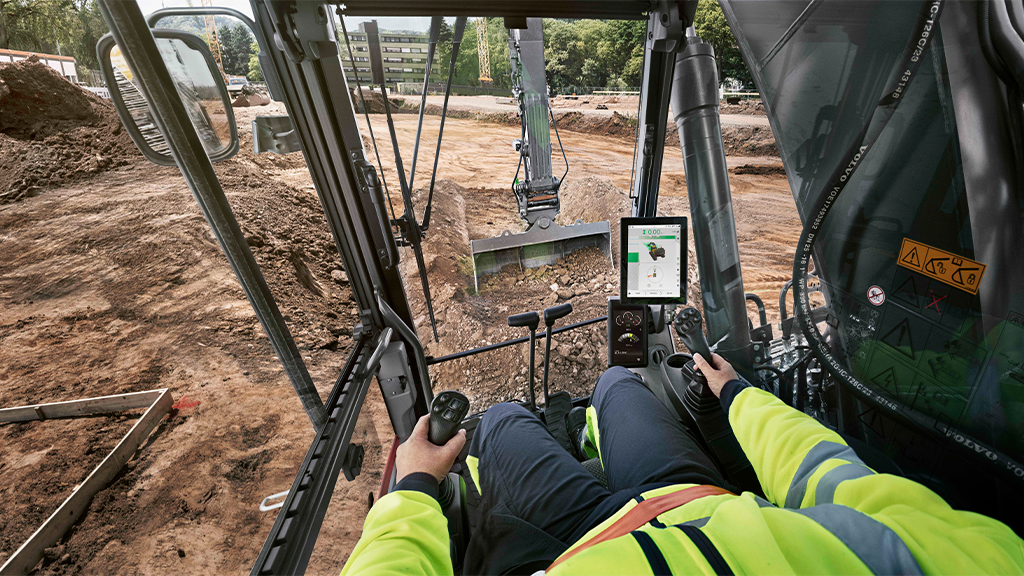
The second method, 2D visual guidance via tablet in the cab, is more efficient and the basis for today's 2D systems. It tells the operator where to dig on a flat plane, relying on sensors that measure the angles of the boom, arm, and bucket to the edge of the tooth. Before digging, the operator sets the bucket down to create an elevation benchmark of zero and inputs the depth they want to dig. As they dig, the tablet displays the depth of the bucket relative to the benchmark.
This real-time visualization of the bucket depth includes both measurements and colour coding. As the operator progresses, the colour changes to indicate whether they need to dig deeper, are on grade, or have gone too far. The colour scale will vary, depending on the system provider, says McLean, but the principle is generally the same.
Initially, both of these guidance methods were only available as third-party additions, but by the mid 2010s, a few OEMs, including Volvo, were introducing proprietary machine control solutions.
Volvo introduced its 2D visual guidance system, Dig Assist, at CONEXPO-CON/AGG 2017 along with In-Field Design software and Co-Pilot, the Volvo-developed, Android-based tablet that serves as the in-cab command centre for software on Volvo machines. Dig Assist 2D relies on robust IMU (internal measurement unit) sensors on the boom and stick and GNSS antennas on the back of the excavator to detect machine rotation. It does not require a base station.
With Dig Assist, the operator can produce compound slopes. It also simplifies trenching, explains McLean. When the operator wants to dig a trench, they can touch two points with the bucket, and the system extrapolates a straight line on the Volvo Co-Pilot screen. The operator just needs to follow the line to dig their straight trench. The screen will let them know if they start digging to the left or right of that straight line.
Volvo later introduced a simpler version of Dig Assist without the GNSS antennas, Dig Assist Start, which comes standard on new Volvo excavators and can be used to produce simple flat surfaces or slopes.
Adding a base station or GNSS receiver allows the operator to use Volvo's In-Field Design to draw complex shapes and slope profiles in the cab on the Volvo Co-Pilot tablet. With this set-up, the excavator can move around the job site, the system knows where the excavator is relative to the design, and the operator can dig to plan.
Select third-party 3D solutions for more complex profiles, such as roadwork that requires curbs, gutters, and utilities, were compatible with Volvo Co-Pilot by 2020, says McLean. With 3D, an engineer draws the plan in the office, producing a CAD file that can be loaded onto the tablet. Initially, USB sticks were used to load plans onto equipment. Today, plans can be transmitted via the cloud to connected machines.
By the mid-2010s, indicate systems for excavators were fairly established, says McLean, but while they can guide operators toward accuracy, indicate doesn't stop them from making mistakes — that requires automatics.
With an indicate system installed, the operator can still over-dig. Once automatics are added, the operator makes far fewer movements to dig to plan, and the automatics will prevent over-digging and the need for rework.
Without automatics, digging a flat plane requires that the operator balance the arm-in function against boom up/down functions and the correct bucket angle. An automatics system eliminates the need for delicate control to hit grade, explains McLean. Once the operator gets within a few centimetres of grade, the automatics kick in, and the operator just pulls back on the arm joystick — the computer will do the rest.
On the excavator, four IMUs — on the bucket's dog bone link, the arm, the boom, and the frame — tie into the machine's computer via controller area network (CAN) bus vehicle communication protocol. An algorithm calculates the position of the edge of the bucket's reference tooth based on the angles of the dog bone, the stick, the boom, and the frame. That information, when tied into the controls, allows the computer to automatically stop boom down movement when the reference tooth gets to grade.
Early automatics just controlled the boom cylinder, says McLean, but the operator could still control the bucket and breach the intended grade. It wasn't perfect, but the system would prevent significant over-digging. As the technology improved, the computer could control the bucket cylinder as well.
Applying automatics to tiltrotators and tilt buckets was more complicated. At first, autos would only work for the tilt function when digging straight and pulling at grade to produce a flat plane, says McLean. Today, automatics are fully compatible with tiltrotators and can be used for compound angles and curves.
Active Control is Volvo's proprietary automatics solution that builds on Dig Assist, and its introduction hinged on Volvo's switch from pilot controls to electro-hydraulic (EH) controls on select E-Series excavators in 2019.
For excavators with mechanical pilot controls, installing automatics is much more complicated. The six hoses that run into each joystick need to be reconfigured with a valve and solenoids to translate electrical signals from the computer into mechanical action on the machine. This integration is a time-consuming, complicated process.
"People who had been using those aftermarket systems were glad to try Active Control because typically electro-hydraulic systems were a lot smoother and faster," says McLean. "If they had previously been using one of those aftermarket systems that intercepted all the hoses, they were game."
By the late 2010s, multiple aftermarket automatics solutions were available, and Komatsu, Caterpillar, and Volvo had all rolled out their own automatics. Komatsu's in-house machine control platform with automatics, Intelligent Machine Control (IMC), was a notable forerunner in 2014. Caterpillar introduced Cat Grade with ASSIST in 2015, and Volvo launched Active Control in 2019.
Today, OEM partnerships with varying combinations of the big three solutions providers, and some smaller players, ensure that 2D and 3D machine control with automatics can be installed on most excavators, either in the factory or as an aftermarket upgrade, and some OEMs offer 2D as standard on new machines. A growing number of OEMs, including Volvo, are fully switching from pilot to EH controls across their new excavator lines to simplify technology integration.
Construction is a conservative industry that is notoriously slow to embrace the latest technologies, especially when a premium price tag comes attached, so it's not surprising that it has taken awhile for machine control to catch on.
As with any technology, the first to jump in were the true believers, says McLean, and there were growing pains, both on the end-user side and on the OEM sales side, as everyone tried to understand the significance and the value proposition of machine control.
McLean recalls first teaching colleagues how to use Dig Assist to dig to a line, which requires that the operator touch two points with the bucket to project the trench's path on Volvo Co-Pilot. An operator touched the bucket to a point in front of the machine, then swung the excavator around to touch another point behind him. When he looked at the line on the screen, it was slanted.
"That actually threw me," says McLean. "In my first training, it's like, ‘What's going on? I thought this was going to be a perfectly straight line.' Then I recognized the fact that on an excavator, the boom is not perfectly centred."
Facing one direction, the boom was on one side of the machine, but rotating to face the other direction meant that the boom was on the other side, so of course it would produce a line diagonal to the intended direction. Volvo worked with customers to address some of these early complications.
Calibration was also more complex on first-generation products, but, McLean says, by 2018 Volvo had made adjustments to the calibration process at the factory, so dealers weren't having to make those adjustments with the customer. It was vital that the system become self-calibrating so the operator could trust the information they were receiving as soon as the bucket touched the ground.
Contractors also needed demonstrations to convince them that machine control was accurate. McLean would position a hardware store laser on the frame, line up the bucket's reference tooth with the laser, and benchmark the position at zero. Then he would move the bucket out in five stages: close, short, medium, medium-long, and all the way out. The tooth touched the laser beam, whether the bucket was all the way in or all the way out, maintaining accuracy within two centimetres, and usually under one centimetre.
The price tag was another barrier. Early machine control systems cost about $50,000, just for the positioning technology. If the machine costs $250,000, that's a 20 percent premium just to know where you're digging, says McLean.
The return on that investment would have to be clear before contractors would commit to the purchase. It first made the most sense for big projects, and McLean cites excavation for factory construction as an example. Large bonuses for on-time completion — and penalties for being late — are at stake on these job sites. The precision technology could ensure that the work was done correctly, and faster, clearly justifying the high financial outlay compared to small-scale work without such bonuses up for grabs.
The value proposition for smaller-scale work, such as digging basements, has since evolved, and machine control now makes sense for those applications, too. Eliminating the time that it takes to lay out stringline and stakes by drawing touchpoints on a screen using In-Field Design delivers significant savings over time, says McLean, adding "Even companies with just one to two machines can make their machine control investment back in months."
Today, over half of Volvo excavators have some form of machine control installed, says McLean, compared to 2018 when total sales were under 50 machines.
"I don't think people were ready for it," he says. "It has only been the last two years that the customers have really come on board and said, ‘Yeah, this makes sense. Let's start using it.'"
There remains a misconception that machine control is hard to install and learn. That may have been the case with legacy systems, but it doesn't bear out in the field today, and growth has become organic.
"The early adopters tried it, and then realized ‘I'm saving 30 percent, 40 percent, 50 percent time on my jobs — and I'm completing my jobs quicker,'" says McLean. When people talk about success, it breeds more success, and contractors have realized that if they want to stay competitive, they have to get in the game.
Integration of machine control architecture at the factory helps. Wires are now pre-run, and some sensors are included on the machine. According to McLean, upgrading a Volvo machine after purchase is now as simple as adding a receiver to the battery box to take the excavator from 2D to 3D, buying an antenna kit, and purchasing the software license. Excavator owners can also call a dealer and ask that other features, such as a weighing system, be remotely activated without taking the equipment off the job site.
"If the customer wants something, there's no reason why they can't have it put on the machine within 24 hours, even if it includes hardware, because the hardware kits aren't that hard to install anymore," says McLean, comparing the process to buying a new laptop. The hardware and software are ready to go. Once you want to use Word, you add a Microsoft licence.
McLean continues to demonstrate machine control at industry events, including CONEXPO-CON/AGG, and finds that contractors are quick to recognize the solutions that best suit their line of work. For a smaller business, that could be the efficiency of In-Field Design for digging pools and basements. For larger contractors, 3D with automatics that can help compensate for a dwindling skilled labour pool.
On any individual job site, machine control can provide reliable accuracy, upskill an operator, and save time. McLean offers an additional perspective on why machine control is so revolutionary. Consider the size of the construction industry and the amount of money that is spent. Now consider what a productivity improvement of 5, 10, or even 30 percent represents. That's an enormous amount of money — it justifies the cost of the technology and accounts for its growth.
"Early in my career, starting in the 1990s, my initial work was transitioning people from the old lever controls over to pilot hydraulics on different kinds of machines. I was getting them to use the hydraulics and experience the benefits of smoother operating, faster operating, and more precision," says McLean. "Now we've converted from pilot over to electro-hydraulic. And, by virtue of that, you can tie in all these technologies that tell you where to dig, help you dig, and tell you how much you've lifted and how much you've loaded. It's just improving the speed at which work can be done."
As the labour market becomes more constricted, machine control won't be optional, remote operation solutions will expand, and development of full autonomy will continue.
"The more work that can be done with less effort, and the least number of people, is where the industry is headed," McLean concludes. "I'm eager to see what's going to happen."
This article originally appeared in the 2026 Excavators special issue of Heavy Equipment Guide.
304 Volvo Way
Shippensburg, PA
US, 17257
Website:
volvoce.com