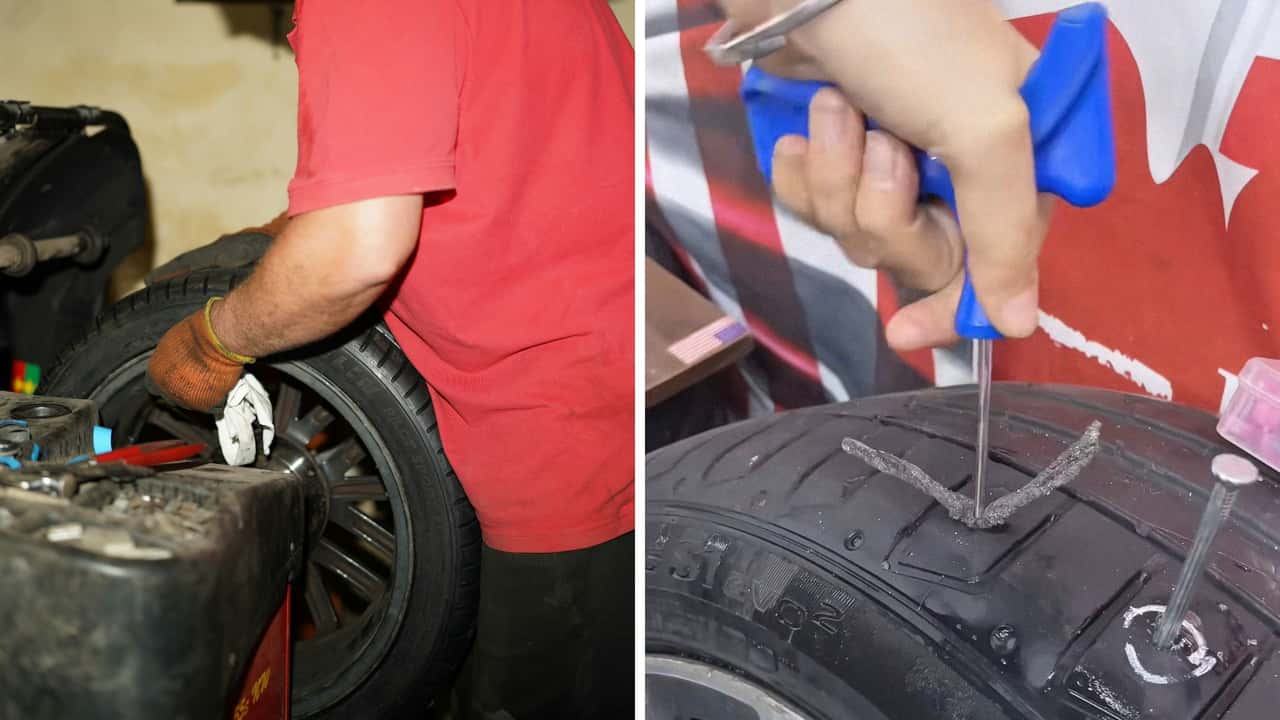
“OR!!! Go to discount tire and they’ll fix it for free.”
Tire repairs have evolved over the decades from patches to plugs.
A viral video claims there’s a revolutionary new solution that makes flat tire fixes easier than ever. The question is: Does this “miracle” product actually work, or is it just another case of social media hype overselling a lesser product?
In a viral video with more than 24 million views, content creator @shine.move2 walks viewers through the history of tire repair methods before unveiling what he claims is the future of flat tire fixes.
“Mechanic will never tell you this trick, and once you see it, you’ll understand why,” he begins.
He explains that in the 1980s, people relied on tire patches, which left a hole exposed on the outside of the tire. Rainwater and debris would eventually erode the repair, creating a risk of secondary damage. Later on, tire repair strips became the standard, but those came with their own challenges.
“These things are hard to push in,” he says. “You have to ream the hole out, and then you just gotta hope that it holds and don’t pull back out.”
Then he introduces what he calls the next evolution: self-sealing rubber screws coated in silicone.
“All you gotta do is pull out the nail or screw that you have in the tire. You don’t have to rim it or anything like that. These are just a little screw, and if you can see, they’re coated in silicon. You just screw it into the tire, and it’ll seal the hole for you.”
The screws come individually packaged in small capsules to prevent them from sticking together or drying out. He claims a pack of 60 of them is currently on sale with free shipping, linking viewers to purchase.
His caption reinforces the pitch: “Flat tire? Don’t get stranded. These self-sealing rubber nails plug punctures fast without removing the tire. Works on cars, motorcycles, trucks & even tractors. A quick fix every driver needs to carry.”
While the video racked up millions of views, the comments section tells a different story.
Many viewers pushed back on the claim that traditional tire plugs are problematic, arguing that when done properly, standard tire plug kits work perfectly fine and have been reliable for decades.
The criticism highlights a common pattern in viral content: presenting old, proven methods as outdated or dangerous to sell a “new” solution—even when the traditional approach is still the industry standard for a reason.
When it comes to fixing a punctured tire, there are three established methods professionals use:
According to AutoZone, tire plugs are the quickest and most accessible repair method. A plug is essentially a piece of tacky rubber that’s inserted into the puncture hole using a reaming tool and probe. The process involves cleaning out the hole, inserting the plug, and trimming the excess, a fix that can be done roadside in minutes.
However, by industry standards, plugs are considered a temporary solution. The Tire Industry Association states that an approved repair requires removing the tire from the rim, inspecting it, and using a combination approach. Dobbs Tire & Auto Centers notes that plugs work best for small, regularly shaped holes in the tread area—not for large punctures, irregularly shaped damage, holes near the sidewall, or spots close to previous repairs. When done properly, though, many drivers find plugs reliable for everyday use.
Patches are flat pieces of adhesive rubber applied from inside the tire. The tire must be removed from the rim, the damaged area cleaned and roughened, and then the patch is placed over the hole. Patches are more durable than plugs alone and require professional equipment, making them more expensive. Like plugs, patches won’t work on sidewall damage or holes larger than a quarter inch.
The gold standard is the plug-patch combo. The patch seals from the inside, while the plug fills the hole from the outside, creating a complete seal. This is what the tire industry considers a proper permanent repair. When done correctly, repaired tires using this method can last seven to 10 years, matching the lifespan of an undamaged tire.
People took to the comments to defend tire plugs.
“We own two shops, please just use a tire plug. it will last the entire life of the tire,” one wrote.
“In the 80s, we used tire plugs. In the 90s, we used tire plugs. Know what we’ve been using since the 2000s? Yep…. tire plugs,” another shared.
“As long as you push the tire plug in with more than 1 lb of force they work,” a third wrote.
“NEVER had a plug fail or come out in 35 years of business,” a fourth added.
Motor1 reached out to @shine.move2 for comment via TikTok direct message and comment. We’ll update this story if they respond.
We want your opinion!
What would you like to see on Motor1.com?
– The Motor1.com Team