“And they will not cover your repair…”
A California mechanic’s warning about warranty practices prompted fleet owners and business operators to take a good look at their vehicle maintenance records.
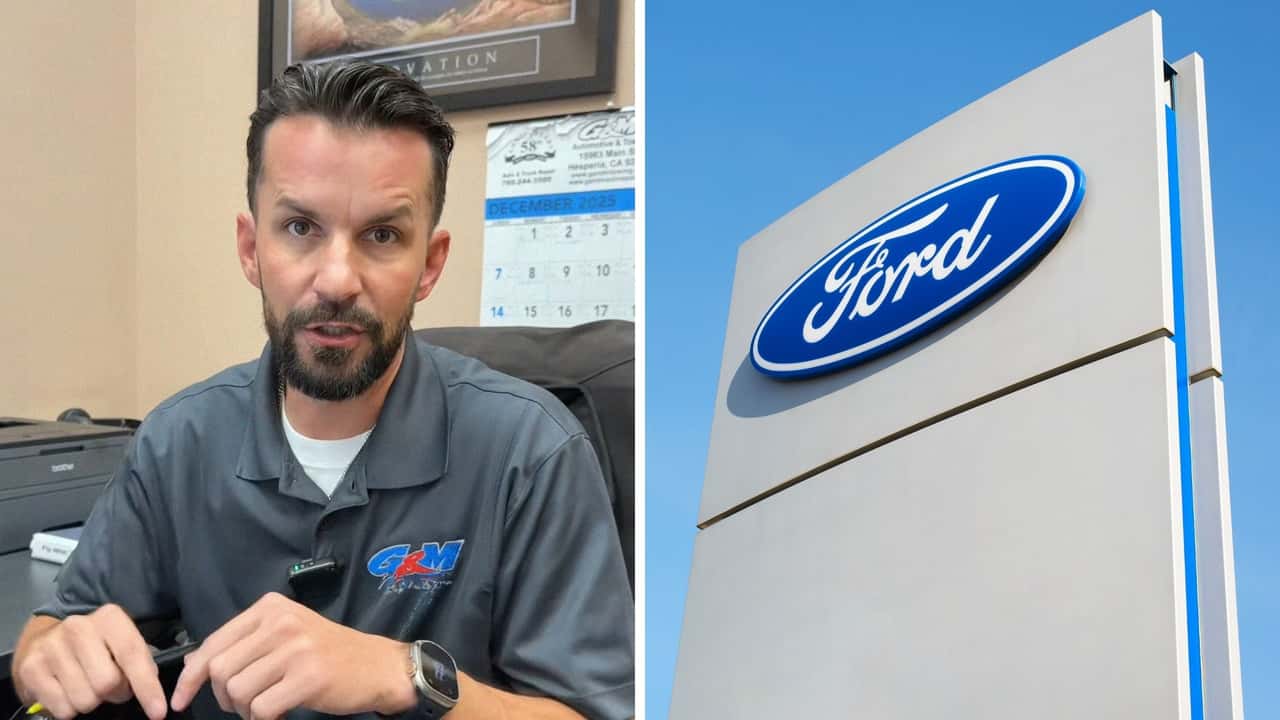
G & M Automotive (@gandmautomotivehd), an auto repair shop in Hesperia, California, posted a TikTok claiming that Ford is using engine idle hours to void warranties on commercial vehicles, even when they haven’t reached their mileage limits.
The video, which has been viewed more than 5,300 times since it was posted, shows the mechanic sitting at his desk explaining how manufacturers allegedly calculate “equivalent miles” based on idle time to deny warranty coverage.
But the reality may be more nuanced than the G & M tech let on.
“Dealership warranty scam: dealerships are now voiding your warranty over engine hours,” the mechanic begins. “Here we go. For example, we’ve got a 2020 Ford F-550. It is a medium-duty vehicle, has 33,000 miles on the odometer. But it has 1,500 engine hours.”
The mechanic then demonstrates on his calculator the figures he claims Ford uses to determine warranty eligibility.
“Here’s what Ford is doing to find any way not to cover your repairs under manufacturer warranty. Thirty-three thousand miles on the engine on the dash, 1,500 hours of engine runtime idling. They are taking the 1,500 hours and multiplying it by the average speed,” he says.
He shows himself working the math on a calculator. “So, in this case, … 1,500 engine hours times 40 average miles per hour, they are claiming that motor has 60,000 miles on it and is now out of warranty.”
According to the mechanic’s explanation, this calculation method allegedly pushes the vehicle beyond Ford’s standard warranty coverage, resulting in denied claims.
“And they will not cover your repair. This goes for business owners, fleet accounts,” he says.
However, Ford’s official documentation reveals a more nuanced reality. Ford’s commercial vehicle warranty for medium-duty trucks includes explicit engine-hour limitations, stating that coverage continues for “4,000 engine hours, whichever occurs first” for certain commercial applications.
The mechanic specifically targets excessive idling as the root cause of these warranty denials.
“They are taking into account engine idling, so if you’re a fleet or a business owner out there and you’ve got employees that are sitting on the side of the road just letting their vehicles run run run keeping the A/C going, you might want to think about that because it’s racking up engine hours, which is causing ‘wear and tear,’” he says.
He positions this as a deliberate strategy to avoid warranty obligations: “Per the dealerships, and they will use that as an out not to cover your repairs.”
The video concludes with the mechanic asking, “How do you feel about that? Drop me some comments. I’d like to hear you.”
The mechanic’s characterization of this practice as a “dealership scam” drew significant pushback from industry professionals in the comments section. Multiple users with apparent dealership and manufacturer experience weighed in to correct the narrative.
“Not per the dealerships, per the manufacturer. Dealers aren’t the ones making these types of calls,” wrote calebbelcher42. “Don’t shoot the messenger. If you’re upset about it the dealership isn’t the place to fight it, you have to call the manufacturer.”
“Service manager at a Ford dealership… this is not happening,” added Marc.
Several commenters with technical expertise provided context that suggests the practice isn’t as arbitrary as the mechanic suggests. “Not a scam. Excessive idle time is considered extreme duty operating conditions. There is a separate maintenance schedule for it,” explained Chrissargent, who shared an example of an Air Force truck with 156 miles but over 3,500 idle hours.
This assessment aligns with industry documentation. Ford’s official maintenance guidelines for Power Stroke diesel engines explicitly recognize that “one hour of idle time is equal to approximately 25 miles (40 km) of driving” and establish separate maintenance schedules for vehicles with excessive idling.
The commenter continued: “It is the same with construction equipment. They go by hours not miles. Seen a truck from the airforce come in with a bad engine at 50 miles. This was in 2011 when the 6.7 came out. Same truck showed up a year later with 156 miles on it. And again it was a bad engine. We pulled the idle hours and it showed over 3,500 idle hours with no oil changes performed.”
Comments revealed that this practice isn’t unique to Ford. “GM has the same thing, however they only use it in extreme cases of oil consumption,” noted Bit Griffin. “They ask the tech to calculate engine hours and they make a decision based off the results. I’ve never seen one get warranty cancelled because of it.”
Industry experts confirm that engine hour calculations are widespread, with fleet management companies routinely using these metrics to determine maintenance schedules and assess vehicle wear.
Another commenter confirmed the widespread nature of hour-based calculations: “This is all manufacturers. especially due to police vehicles showing 20k miles but engine idle hours equate out to 135,000 miles. Just had this one in particular a few weeks ago,” wrote Heath Weaver.
Some commenters raised questions about the legal basis for these warranty denials.
“Well, legally they’re at an uphill battle because if it’s not disclosed in the warranty agreement with specific language pertaining to engine hours they are asking for trouble denying coverage,” argued SnapfromWI. “They have a contractual agreement to cover repairs as stated in the contract.”
Others disagreed, with one commenter stating, “It is most definitely in the contract. It’s on the window sticker. This applies on medium duty and up.”
Under the Magnuson-Moss Warranty Act, manufacturers must clearly disclose warranty terms and cannot use deceptive practices to deny coverage. However, courts have generally upheld engine hour limitations when they are properly disclosed in warranty documentation.
The comments section revealed numerous examples of vehicles with extreme idle hour ratios.
“I once had a pursuit Tahoe come in with 17k miles and 6,000 hours, it was completely sludged up about 1/2 in thick and had lifter failure,” shared jake_s358.
Police and emergency vehicles appear to be particularly affected by this issue due to their operational requirements. JDOZERO commented, “Need to do it for police vehicles! they are always low mileage and crazy hours! idling all day long!”
Research shows that excessive idling significantly impacts warranty compliance for fleet vehicles, with one hour of idling considered equivalent to 25-30 miles of driving in terms of engine wear and maintenance scheduling.
Several mechanical professionals defended the practice.
“Are you suggesting that long idle hours doesn’t wear on the engine?” asked Paul Gardner. “Same heat cycles as mileage. Some would say its worse as things don’t heat up and lubricant properly.”
For diesel engines specifically, excessive idling creates additional complications.
“Well on diesels that’s how you end up with clogged dpf, egr and grid-heater,” noted Edgar Leon, referencing the emissions equipment problems that can result from extended idle periods.
Automotive industry research confirms that diesel engines face significant emissions system problems from excessive idling, including clogged diesel particulate filters (DPF) and exhaust gas recirculation (EGR) issues that can lead to costly repairs.
While the mechanic in the video used a 40 mph average to calculate equivalent miles, commenters suggested different conversion rates.
“1 engine hr = 25 miles, 70,500.. yes now you are out of warranty,” wrote Jack A Harmon, while another suggested “idle hrs x25” and yet another mentioned “GM considers it 33 miles per hour of idle time.”
Fleet management industry standards typically use a conversion rate of 25-30 miles per engine hour, with variations depending on the manufacturer and specific application.
Several commenters emphasized that customers should be better informed about these policies upfront.
“They should be telling the buyer at the same time they’re doing their ‘buy the warranty’ talk,” suggested Walter Granger.
Another noted the importance of reading warranty documentation.
“If it’s not listed in the extended warranty contract then they have to cover it, read your warranty contracts before you spend $100K on a truck,” they wrote.
The video and subsequent discussion highlight a disconnect between customer expectations and manufacturer policies regarding warranty coverage for commercial and fleet vehicles. While the practice may not be the arbitrary “scam” described in the original video, it appears to be a legitimate industry practice based on documented engine-wear principles that many vehicle owners discover only when facing warranty claims.
Motor1 has reached out to G & M Automotive via its website contact form for comment. We’ll be sure to update this if they respond.
We want your opinion!
What would you like to see on Motor1.com?
– The Motor1.com Team