“How the tire shop even sell that sucker?”
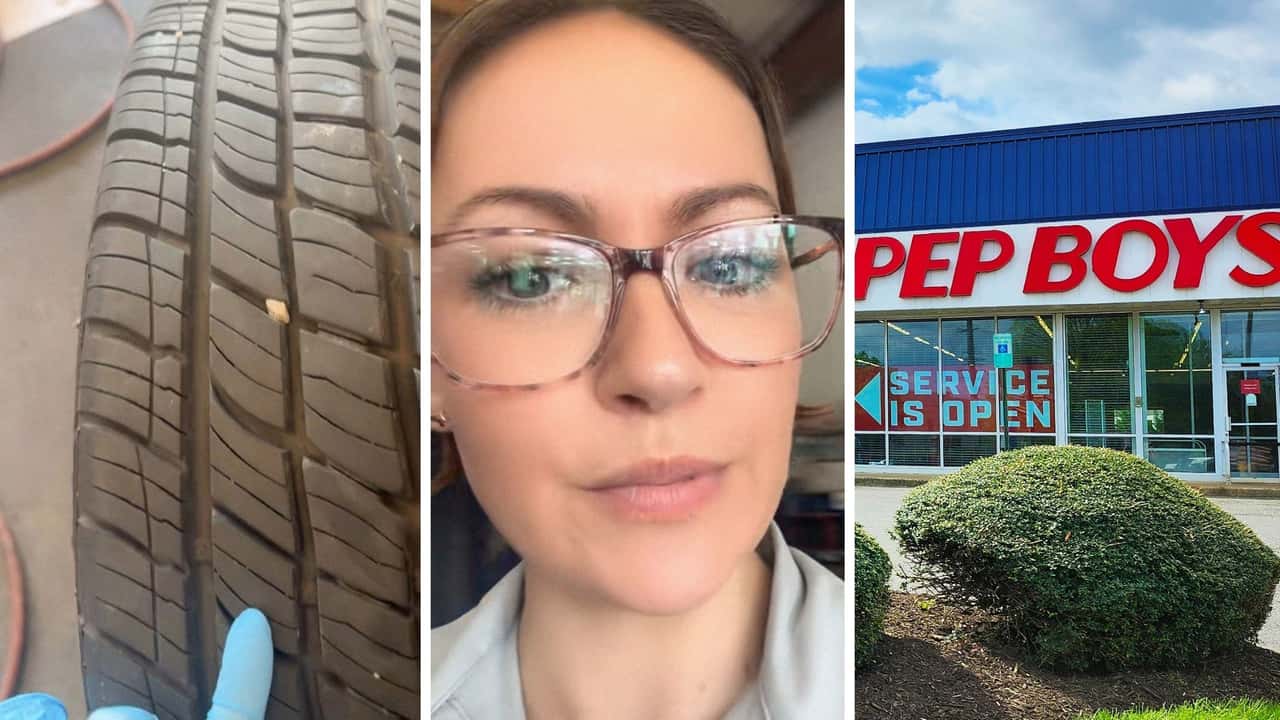
A Pep Boys employee says a driver came in complaining about a “vibration” whenever the car went faster than 10 mph.
Emm Lura (@emm.lura), who posts about her work at Pep Boys, showed viewers what she says was behind the rough ride.
She zoomed in on one of the car’s tires after it had been removed.
“I can’t possibly imagine why,” Lura says sarcastically.
The problem might not have been obvious at first glance, but Lura explained in the comments that the tire had “a giant bulge extending along most of the right side of the tread due to a separated belt (or belts) inside the tire.”
That internal damage, she said, meant the tire could no longer roll evenly.
“The tire cannot roll straight and when on a vehicle will cause an extremely rough ride,” she wrote.
As of this writing, her video has more than 41,100 views.
Story subjects did not respond to requests for comment.
Why A Separated Belt Can Make A Car Shake
A vibration that starts at only 10 mph sounds dramatic, but internal tire damage or poor alignment can absolutely make a car ride that rough at low speeds.
According to the US Tire Manufacturers Association (USTMA), tires are built from several layers, including steel belts beneath the tread. When those internal components begin separating, the tire can lose its uniform shape. That can create a raised or distorted section like the one Lura described, so the tire no longer rolls smoothly as the wheel turns.
Consumer Reports lists new excessive vibration, cracking or cuts, and visible bulges as warning signs of internal tire damage. Xtreme Auto also notes that problems such as broken cords or belt separation can sometimes be hidden internally.
That helps explain why the customer’s complaint may have been much easier to feel from the driver’s seat than to spot at a glance.
The National Highway Traffic Safety Administration likewise tells drivers to pay attention to any change in how a tire performs. Mavis says unexplained noise or vibration should prompt a professional inspection in most cases.
USTMA expands its passenger- and light-truck tire service guidance. It lists localized tread spot wear caused by separation, along with tread bulges or damage exposing internal cord or fabric, among the conditions that call for removing a tire from service.
Internal tire damage can, of course, develop for several reasons, and Lura’s clip does not establish what caused this particular failure. Heat, impacts, improper inflation, and overloading can all contribute to tire damage.
Viewers Knew The Tire Was Done
The comments did not spend much time debating whether the tire needed attention.
“It’s finnnneeee,” one viewer joked.
Another person said they were dealing with something similar.
“I have the same problem right now with a 10-ply tire,” they wrote.
Others immediately zeroed in on the separated tread.
“Got to love tread separated tires as the reason. It is a simple fix,” one commenter wrote.
Another joked about what the tire might have looked like on a balancing machine.
“How the tire shop even sell that sucker? Just ignore the balance machine warning lights,” they said.
The bulge itself also got plenty of attention.
“Want some toast for the size of that egg? Hopefully warranty for customer,” one viewer wrote.
Lura replied with some good news: “It was! They were super sweet. I wish all my customers were like them.”
Others kept the jokes going.
“I bet it takes them left turns like a champ!” one person wrote.
We want your opinion!
What would you like to see on Motor1.com?
– The Motor1.com Team