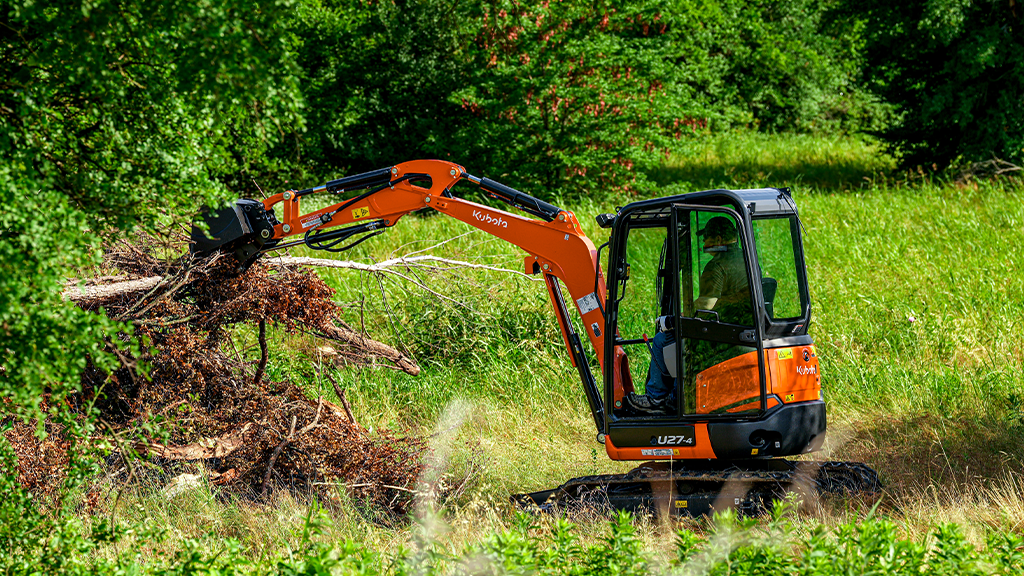
Job site safety is influenced by many factors, including planning, training, communication, and, most importantly, equipment. Incidents often stem from visibility gaps when an operator can't clearly see someone behind a machine, unexpected load shifts from equipment misuse, or newer operators pushing equipment past unclear limits. In seconds, a routine task becomes an incident. While human error remains a reality on every job site, equipment design can give operators better visibility, clearer feedback, and more intuitive control when quick, informed action is needed.
Contractors managing these risks face a persistent challenge. Safety often depends on operator discipline and training alone. But that equation shifts when safety is engineered into the machine from conception. Design-first safety philosophy recognizes that operator error and fatigue are predictable human factors, not failures of discipline. Excavators offer a clear example of how this philosophy can take shape in practice. By accounting for predictable factors such as operator error, fatigue, and varying levels of experience, they can support safer operation. In this way, the machine becomes an active part of a broader safety approach rather than a tool that depends on human perfection
Visibility is fundamental to a safe operation, particularly on tight residential sites, around structures, or on busy job sites where crews and their equipment are moving nearby. Limited sightlines can leave operators with blind spots around the machine, making it hard to identify people, obstacles, and changing conditions.
Modern excavator design can help address that challenge. Clear cab sightlines, rear-view cameras, and available 360-degree camera systems can help operators maintain better awareness without leaving the cab. Monitor placement matters, too: displays should be easy to check within the operator's natural field of view, allowing them to access camera information while remaining focused on the work area.
These systems must be usable in the conditions crews will likely face year-round. Dust, glare, low-light, and more can affect an operator's sight, so camera performance and display clarity are important to consider. These thoughtful integrations can help operators spot hazards earlier and make fully informed decisions.
How an operator interfaces with the machine shapes both safety and performance throughout the day. After sitting for eight or ten hours, fatigue sets in; ergonomic control layout reduces this. A poorly positioned joystick forces operators to strain or reach awkwardly, which compounds across a full day of repetitive movement, degrading decision-making and reaction time. Intuitive joystick positioning allows operators to work naturally rather than fighting machine controls. When controls feel natural, operators make better decisions about task sequencing and machine limits.
Real-time feedback through monitors communicates load, pressure, engine status, and machine performance. Operators who can see what the machine is doing operate more confidently and safely. They understand the machine's current state and can make informed decisions about the next task. A newer operator watching load pressure on screen learns to feel the machine's capabilities without guessing. That feedback loop is foundational to safe operation, and it's especially valuable when crews include operators at different experience levels.
Excavators are engineered for specific lifting capacities, swing angles, and reach distances, with a critical design principle that prevents operators from exceeding those limits. Load monitoring systems alert operators before they approach dangerous thresholds, while automatic stabilization prevents tipping and load shifts that could send material falling onto people below.
Take, for example, a crew working near utilities or with multiple operators at different skill levels. One operator lifts carefully within limits; another pushes the machine harder without understanding the consequences. Without built-in safeguards, these moments are where incidents can happen, but with them, the machine enforces safe operation regardless of operator judgment.
Attachment-specific limits matter too. A breaker attachment has different load and torque characteristics than a bucket, and a grapple requires different stability management than a thumb. Modern excavators allow fleet managers to configure these parameters for specific attachments, so the machine guides operators toward safe practices for each task.
Fleet managers can also enforce limits through software lockouts. Restricting rpm, limiting high-flow hydraulics access, or disabling second-speed modes keeps operators within safe parameters. An operator working within engineered limits all day reduces downtime, protects attachments, and maintains safe performance. Over time, this consistency also means less operator stress and fewer mistakes born from exhaustion or uncertainty.
Access to high-quality labour is tightening across job sites. Seasonal crews, regional gaps, and skill shortages mean contractors are deploying more inexperienced operators who are learning as they work. Owning equipment designed for this reality is an advantage.
For newer operators, intuitive monitor displays and machine guidance can make the learning curve more manageable by providing clear information about machine functions and performance as they work. Features such as grade control support more consistent depth and angle, while stabilization technology helps operators maintain control when working on uneven ground or handling material. These tools don't replace training, experience, or sound judgment, but rather reinforce them by giving less-experienced operators useful feedback and support as they build familiarity with the machine. This helps crews work more confidently and consistently, and newer operators can develop their skills without feeling overwhelmed.
When choosing an excavator for your crew, three factors matter most:
Visibility systems: Assess 360-degree camera coverage, rear-view camera placement, and cab sightlines. Can operators see the display without losing visibility of the job site around them? Does the camera system feel intuitive, or do you have to hunt for angles? Spend time evaluating whether the system works for real job site conditions.
Control feel and feedback: Do the controls feel intuitive? Can operators see machine information without strain? If the controls feel awkward or the operator must reach or strain, that's a problem that won't go away after purchase.
Built-in safeguards: Look for load monitoring, automatic stabilization, ride control, and fleet management lockout options. These systems reduce incidents, lower downtime, and protect equipment while enabling you to confidently deploy operators across different experience levels.
When safety is engineered into the machine from conception, everyone benefits. The operator works more confidently, and crew retention improves. The job site runs safely. Insurance costs decrease, equipment lasts longer, and downtime drops. That's the difference between treating safety as a feature you add later versus as a foundational design philosophy.
__________________________________________________________________________________
Jonathan Gardner is a construction equipment product manager at Kubota Canada.
This article originally appeared in the 2026 Excavators special issue of Heavy Equipment Guide.
1155 Kubota Drive
Pickering, ON
CA, L1X 0H4
Website:
kubota.ca
Phone number:
905-294-7477