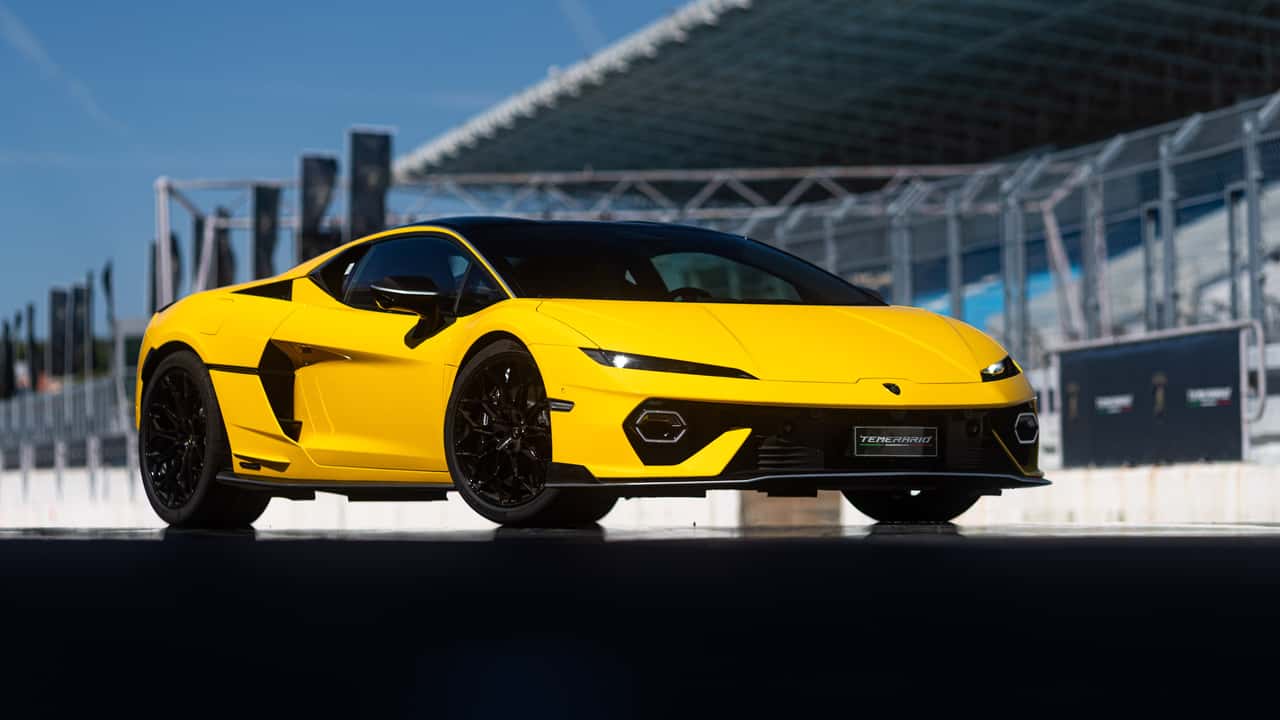
For Lamborghini, speed is only part of the supercar equation.
There was a time when building a supercar was relatively simple: Make it ridiculously fast, give it a dramatic design, put an exotic engine behind the occupants, and charge a fortune for it. Apparently, that’s no longer enough. Lamborghini believes outright speed is losing importance as even plain EVs make supercar-rivaling acceleration increasingly accessible.
When family sedans and SUVs without an engine can launch from 0 to 60 mph in the three-second range, bragging about a supercar’s acceleration figure doesn’t have quite the same impact anymore. Speaking with CarExpert in Milan, Temerario model line director Paolo Racchetti said outright speed remains relevant, but it’s no longer enough by itself to define a supercar.
‘Speed is still an important part of performance, but it’s clear that it’s necessary, not sufficient, for a car to be called a super-sports car. It’s becoming more important [to focus on] the dynamic capabilities of the car, and maybe the level of performance… will be less relevant in the future. What a super-sports car must provide is not only acceleration and speed, but also emotion.’
2027 Lamborghini Temerario
Lamborghini certainly knows a thing or two about supercars, having basically invented the segment 60 years ago when the stunning Miura broke cover. The Italian brand’s thinking also helps explain why it has been reluctant to jump into the fully electric supercar game. CEO Stephan Winkelmann previously confirmed that the company’s first EV has been postponed indefinitely, although development continues.
The upcoming fourth model, a 2+2 GT inspired by the Lanzador concept, will instead use a plug-in hybrid powertrain. That doesn’t mean Lamborghini is turning its back on electrification. Quite the opposite. The Revuelto, Temerario, and Urus SE are all electrified in one way or another. But Lamborghini clearly doesn’t want its cars to become little more than very expensive acceleration machines.
While playing the emotional card will become increasingly important in the years to come, bringing back the manual gearbox isn’t a priority, according to Racchetti:
‘I think there will always be Lamborghini customers asking for a manual transmission, and for everything that is rooted in our tradition. But on the other hand, Lamborghini is defined by always evolving and thinking about the future. We are the most innovative brand in the super-sports car segment, and at this moment our target is to evolve this new architecture even further.’
Even without a stick shift comeback, Lamborghini is trying to make sure its next generation of supercars still feels special in a world where blistering acceleration is becoming increasingly easy to achieve.
Motor1’s Take: This is an interesting one-percenter problem for those shopping in the supercar niche. Once 0-to-60-mph times start with a three or even a two, shaving another tenth off doesn’t exactly produce the same wow factor it once did. A car can only accelerate so fast before the number becomes little more than something to brag about in a configurator.
That’s why Lamborghini’s focus on emotion, sound, revs, handling, and how it delivers that performance makes sense. It explains why the V12 is still very much alive and, while the naturally aspirated V10 is gone, its twin-turbo V8 replacement revs to a screaming 10,000 rpm to soften the blow. With plans for an EV pushed back, it’s clear that its audience still wants engines, even if that means hybridization to keep up with increasingly strict emissions regulations.
More From Lamborghini:
Source:
CarExpert
We want your opinion!
What would you like to see on Motor1.com?
– The Motor1.com Team